
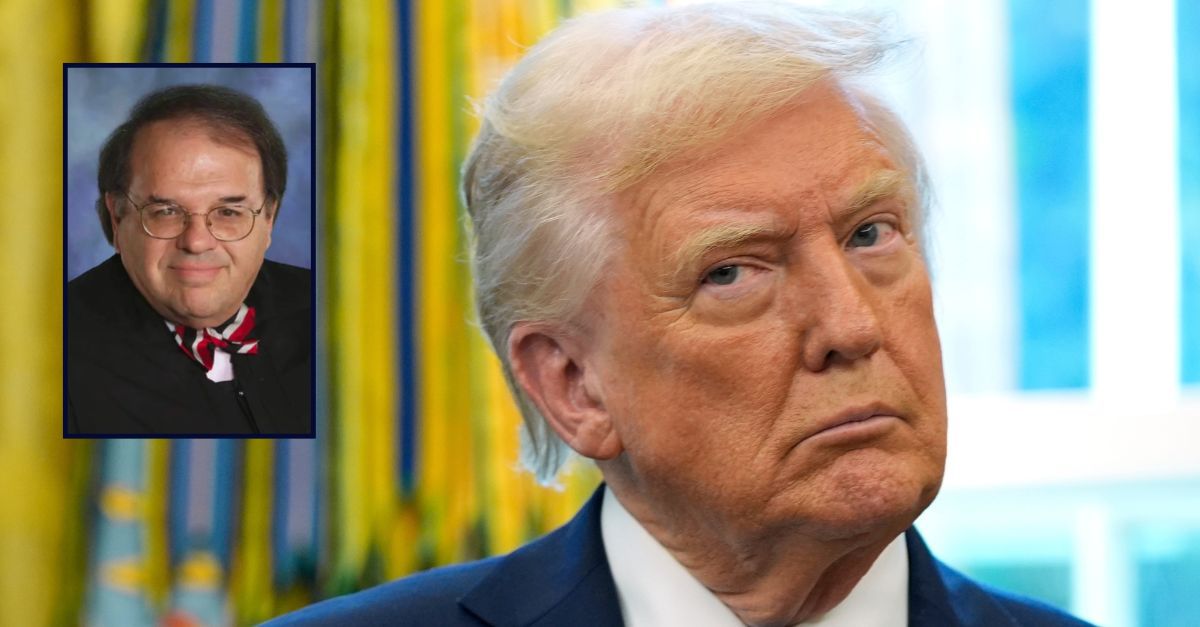
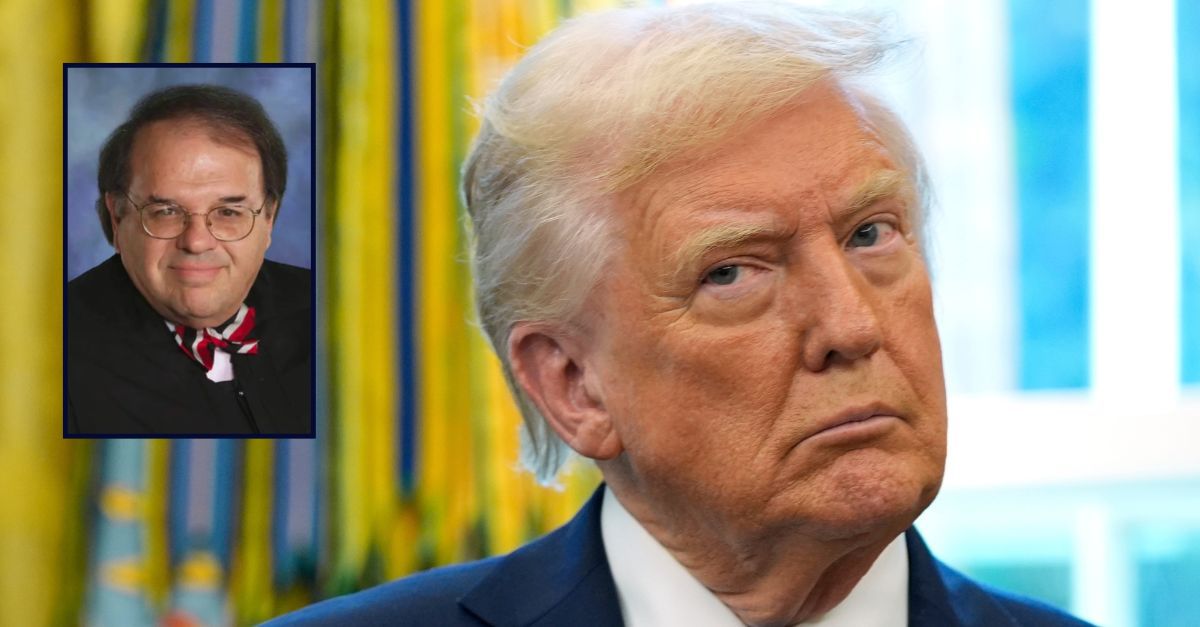
Inset: Senior U.S. District Judge Richard Leon (U.S. District Court). Background: President Donald Trump listens during a ceremonial swearing-in of Paul Atkins as chairman of the Securities and Exchange Commission, in the Oval Office of the White House, Tuesday, April 22, 2025, in Washington (AP Photo/Alex Brandon).
President Donald Trump, once described by a jurist as the “mastermind of strategic abuse of the judicial process,” complained to the U.S. Supreme Court on Friday that another judge has opened the door to “serial litigation and abuse” by blocking his East Wing ballroom project.
The DOJ’s application for a stay at the Supreme Court comes one week after a three-judge U.S. Court of Appeals for the District of Columbia Circuit panel affirmed Senior U.S. District Judge Richard Leon’s injunction, with only Trump-appointed U.S. Circuit Judge Neomi Rao dissenting.
“This case involves an extraordinary and unlawful injunction that will halt the ongoing construction of the integrated military complex, including a totally secure ballroom space, at the East Wing of the White House, which is vitally required by national security,” said U.S. Solicitor General D. John Sauer, Trump’s former personal attorney.
Love true crime? Sign up for our newsletter, The Law&Crime Docket, to get the latest real-life crime stories delivered right to your inbox.
Leon in April found that the National Trust for Historic Preservation and architectural historian Alison Hoagland had standing to sue on “aesthetic injury” grounds, and he blocked construction of the aboveground portion of the ballroom project while clarifying that belowground security work could proceed.
Trump, who tore down the East Wing without congressional input, has blamed the judge for putting him at risk by ruling against him.
Prior to arguments at the D.C. Circuit, the president posted that Leon “will be held responsible” for the “Death and Destruction” of the nation as a result of not having a ballroom at the White House with a “DronePort” and other security features.
Once in court, a DOJ lawyer argued that a president could tear down the Statue of Liberty and nothing could be done about it after the fact, let alone through the “aesthetic harm” theory advanced by Hoagland.
U.S. Circuit Judges Bradley Garcia and Patricia Millett, who formed the D.C. Circuit’s majority, said that the DOJ’s “bold” position was “wrong.”
“The bold assertion that the Executive can act with utter lawlessness, destroying treasured national landmarks and harming the interests of individuals, and that no court can stop it flouts our constitutional order,” said the judges, appointees of former presidents Joe Biden and Barack Obama.
The DOJ is leaning heavily on Rao’s “vigorous dissent,” which dinged Leon for a “blatant abuse of discretion” that inappropriately placed Hoagland’s “aesthetic displeasure” over Trump’s determination that the “ballroom is necessary[.]”
“The updated East Wing complex is absolutely required and should not be enjoined,” the DOJ said, urging the Supreme Court to promptly stay Leon’s injunction. “To recognize standing based on a casual observer’s preferences invites serial litigation and abuse. She has no standing to be involved in this case.”
Amid reporting that hundreds of millions of taxpayer dollars stand to fund the “national security” bunker, the DOJ told the Supreme Court that the ballroom is “funded with approximately $400 million in private donations by President Donald J. Trump and ‘some of the most prominent and successful corporations and people in America'” and that “zero taxpayer dollars are needed or required.”
“This Project, like its predecessors, should be a matter for the President and the political process, not construction-by-injunction,” the DOJ added.
The post Trump wants SCOTUS to put ballroom judge in his place for opening door to ‘serial litigation and abuse’ with ‘construction-by-injunction’ approach first appeared on Law & Crime.


