
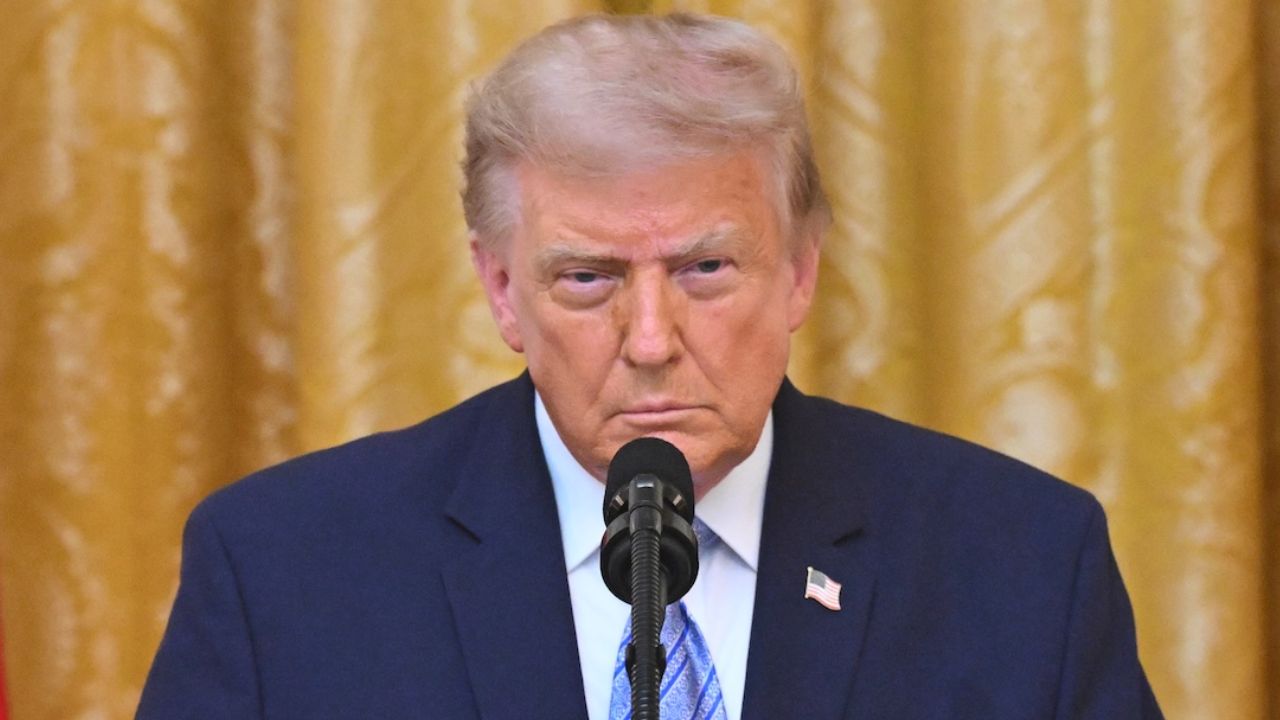
FILE – President Donald Trump speaks in the East Room of the White House, July 16, 2026, in Washington (Saul Loeb/Pool via AP, File).
A federal judge on Friday dismissed a Trump administration lawsuit against New Jersey after the Garden State limited its cooperation with Immigration and Customs Enforcement (ICE).
In early February, New Jersey Gov. Mikie Sherrill signed an executive order barring ICE agents from “entering, accessing, or using nonpublic areas” of state-owned property for immigration enforcement and prohibiting agents from using state property as a “staging area, processing location, or operations base” for immigration enforcement — unless such agents have a warrant issued by a judge.
In late February, the Department of Justice (DOJ) filed a 21-page complaint against New Jersey and Sherrill. The lawsuit complained that the executive order results in “exclusionary treatment” of ICE agents and has the “clear objective of obstructing” President Donald Trump. The filing alleged the policy “is designed to and in fact does interfere with and discriminate against the Executive’s enforcement of federal immigration law in violation of the Supremacy Clause.”
Love true crime? Sign up for our newsletter, The Law&Crime Docket, to get the latest real-life crime stories delivered right to your inbox.
Now, U.S. District Judge Georgette Castner, a Joe Biden appointee, has tossed the lawsuit for failure to state a claim in a 30-page opinion and order granting the defendants’ motion to dismiss with prejudice.
In the opinion, the court assesses the government’s claims under the Supremacy Clause and finds them all substantially lacking.
First, Castner finds that federal law does not preempt the executive order under the preemption doctrine.
Specifically, the government argued the order was preempted by the Immigration and Nationality Act (INA).
“New Jersey’s Executive Order creates burdensome obstacles to the enforcement of federal immigration law,” the DOJ’s complaint reads. “The Executive Order ‘stand[s] as an obstacle to the accomplishment and execution’ of federal immigration law.”
The judge looked at several provisions of the INA cited by the government, both “in isolation” and “in tandem,” as well as other sections of the INA the government “failed to cite,” but still could not make the “logic” work for the Trump administration.
“[W]hen zooming out and viewing the provisions in sequence, the provisions paint a clear picture: Congress contemplated state assistance in federal immigration enforcement, but it contemplated that assistance on a voluntary basis,” the opinion reads. “The fact that New Jersey has decided not to volunteer—in the limited context of [the executive order]—is in accordance, not in conflict, with Congress’s design.”
The judge also credits the anticommandeering doctrine defense cited by New Jersey, which she frames as a “backstop” to the Supremacy Clause “rooted in the Tenth Amendment.”
From the opinion, at length:
The federal government has an obligation to remove certain non-citizens within 90 days of their release from custody, but nothing in the INA indicates that states are required to assist the federal government in meeting this obligation….[T]he cited provisions contemplate only that states would be able, but not required, to assist…[T]he Third Circuit has ruled “that ICE detainers are indeed permissive, not mandatory” because “[u]nder the Tenth Amendment,” and the anticommandeering doctrine, “immigration officials may not order state and local officials to imprison suspected aliens subject to removal at the request of the federal government.”
Castner then, relatively quickly, dispenses with the Trump administration’s other arguments.
The DOJ also claimed that Sherrill’s executive order unlawfully regulated the federal government. This claim was a nonstarter.
“[B]y merely ‘seeking to preserve its own property,’ Defendants ‘at most . . . might incidentally affect how agents do their jobs,'” the opinion goes on. “This is insufficient to constitute unlawful regulation. Accordingly, the United States has failed to plausibly allege that EO12 crosses the line into direct regulation of the federal government, so Count Two will be dismissed.”
Finally, the DOJ argued the executive order unlawfully discriminated against federal agents. Again, the judge was not impressed.
“[T]he question is whether state and local law enforcement are ‘similarly situated,’ and therefore appropriate comparators to, federal immigration officers,” the opinion continues. “The Court holds they are not. [The executive order] prohibits New Jersey executive branch departments and agencies from allowing federal immigration officers to use state property ‘for the purpose of facilitating federal enforcement of civil immigration law.’ But there is no other entity besides the federal government that could be the beneficiary of this facilitation because ‘only the federal government is authorized to enforce civil immigration law.'”
In other words, federal law enforcement officers are not being discriminated against because state law enforcement officers do not gain anything from the prohibitions in Sherrill’s order, Castner ruled.
“Local and state law enforcement officials are therefore not similarly situated for comparator purposes,” the order goes on. “This is fatal to the United States’ discrimination claim.”
The post Judge tosses Trump admin lawsuit over New Jersey barring ICE agents from ‘entering, accessing, or using’ nonpublic areas of state property for immigration enforcement first appeared on Law & Crime.


