
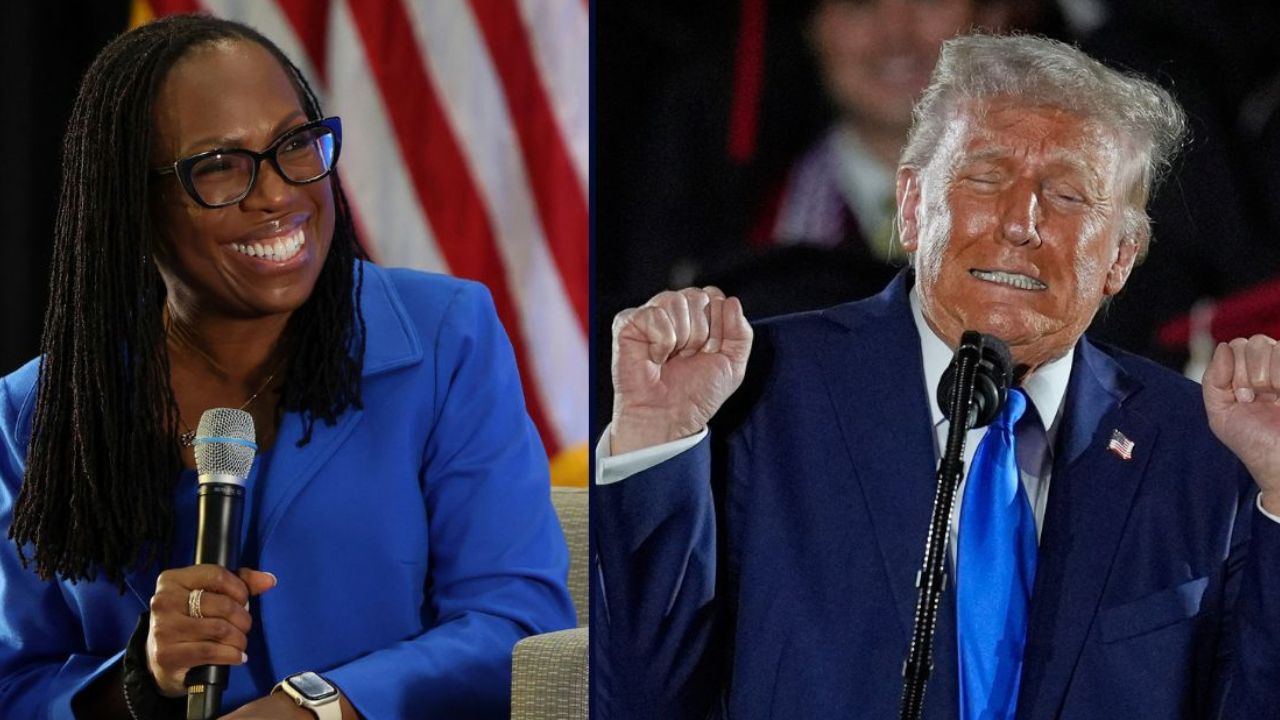
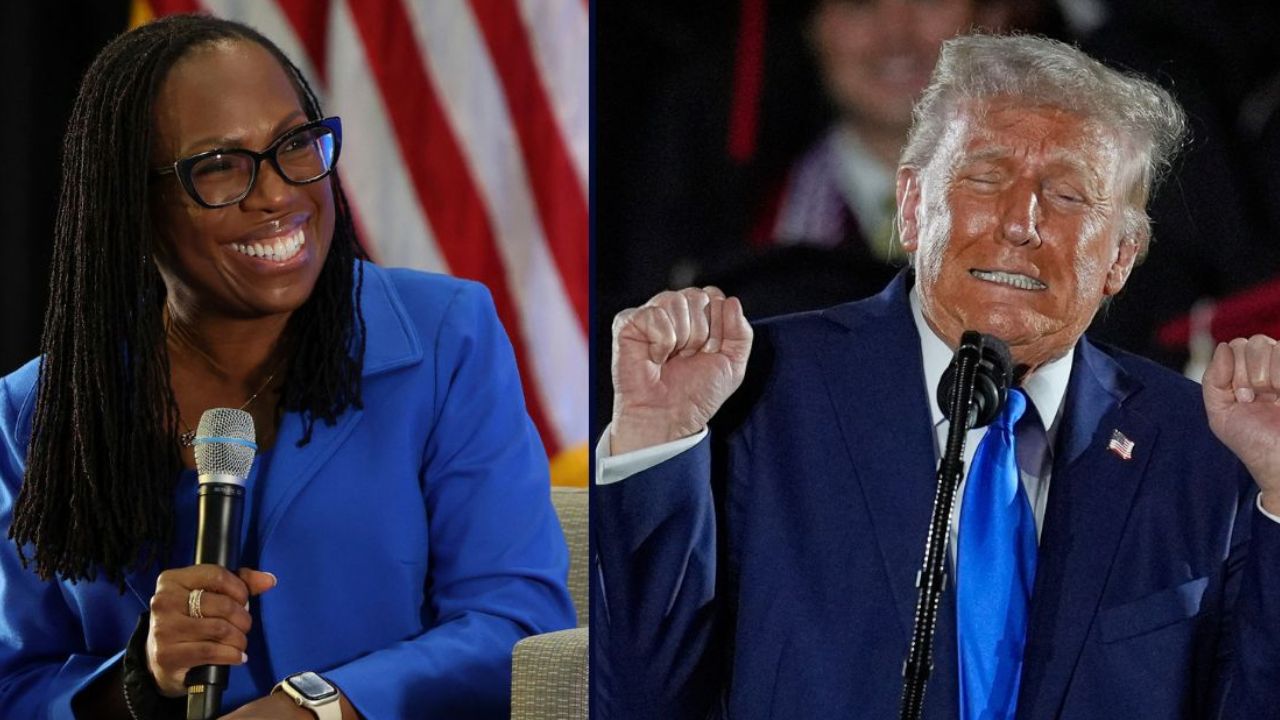
Left: MIAMI, FL: U.S. Supreme Court Justice Ketanji Brown Jackson is seen during an Evening with Ketanji Brown Jackson at Chapman Conference Center at MDC Wolfson Campus on March 10, 2025, in Miami, Fla. (Photo by Alberto E. Tamargo/Sipa USA)(Sipa via AP Images). Right: President Donald Trump talks about transgender weightlifters as he gives a commencement address at the University of Alabama, Thursday, May 1, 2025, in Tuscaloosa, Ala. (AP Photo/Mike Stewart).
The U.S. Supreme Court late Friday cleared the way — over a sharp dissent — for the Trump administration to use a “modified system” for “voter verification” aimed at noncitizens in a “shadow docket” ruling.
Acting on a motion for a stay, a majority of justices voted to pause a lower court order issued by U.S. District Judge Sparkle L. Sooknanan, a Joe Biden appointee, which barred the use of the recently modified Systematic Alien Verification for Entitlements (SAVE) database.
In the case filed by the League of Women Voters, both the district court and the U.S. Court of Appeals for the District of Columbia Circuit rejected government efforts to use the database for the stated purpose of keeping noncitizens away from the polls.
Love true crime? Sign up for our newsletter, The Law&Crime Docket, to get the latest real-life crime stories delivered right to your inbox.
In June, Sooknanan issued a 75-page opinion that cast the dispute as a battle over “fundamental” rights to privacy and the franchise.
The lower court, finding the modified SAVE system likely in violation of the Administrative Procedure Act (APA), decried the government’s efforts to create a “centralized federal database that contains the private information of United States citizens, including Social Security numbers, citizenship status, and other sensitive data.”
In early September, the D.C. Circuit left the summary judgment order untouched and denied a stay pending appeal, explaining that the government “forfeited arguments” it later asked the court to credit.
The Supreme Court majority, without full briefing and oral argument, and without a named author, has now given the Trump administration a victory on one of its defining issues for the midterm elections.
To hear the high court tell it, the government’s spring 2025 modifications to the SAVE database are simply allowed by statute.
“The plaintiff organizations claim that the federal defendants violated the Social Security Act, Privacy Act, and APA,” the unsigned order reads. “In 1996, Congress, however, separately and expressly authorized DHS to request and receive information relating to citizenship and immigration status from other agencies, including SSA, in the Illegal Immigration Reform and Immigrant Responsibility Act (IIRIRA).”
The justices then recite the relevant statutory language and a secondary statute which says “no person or agency may prohibit, or in any way restrict” the government from “[s]ending such information to, or requesting or receiving such information from, the [DHS].”
And that, order says, is the long and short of it. The justices found the combined statutes work to prohibit “interference with the disclosure of information regarding citizenship status to DHS.”
“Congress necessarily authorized DHS to request and receive that information,” the per curiam order continues. “Otherwise, agencies, entities, and officials could find themselves in [an] impossible predicament.”
That predicament, the majority says, is a choice of whether to violate privacy laws or the immigration law in question.
“It is improbable that Congress intended to place officials in such a bind when it passed IIRIRA, so [IIRIRA] likely supersedes restrictions on disclosure elsewhere,” the order states.
The ruling goes on to characterize the modified SAVE program as “an important federal program.” The ruling also predicts the court “is likely to reverse the District Court’s holding that the federal defendants violated the Social Security Act, the Privacy Act, and the APA.”
“Under [federal law], the Federal Government has an obligation to respond to requests from state and local election officials seeking to verify the citizenship of voters,” the unsigned order explains. “The order below prevents the Federal Government from using the program it believes is best suited to the task.”
The upshot of the ruling is cabined by a national voting rights law that prohibits the bulk removal of names from voter lists within 90 days of an election, the high court notes. But the government may still “conduct individualized inquiries, which are permitted under federal law during this period,” the per curiam order says.
In dissent, Justice Ketanji Brown Jackson, joined by Justice Sonia Sotomayor and Justice Elena Kagan, blasted her conservative colleagues for the nature of the ruling and for its particulars.
In a criticism typical of “shadow docket” complaints, the dissent notes the decision was rendered “without full briefing or oral argument” and challenges the wisdom of the Supreme Court “rendering questionable interim rulings about two statutory provisions it has never before interpreted.”
“The Court also focuses only on the harms the Government will purportedly suffer absent a stay, disregarding the harms that the modified SAVE system has caused, and will likely continue to cause, to lawful voters,” the dissent continues. “The Court thus misuses its equitable powers.”
On the merits, the dissent goes on to fault the majority for its “back-of-the-napkin assessment” that “two IIRIRA provisions that we have never before interpreted” override a whole suite of privacy laws.
Jackson also argues that “the harm caused by burdening or disenfranchising even a few lawful voters outweighs the nonexistent harm that the Government experiences when it is prevented from taking an action that it likely lacks the authority to take.”
The post ‘Back-of-the-napkin assessment’: Justice Ketanji Brown Jackson faults SCOTUS majority for ‘disenfranchising’ voters ‘without full briefing or oral argument’ first appeared on Law & Crime.


