
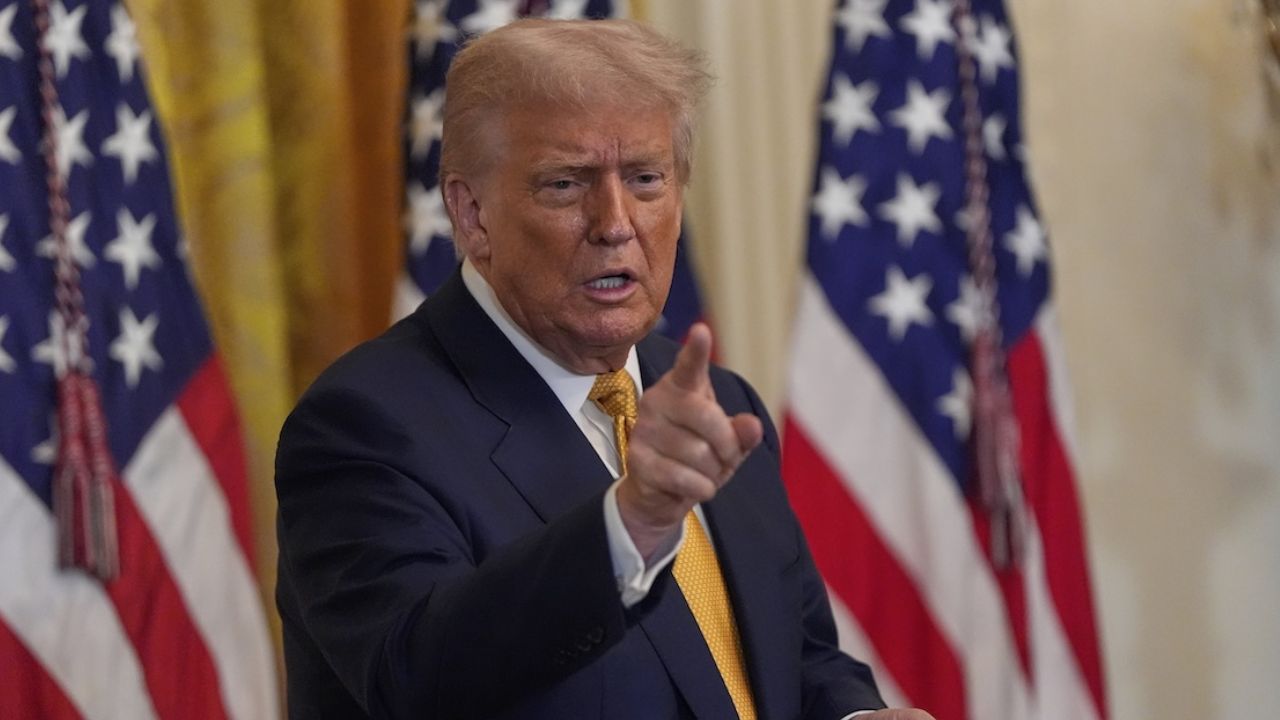
President Donald Trump gestures during a reception for Republican members of Congress in the East Room of the White House, Tuesday, July 22, 2025, in Washington (AP Photo/Julia Demaree Nikhinson).
The Trump administration on Thursday asked the U.S. Supreme Court to intervene on the so-called “shadow docket” to allow deportations of immigrants to “third” countries they are not from and have no connection to.
In March 2025, the litigation began when several detained men challenged the underlying Department of Homeland Security (DHS) deportation directive. The case then snowballed when DHS attempted to deport eight men to South Sudan — men who are not Sudanese nationals. After a series of court orders, those men were detained on a U.S. military base in the East African country of Djibouti.
The controversial policy has twice come before the nation’s high court on emergency stay requests after U.S. District Judge Brian E. Murphy, a Joe Biden appointee, twice blocked such deportations. In turn, the conservative majority twice allowed the policy to go back into effect.
Earlier this month, however, the U.S. Court of Appeals for the 1st Circuit became the first appellate court to rule on the merits and find that the policy does not pass muster under numerous federal laws — after Murphy finally issued his own merits decision in February.
Love true crime? Sign up for our newsletter, The Law&Crime Docket, to get the latest real-life crime stories delivered right to your inbox.
Notably, the 1st Circuit previously granted the U.S. Department of Justice an emergency stay of Murphy’s ultimate merits ruling — which is procedurally the same form of relief the DOJ is now asking the Supreme Court to issue regarding the 1st Circuit’s merits ruling.
In the 45-page emergency appeal, Solicitor General D. John Sauer asked the justices to immediately reverse the appellate court with an administrative stay and to allow the resulting pause to last until the appeals process plays out completely before the Supreme Court itself.
The stay request begins with the government leaning into its previous emergency docket victories with regard to the deportation issue.
“This is the third time the government has been forced to seek emergency relief from the district court’s orders in this case about ‘third-country removals’—an essential tool to remove certain aliens, including some of the worst criminal aliens,” the motion begins. “This Court granted relief on both previous occasions. The latest order rests on the same fundamentally flawed legal premises as the previous rulings, and the nominal new grounds that the lower courts added to try to buttress those prior decisions are even weaker than those that failed to sustain the originals.”
In ruling against the administration, the 1st Circuit said DHS was ignoring multiple rules, processes and protections governing the deportation of individuals with fear-of-persecution claims.
The government, for its part, accused the 1st Circuit of “confusion” about how the relevant statutes actually work when applied — and used the opportunity to assert a jurisdictional battle over the relevant kinds of courts that can review deportation-related claims.
“[T]he lower courts simply relied on the same meritless grounds on which the preliminary injunction was based,” the motion goes on. “The courts again disregarded multiple jurisdictional bars that preclude judicial review of aliens’ claims of persecution or torture except in a petition for review from a removal order.”
The panel also complained the third-country removal system was operating “without effective notice and a meaningful opportunity to assert” fear-of-persecution claims under the relevant laws.
In its emergency appeal, the DOJ defended its policy of only providing would-be deportees with one day of notice to lodge a fear-of-persecution claim about a third country they might be sent to.
“The lower courts’ preference for more elaborate and lengthy procedures cannot overcome the lack of statutory support for imposing such procedures, much less the sort of requirements the district court imposed by fiat when enforcing the preliminary injunction,” Sauer argued.
Additionally, the appellate panel said it had grave doubts about the “blanket assurances” issued by third countries that have agreed to take in such deportees, saying those with fear claims could still be subject to violence by “rogue agents and non-state actors.”
The DOJ categorized this objection as a bureaucratic complaint.
“Neither the lower courts nor respondents have identified any sort of imminent or irreparable harm from the government’s ability to obtain those assurances categorically versus one-by-one, or with respect to withholding. Because either decision would rest on the same basis (i.e., that no alien will be tortured or persecuted), any requirement for ‘individualized’ determinations amounts to a paperwork demand,” the stay motion goes on.
Sauer also stressed on-the-ground hurdles stemming from the 1st Circuit’s ruling — and its concomitant dissolution of the earlier stay.
“The unexpected springing-back of district court’s order has, this Office is informed, created substantial logistical problems with ongoing removal operations — including the cancellation of flights — and led to added expense, potential diplomatic issues, and the inability to remove dangerous criminals,” the stay motion continues. “Those disruptions will only get worse. To halt that chaos, an immediate administrative stay should be entered while the Court considers this application.”
The post ‘Will only get worse’: Trump admin goes to SCOTUS with a warning of imminent ‘chaos’ after 1st Circuit puts the kibosh on 3rd-country deportations first appeared on Law & Crime.


