
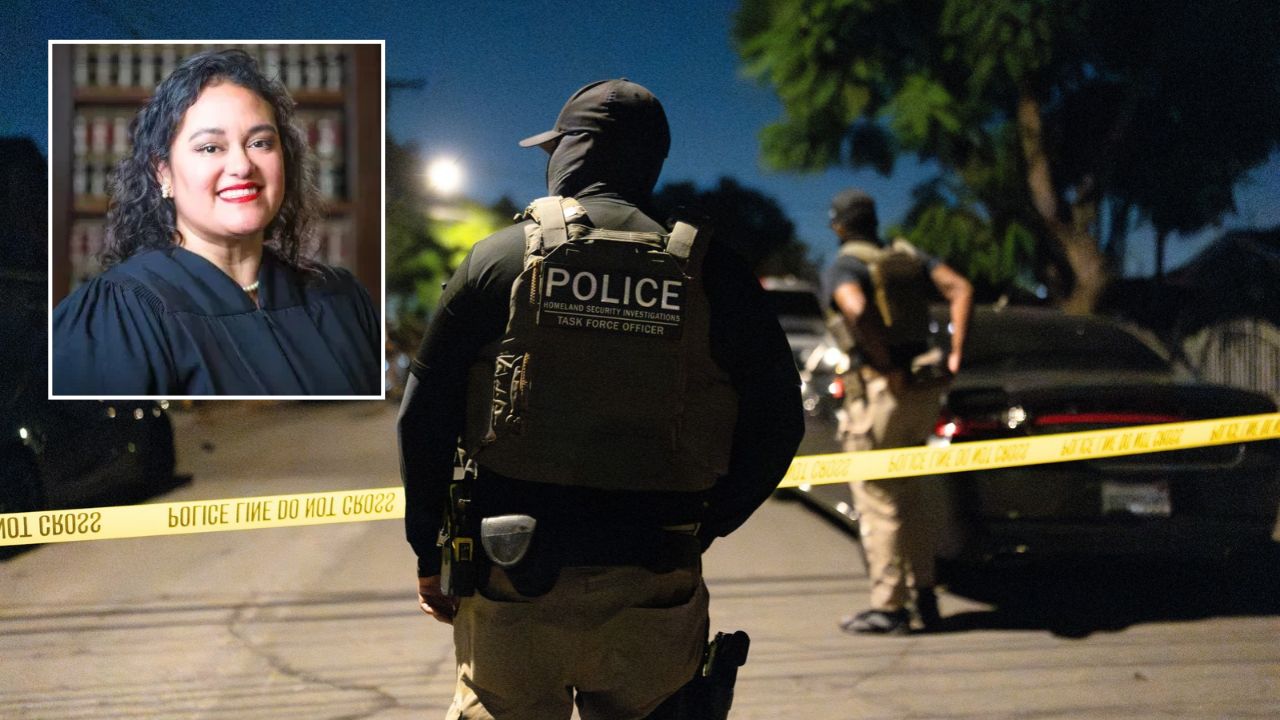
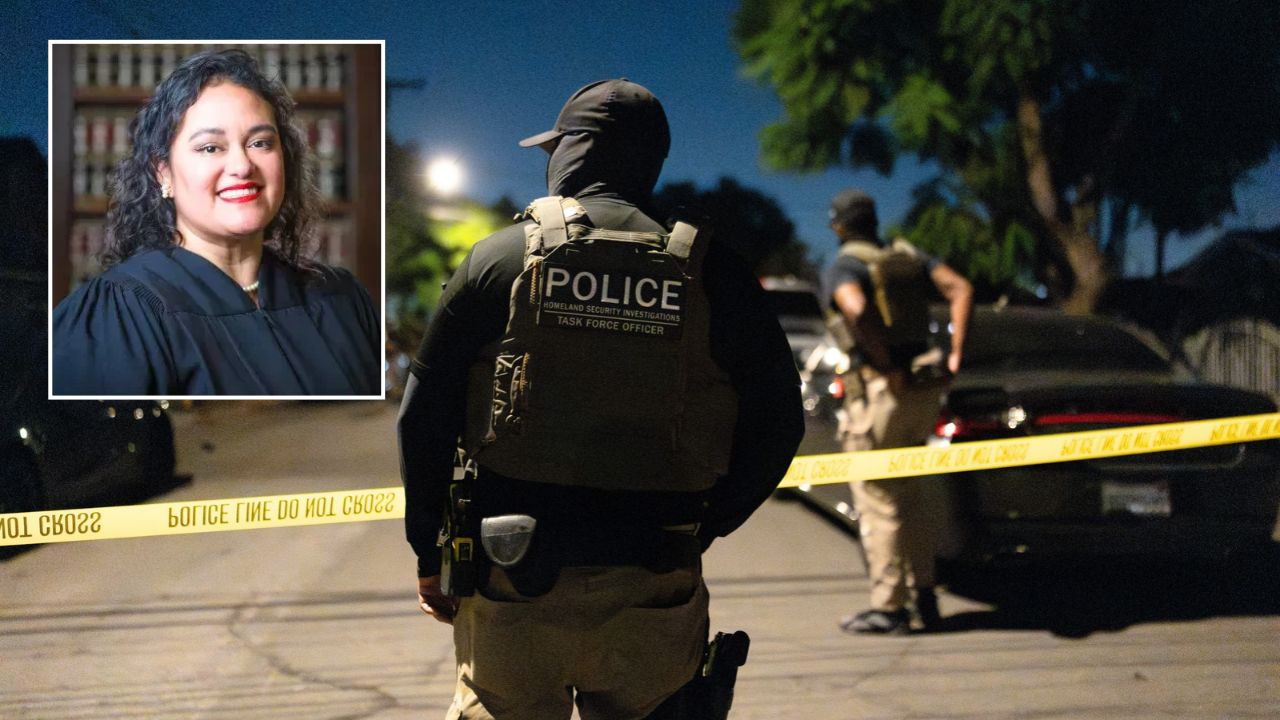
Background: A Homeland Security Investigations task force officer stands near police tape marking a perimeter during a federal operation targeting suspected illegal voter registration in Commerce, Calif., Monday, Oct. 19, 2026. (AP Photo/Jae C. Hong). Inset: District Judge Araceli Martínez-Olguín (U.S. District Court for the Northern District of California).
A judge has blocked the Trump administration from performing immigration enforcement-related field interrogations in areas containing U.S. citizens, finding that prospective voters have been intimidated by the federal government’s actions.
In a 19-page order handed down on Wednesday, U.S. District Judge Araceli Martínez-Olguín wrote that the U.S. Department of Homeland Security’s (DHS) “stated intent to narrow” the impact of its investigations to noncitizens “does not cure the reasonable fear of citizens being wrongly swept up” in them and then “subjected to intimidation for exercising statutorily-protected voting rights.”
The judge granted a preliminary injunction requested by voting rights groups including the California Nurses Association and National Nurses United (CNA/NNU).
Love true crime? Sign up for our newsletter, The Law&Crime Docket, to get the latest real-life crime stories delivered right to your inbox.
In June, DHS ordered Immigration and Customs Enforcement (ICE) to “enforce stricter penalties, including deportation, for aliens who illegally vote in American elections.” Two months later, DHS executed the “Unlawful Voter Initiative,” which directed United States Citizenship and Immigration Services (USCIS) to create lists of people they believed were voting as noncitizens.
That same month, DHS distributed the “Surge Initiative Guidance,” which instructed HSI officers to prioritize interrogations in nine states: California, Connecticut, Georgia, Missouri, Nevada, New York, Pennsylvania, Washington and Wisconsin. The surge required two things: the Voter Eligibility Matching Policy, which described how federal officers would identify and investigate people suspected of voter fraud, and the Field Operations Policy, which instructed HSI units to, among other things, “conduct field interviews” in those states.
In September, U.S. senators released a whistleblower report alleging that, as part of the initiative, USCIS officers “are being directed to illegally access state voter records and create erroneous federal law-enforcement records against purported ‘unlawful’ voters, some of whom are known to be naturalized U.S. citizens.” Four days later, CNA/NNU filed a complaint in the U.S. District Court for the Northern District of California against DHS, alleging, among other things, that the Trump administration was violating the Voting Rights Act (VRA) by intimidating voters.
Martínez-Olguín found this argument persuasive.
She wrote that the data from the “initial target list” in the Voter Eligibility Matching Policy is “voluminous and unreliable” and that, as with the Field Operations Policy, it “targets some naturalized citizens.” As a result, and with “substantial evidence” provided by the voting rights organizations, DHS’s “intimidating conduct, pursuant to the Unlawful Voter Initiative and Surge, is directly interfering with their members’ right to encourage voters to participate in the 2026 midterm elections.”
The jurist suggests the “Surge” is faulty throughout its process. From the order:
The Surge, including publicization of the use of faulty data sources that sweep in U.S. citizens, engagement in investigations based on this faulty data, and the Field Operation Policy’s implementation of a social media campaign showing arrests and interactions with armed officials, create a reasonable fear of harm to those assisting and mobilizing voters. Defendants announced the deployment of armed officers in a militarized action to individuals’ homes and communities during the final months before midterm elections, inspiring fear in the CNA/NNU members who wish to mobilize, educate, and assist voters. Defendants’ threats have already caused CNA/NNU members to withdraw from participating in electoral activity because they reasonably fear being subjected to physical, legal, or reputational harm to themselves and their loved ones.
“The fear is objectively reasonable, and compounded by Defendants’ use of data that is widely known to inadvertently include U.S. citizens, leaves citizens afraid that their name will be wrongly included in the hundreds of thousands identified for investigation,” the Joe Biden appointee added.
The Trump administration has argued that its agents cannot violate the VRA because it is illegal for noncitizens to vote in federal elections. In other words, the administration says the federal government has the right to conduct these investigations to root out illegal activity.
Martínez-Olguín, however, said the administration “has not shown that investigation of fraudulent voting requires the targeting of U.S. citizens, the deployment of armed agents, and the resulting [intimidation] of citizens urging or aiding other persons to vote.” She added that “at issue here is the reliance on admittedly flawed and incomplete data to create a list of individuals for HSI to interview in the months leading up to an election, including the roll out of a social media campaign publishing photos and videos of individuals being arrested for ‘unlawfully registering to vote in California.'”
“These items, taken together, lead to an objectively reasonable fear of law enforcement entanglements that intimidates citizens from urging or aiding others in exercising their right to vote,” the judge continued.
The preliminary injunction bans the Trump administration from enforcing field operations in the nine named states and from relying on the data from the Voter Eligibility Matching Policy to target U.S. citizens. It will remain in effect until Nov. 3.
The post Federal judge blocks Trump admin from deploying armed agents to interrogate voters in 9 states before midterms first appeared on Law & Crime.


