
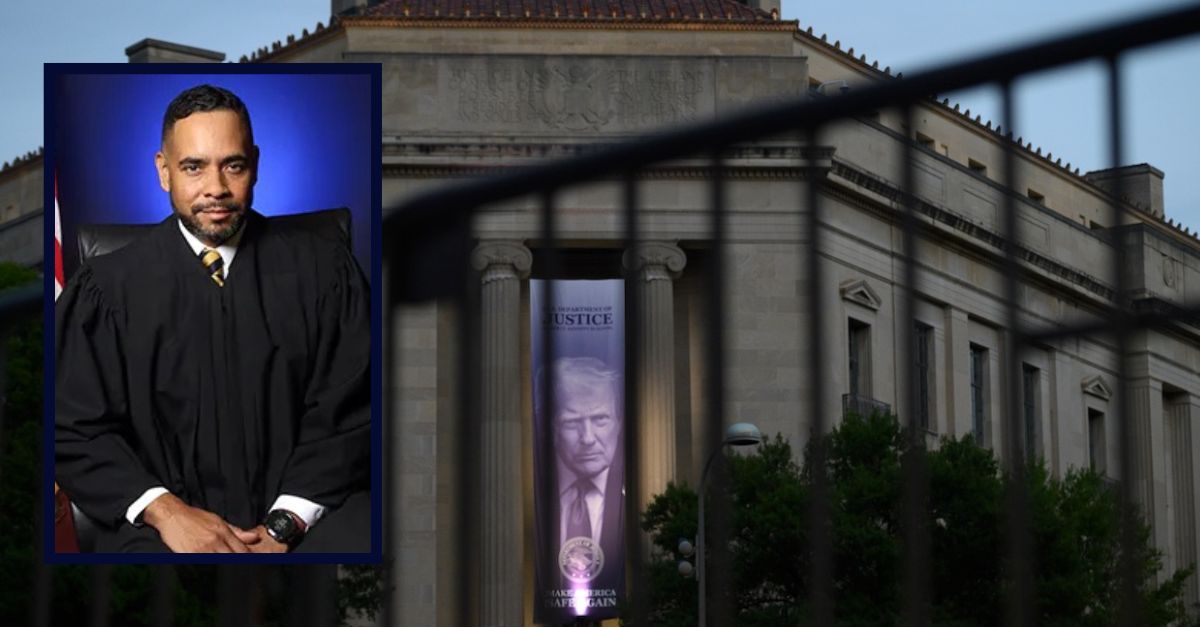
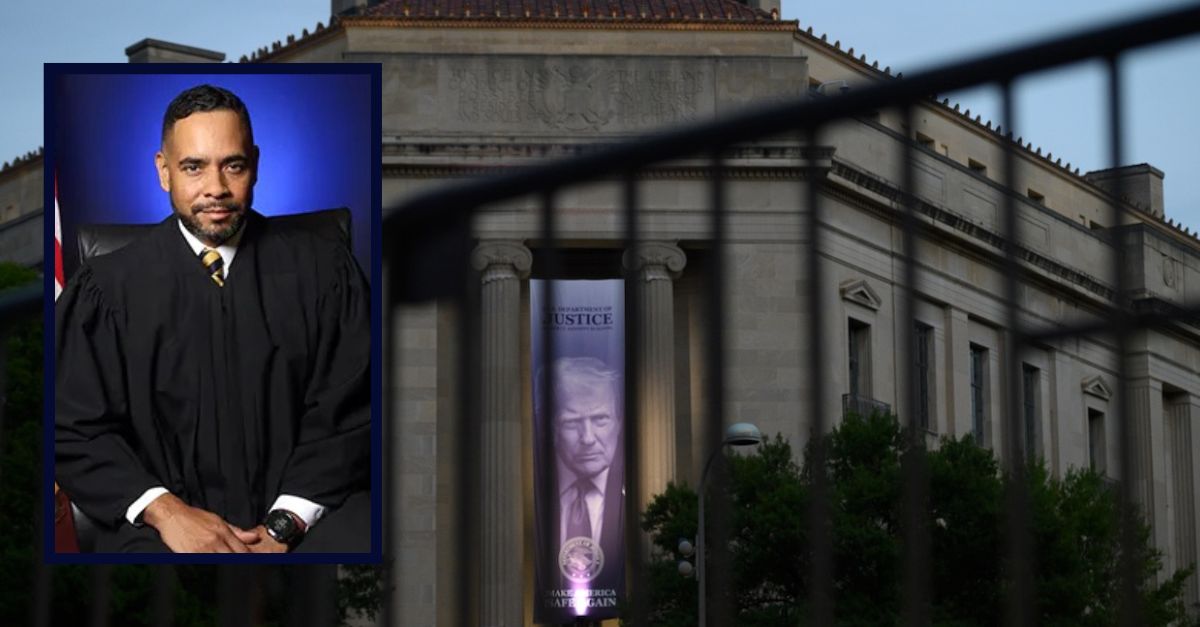
Main: A portrait of President Donald Trump, is seen through a security fence on the Justice Department in Washington, Friday, July 24, 2026, as the White House Correspondents’ Association dinner takes place nearby (AP Photo/Cliff Owen). Left inset: U.S. District Judge Carlos Mendoza (U.S. District Court).
What constitutes a “true threat”? To hear prosecutors in Florida tell it, a 35-year-old woman’s social media post wishing “someone would in alive” someone else was enough to make a federal case. A judge has now responded by tossing that indictment right out the door, writing that the supposed crime was “simply not a threat.”
Law&Crime has had many occasions to report on various individuals accused of threatening or committing violence against President Donald Trump, his opponents, his cabinet members, federal judges and justices, members of Congress, and beyond.
Signs of an overcorrection imperiling the First Amendment rights of ordinary people — angrily reacting to the world’s events around them online — are apparent, however, because it turns out that not all claimed threats are “true.”
Former FBI Director James Comey is an example of a powerful person currently making that argument to defeat his “8647” seashells threat prosecution on the merits. But his defense relies on recent rulings that went in favor of anti-Trump activists, protesters who sued and fought to keep their permits after flying “8647” flags on National Park Service property near the National Mall.
A threats case against Neda Joudeh in the Middle District of Florida, on the other hand, appears to have received almost no media attention — aside from Court Watch in November, which presciently commented this “may be the most elastic application of 18 U.S.C. 875 we’ve ever seen.”
The statute criminalizes the transmission “in interstate or foreign commerce any communication containing any threat to kidnap any person or any threat to injure the person of another,” an offense punishable upon conviction by up to five years in prison.
And the indictment says almost nothing — just that the defendant allegedly posted “I wish someone would in alive him” under the handle falasteen8090 on June 21, 2025, with the alleged intent to “communicate a true threat of violence.”
An affidavit in support of a search warrant revealed that the government made a federal case of Joudeh’s reaction to commentary about the New York Times article, “White Nationalist Wrote a Law School Paper Promoting Racist Views, It Won Him an Award,” after a Trump-appointed federal judge contacted U.S. Marshals.
U.S. District Judge John Badalamenti in 2024 taught a class at the University of Florida on originalism and awarded Preston Damsky, a “white nationalist and antisemite,” an accolade signifying his work was the best in the law class, the Times reported.
Joudeh’s alleged offense from there was her reaction to attorney Qasim Rashid’s criticism of Badalamenti and the university.
“As Trump attacks students who dare speak up for basic justice for Palestine, a student at the University of Florida Law School named Preston Damsky wrote a paper arguing that the Constitution only applies to white people & Jews and non-whites should be ‘abolished by any means necessary,” Rashid said at the time, according to a court exhibit. “A Trump-nominated judge named John L. Badalamenti who teaches the class gave Damsky the highest grade and awarded him the Book prize. University of Florida Law School defended the decision as ‘free speech.'”
The government’s affidavit said U.S. Marshals and the judge “suspected” that the Instagram user later revealed to be Joudeh “meant to say ‘unalive him,’ meaning ‘kill him.'”
Days later, Marshals interviewed Joudeh in Austin, Texas, while she was on the phone with a lawyer, and she “confessed to authoring the Instagram post in question on her account[.]”
Documents said she admitted posting “out of anger but had no intentions of acting on” that, also agreeing she meant to say “unalive” in reference to the judge.
Ultimately, her decision to delete the post was construed as creating the “inference that Defendant knew her Charged Statement would be viewed differently than others,” and an indictment followed on Oct. 29, 2025.
While an affidavit stated the judge and his “family are Jewish and [were] concerned that the comment from Falasteen8090 was also partially motivated by antisemitism,” the government as recently as three days ago said that was “incorrect.”
“Additional investigation has revealed that J.B. and his family are not Jewish, and the foregoing statement was incorrect,” a discovery-related filing said.
Part of the affidavit focused on other unrelated comments Joudeh made, like, “Iran please hit their news channels so we stop hearing people like this.”
In early July, Joudeh filed a motion claiming that she was selectively prosecuted based on the fact she is a “Muslim-American woman of Palestinian heritage.”
Orlando-area defense attorney Fritz Scheller, Joudeh’s lawyer who once represented former Matt Gaetz “wingman” Joel Greenberg during the DOJ’s sex-trafficking probe, additionally filed a motion to dismiss an indictment criminalizing speech that “is not a true threat as a matter of constitutional law.”
U.S. District Judge Carlos E. Mendoza, a Barack Obama appointee, made short work of the indictment on Saturday, granting dismissal and setting an in-person status conference for 9:30 a.m. on Sept. 4 — unless the DOJ appeals.
The judge was not impressed with the U.S. Attorney’s Office for the Middle District of Florida’s case, in which former U.S. Attorney General Pam Bondi’s interim pick, Gregory Kehoe, still oversees as acting U.S. attorney.
“The facts alleged in the Indictment state that Defendant violated this statute via an online comment that included the statement, ‘I wish someone would in alive him.’ The Indictment provides no further information as to where or why this comment was posted, to whom it was communicated, or who the referenced ‘him’ is in the comment,” Mendoza began, observing that “no reasonable jury could consider this broad, non-detailed wish to be a threat at all, much less a true threat.”
Joudeh’s post, the judge went on, was “not specific, not graphic, and not explicitly violent,” and didn’t “express an intent to commit harm in the past, present, or future,” so it is “simply not a threat” and “[n]o reasonable jury could conclude otherwise.”
“The Indictment is due to be dismissed,” Mendoza stated.
Reached for comment on the dismissal, Scheller told Law&Crime that his client’s case was the “disturbing, but expected result, of a justice system that has been infected by political considerations.”
“It has probably always been that way,” Scheller allowed, “but it sure feels different now based on the type of federal prosecutions being brought across the land.”
“In such a corrupt realm,” the defense attorney said, “Ms. Joudeh’s case proves once again that federal district court judges constitute democracy’s last line of defense — safeguarding the rule of law and our constitutional liberties.”
Law&Crime reached out to Kehoe for comment.
The post A federal judge just dismissed a ‘disturbing’ DOJ indictment you’ve probably never heard about: ‘Simply not a threat’ first appeared on Law & Crime.


