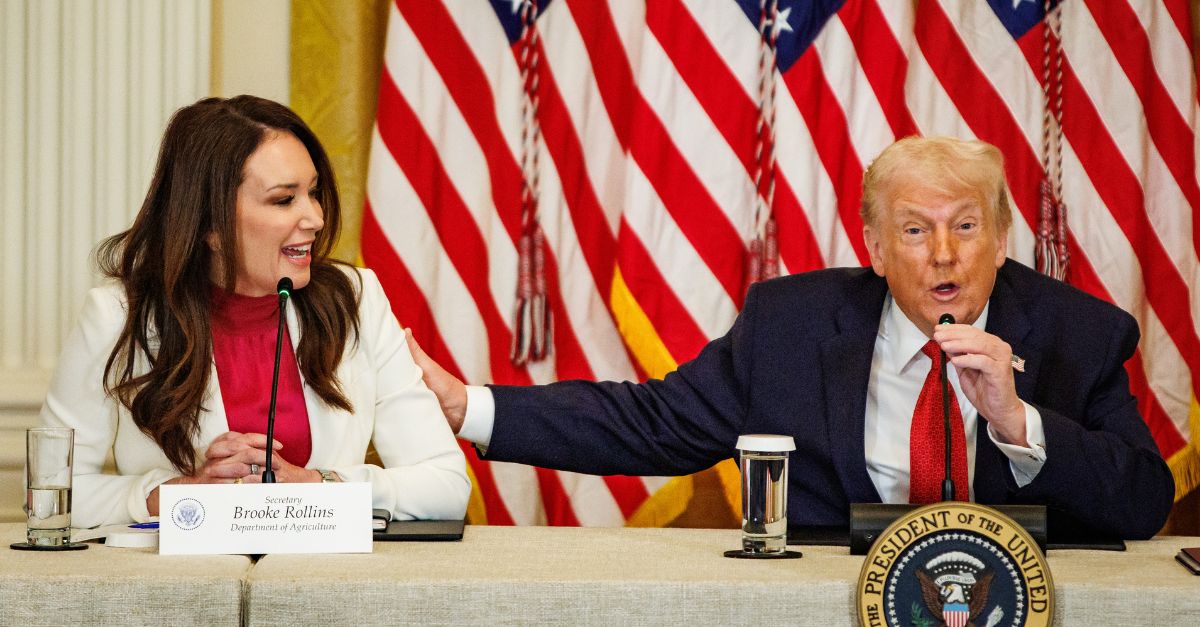
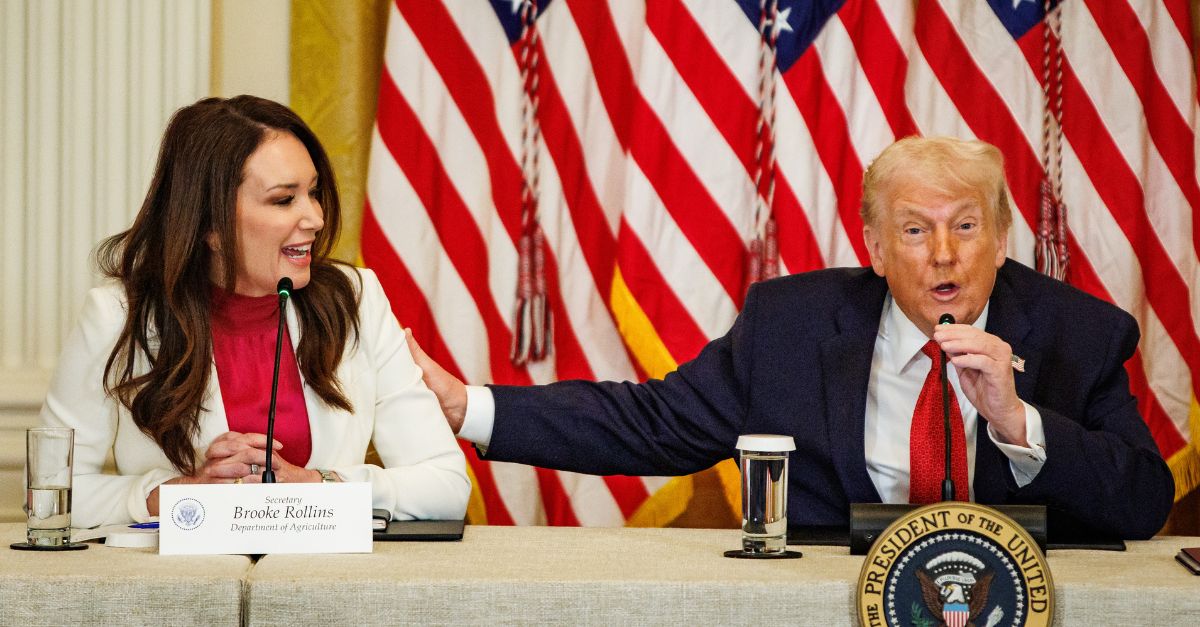
U.S. President Donald Trump and U.S. Agriculture Secretary Brooke Rollins during a roundtable discussion on healthcare reform in the East Room of the White House on January 16, 2026 in Washington, D.C. The President spoke about his healthcare initiatives to lower costs for Americans by cutting out the middlemen and negotiating with drug companies to lower the costs of prescription drugs. (Photo by Samuel Corum/ Sipa USA/via AP Images).
The Trump administration is holding funding for food, farmers and ranchers “hostage” to various political crusades against immigrants, so-called “gender ideology” and diversity, equity and inclusion (DEI) initiatives, a federal lawsuit filed this week alleges.
The federal government”s efforts to score victories through the use of funding conditions for disfavored states and jurisdictions are nothing new. As of this year, however, “all” the “programs, grants, cooperative agreements, and mutual interest agreements” administered by the U.S. Department of Agriculture (USDA) are subject to the Trump administration’s political litmus testing, according to the lawsuit.
The plaintiffs, several states led by Massachusetts, take issue with challenged conditions related to “purported anti-discrimination ‘policies,’ ‘gender ideology,’ ‘fair athletic opportunities’ for women and girls, and immigration.” Those imposed conditions are “vague, extraneous, and unreasoned,” according to their 81-page lawsuit.
“USDA has now thrown unconstitutional and unlawful roadblocks between the programs created by Congress and the States that rely on them, threatening critical nutrition support, vital agricultural research, and the safety of our national food chain and communities,” the original petition filed in Massachusetts federal court reads.
Aside from basic objections with the conditions, the plaintiffs say the government has simply not been clear about what is expected.
To hear the states tell it, “the 2026 Conditions do not specify the set of included ‘policies,’ or even confirm that certification is limited to currently existing policies” and “do not explain what activities are prohibited under” the verboten terms at issue.
The filing offers additional examples of the alleged lack of clarity:
The Challenged Conditions also prohibit directing funding towards programs that “allow illegal aliens to obtain taxpayer-funded benefits… or provide incentives for illegal immigration.” But the 2026 Conditions do not define “benefits” or explain how to analyze what kind of “incentive” any particular program creates. Finally, the Challenged Conditions require States to “comply” with certain Executive Orders but fail to explain how the Executive Orders, which on their face apply to federal agencies, would apply to States.
Moreover, the plaintiffs say, the new conditions are at odds with “prior certification requirements” which leave states further in the lurch about how to comply. On top of this internal inconsistency, the lawsuit says, many requirements would be “incompatible with many States’ own laws and policies.”
Such a combination of competing priorities, rules, regulations, and laws is a recipe for disaster, the plaintiffs say.
“[W]ith billions at stake for life-sustaining food and critical funding for their residents, the States may be forced to accept funding conditions that they fundamentally do not understand, that are designed to coerce the States and their instrumentalities to adopt USDA’s policies, and which are ultimately unlawful,” the lawsuit goes on. “[B]y holding federal funding hostage in order to impose policy preferences on the States, the Defendants could interfere with the Plaintiff States’ sovereign authority to govern themselves, and to enact laws to promote the general health and welfare of the people.”
The alleged morass is likely unconstitutional, the plaintiffs say.
“The U.S. Constitution requires more from USDA,” the lawsuit continues. “Specifically, the Spending Clause requires that any funding condition be communicated with sufficient clarity that it can be accepted knowingly and voluntarily, and it prohibits coercive conditions that place a gun to the head of recipients that cannot forgo critical funding. Ambiguous, coercive conditions like the ones that USDA advances ‘undermine the status of the States as independent sovereigns in our federal system.’ The Challenged Conditions fall far short of the Spending Clause’s requirements.”
Additionally, the plaintiffs say the confusing and contradictory conditions are the result of a “slapdash approach” that also violates an entirely different set of laws under the Administrative Procedure Act (APA), the decades-old federal statute governing the behavior of, and lawsuits against, administrative agencies.
“That law requires agencies to act in a reasoned manner, rather than through arbitrary and capricious actions, and to account for the reliance interests of the States,” the complaint reads. “Here, the lack of reasoned decision-making is astounding: USDA threatens to withhold billions of dollars in critical funding from the States across every grant, cooperative agreement, and other similar arrangements including mutual interest agreements, all without considering the grave harm it inflicts on longstanding reliance interests and without ever considering alternative means of advancing its agency priorities.”
In real terms, the plaintiffs warn the comprehensive conditions threaten funding for school lunch programs, the Special Supplemental Nutrition Program for Women, Infants and Children (WIC), the Supplemental Nutrition Assistance Program (SNAP), forestry initiatives, wildfire readiness, crop resiliency, food and farm research programs, and the Emergency Food Assistance Program – which provides critical support to families and markets for farmers alike.
“The federal government cannot hold critical funding hostage to force states to comply with vague, ideological directives,” New York Attorney General Letitia James said in a statement announcing the Empire State’s participation in the lawsuit. “These new conditions put essential programs at risk and cause chaos for states that rely on this funding to feed families, support farmers, and keep communities safe.”
The six-count lawsuit seeks injunctive relief against the new conditions and a declaration that the conditions are “unconstitutional and/or unlawful” because they violate the Spending Clause and the APA. The plaintiffs are also asking a judge to issue separate but related injunctions to maintain their funding under the relevant programs and a general vacatur of all the disputed conditions.