
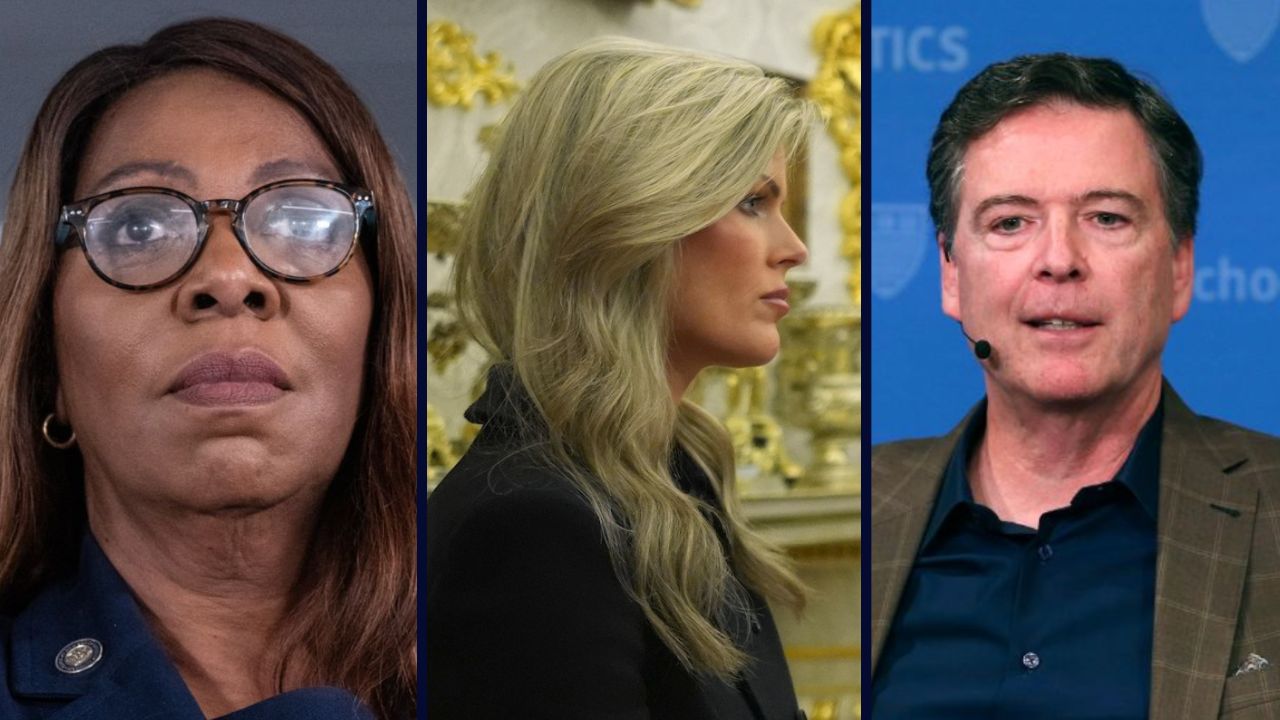
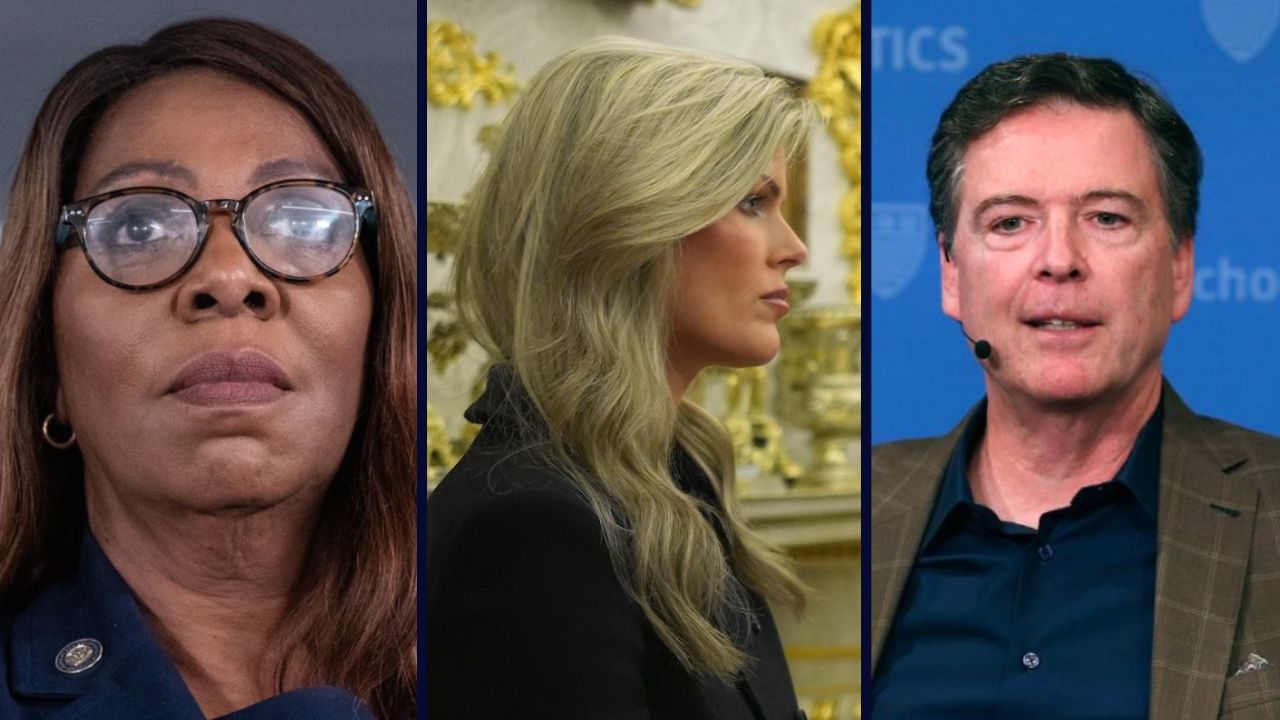
Left: Attorney General Letitia James attends joint press briefing with Mayor Zohran Mamdani, Governor Kathy Hochul and elected officials and activists standing up to Federal ICE overreach at governor’s office in New York, NY on August 12, 2026 (Photo by Lev Radin/Sipa USA)(Sipa via AP Images). Center: Lindsey Halligan listens as President Donald Trump speaks during an event about loosening a federal refrigerant rule, in the Oval Office at the White House, Thursday, May 21, 2026, in Washington (AP Photo/Jacquelyn Martin). Right: Former FBI director James Comey gestures while speaking at Harvard University’s Institute of Politics’ JFK Jr. Forum in Cambridge, Mass., Feb. 24, 2020. (AP Photo/Charles Krupa, File).
The Department of Justice (DOJ) told a federal appeals court on Tuesday that a judge wrongly “administered […] strong medicine” as a consequence of Lindsey Halligan’s “unlawful” appointment, insisting a mere “error in the title” should not have led to dismissal of Letitia James’ and James Comey’s indictments in Virginia.
Counselor to the Attorney General Henry Whitaker argued Tuesday before the 4th U.S. Circuit Court of Appeals that the three-judge panel should “respect” grand juries’ decisions and revive fraud and false statement indictments against President Donald Trump’s rivals: New York’s attorney general and the former FBI director.
The DOJ recently failed in its separate efforts to salvage grand jury subpoenas of James’ office on appeal, and the distinct “8647” seashells prosecution of Comey may also be heading toward protracted delay.
Love true crime? Sign up for our newsletter, The Law&Crime Docket, to get the latest real-life crime stories delivered right to your inbox.
Against that backdrop, Whitaker stated that Senior U.S. District Judge Cameron Currie erroneously concluded in November that ex-U.S. Attorney General Pam Bondi “unlawfully appointed” Trump’s former personal attorney Halligan as interim U.S. attorney in the Eastern District of Virginia.
In briefs, the government said the district judge should not have tossed the indictments as a remedy, when any “error” in Halligan’s “title” was “harmless.” Beyond that, the DOJ asserted Bondi’s move to retroactively ratify Halligan’s actions before the grand juries should have been the end of the issue.
But attorneys for Comey and James countered that Halligan was little more than a private citizen when she was the only prosecutor to sign the indictments and present to the grand jury. Notably, that is how U.S. District Judge Aileen Cannon described ex-special counsel Jack Smith when she dismissed his Mar-a-Lago case against Trump on Appointments Clause grounds.
“Mr. Smith is a private citizen exercising the full power of a United States Attorney, and with very little oversight or supervision,” Cannon said, tossing out the president’s willful retention of classified documents and conspiracy case as a remedy.
Perhaps it was no surprise, then, that United States v. Trump came up early during oral arguments on Tuesday, as Whitaker insisted the Comey and James dismissals be reversed.
“How would you then distinguish United States v. Trump when Judge Cannon found that Mr. Smith, whatever his name was, wasn’t lawfully appointed? What happens in this case? How would you distinguish it if Ms. Halligan’s not lawfully appointed?” asked Senior U.S. Circuit Judge Henry F. Floyd, a Barack Obama appointee.
Whitaker answered that Halligan’s case deals with the “interim appointment statute” and its 120-day limit on service, not an appointment of a special counsel.
“That’s point number one,” Whitaker said.
“The point is that she says it wasn’t a lawful appointment,” Floyd replied.
“She did, Your Honor, but Judge Cannon there was faced with the appointment of a special counsel to which different appointment authorities apply. For example, in this case, we could have appointed Ms. Halligan to conduct these prosecutions under 28 U.S.C. 542 and 543, which were appointment authorities that the United States did not invoke in defending the Jack Smith appointment,” Whitaker answered.
Chief U.S. Circuit Judge Albert Diaz, also an Obama appointee, then jumped in.
“To put it bluntly, would have, could have, should have. That didn’t happen,” Diaz said, instead suggesting the DOJ’s repeatedly rejected personnel musical chairs “cut[s] off both the court — the district court — and the Senate’s advice and consent power” over U.S. attorney appointments under 28 U.S.C. 546.
From there, the chief judge pressed Whitaker on “ratification” — particularly, the claim that Bondi’s move to retroactively ratify Halligan’s actions before the grand juries through a special attorney title “cured any arguable flaw” with the interim appointment.
“Can I ask you about that? But isn’t — I mean isn’t the tenor of the cases, including our cases, that one can ratify acts, but not actors?” Diaz asked. “You don’t ratify actors; you can ratify acts. And if the initial appointment of Ms. Halligan was defective from the jump, then I don’t know how that solves your problem with respect to the statute [of] limitations” issue in Comey’s case.
“Well, it does solve the problem,” Whitaker answered, “because we ratified her acts, namely her presentation before the grand jury and signature on the indictments.”
“That and that those are acts that we ratified, and the district court said, ‘Oh, well, you know, Ms. Halligan was unauthorized from the start, so it couldn’t be ratified,'” he added.
When Ephraim McDowell argued on Comey’s behalf and Abbe Lowell did the same for James, U.S. Circuit Judge Julius “Jay” N. Richardson — the lone Trump appointee on the panel — pushed back against the idea that the administration, to keep loyalists in place, will just keep ignoring the nomination process and lash out at district courts empowered by statute to fill U.S. attorney vacancies.
“Maybe it’s not been a ton, but over history there’ve been successive appointments, and if the sky is falling, as you suggest, that like if successive appointments means that 541 is read out of the U.S. code, I have a little hard time understanding like why that hadn’t happened already, right?” Richardson told Lowell. “We certainly had periods of time where people were making successive appointments, and yet the executive branch did not thumb their nose at the district courts in every instance and just reappoint people every 119 days.”
“This sort of sky is falling idea seems counter to the history we had, where successive appointments were occurring and yet the sky was not falling. So why should I buy this, like we are undermining the very nature of government argument, which is what I I take your argument to be, when when like the history really doesn’t tell us that?” the judge added.
“Well, in terms of my professing that the sky is falling,” Lowell quipped, “I think what we do is apply the statute in a way to prevent the clouds from ever hitting the ground.”
On the ratification question, Floyd asked McDowell directly how Halligan is “any different the day she walked in that grand jury to a man off the street when she went and got the indictment?”
McDowell confirmed that is “precisely” Comey’s position.
“We don’t think that the attorney general can ratify what she did, and that was Judge Currie’s point,” the attorney said.
The post Appeals court presses lawyer on Judge Cannon’s Mar-a-Lago dismissal as Trump DOJ tries to revive Comey, AG James indictments first appeared on Law & Crime.


