
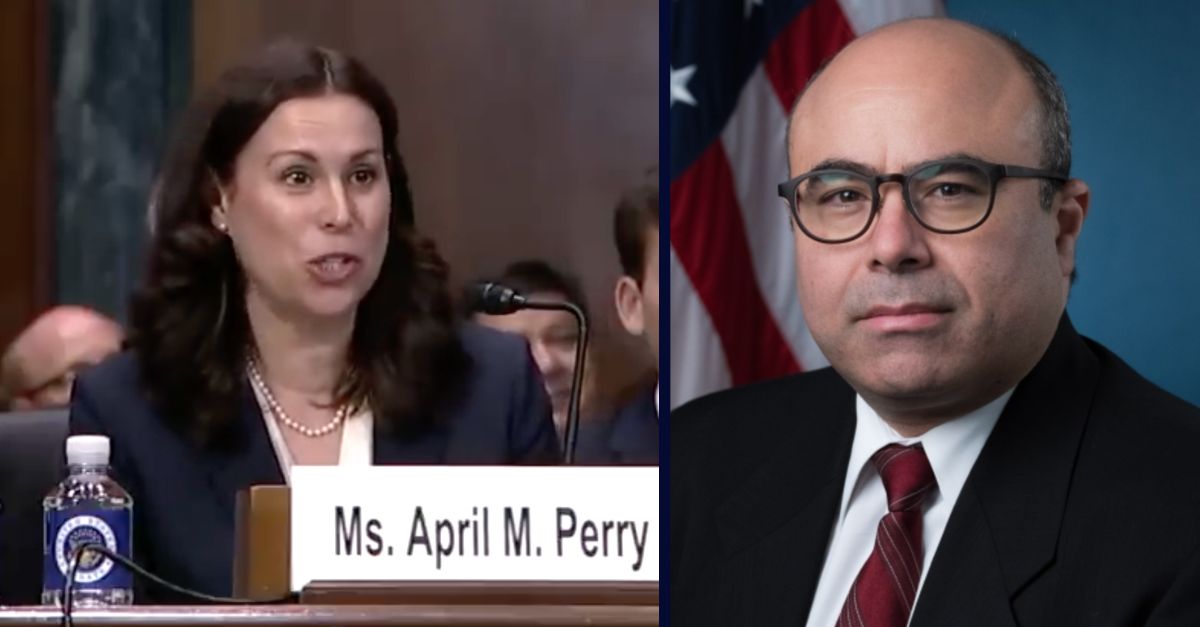
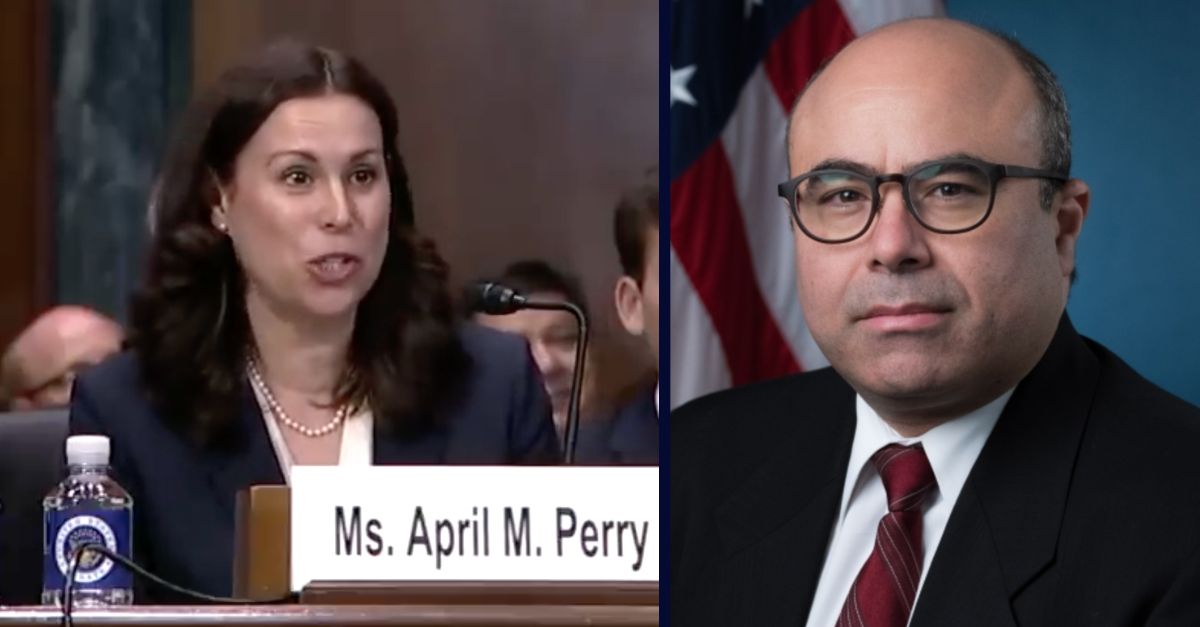
Then-judicial nominee April Perry answers the Senate”s questions in July 2024 (Sen. John Kennedy/YouTube). Right: U.S. Attorney for the Northern District of Illinois Andrew Boutros (DOJ).
Defense lawyers in Chicago are trying to toss out a criminal indictment in a massive COVID-19 fraud case for the rest of time after a “shocked” judge exposed federal prosecutors’ improper grand jury “behavior” in a separate high-profile case involving activists protesting the actions of U.S. Immigration and Customs Enforcement (ICE).
A co-defendant of indicted former Loretto Hospital CFO Anosh Ahmed, Mahmood “Sami” Khan worked at Anosh Inc. — a “Chicago-based non-profit organization fighting medical and educational inequality worldwide” — and allegedly conspired to carry out a nearly $900 million COVID-19 testing fraud “scheme.” But a motion to dismiss with prejudice says there’s now reason to believe that the U.S. Attorney’s Office for the Northern District of Illinois tainted his case with the same kind of grand jury misconduct.
As Law&Crime previously reported, U.S. District Judge April Perry last week ripped federal prosecutors on the “Broadview 6” case for “behavior” before the grand jury she had “never seen” before, behavior that was hidden due to redactions in transcripts — and aided by the government’s decision to pursue misdemeanor charges against anti-ICE protesters instead.
Slamming newly exposed evidence of “improper prosecutorial vouching to the grand jurors,” “improper prosecutorial communications of a substantive nature with the grand jurors outside of the grand jury room,” and a “prosecutor excusing grand jurors who disagreed with the government’s case from the deliberations process,” the judge warned of possible sanctions for prosecutorial misconduct and for potential ethics violations.
A short time later, U.S. Attorney Andrew Boutros entered the courtroom, expressed his intention to dismiss the remaining cases against Kat Abughazaleh, Andre Martin, Brian Shaw, and Michael Rabbitt, and said he understood the judge was “quite upset.” Still, Boutros claimed he was not aware of the “vouching” behavior until later on, when the government bumped the charges down. During the hearing, one of the inexperienced DOJ attorneys involved assigned blame to Sheri Mecklenburg for the grand jury “vouching.”
In court, Boutros said he “too had not seen conduct like that, and it upset me, which is why we did dismiss that indictment and proceeded with an information.”
After he dug a deeper hole for himself by mischaracterizing the judge’s public comments on the case, Perry reminded Boutros that “what matters right now is not the defense attorneys or Mr. Boutros or the prosecutors,” but the “four defendants whose cases just got dismissed, who no longer have to go to trial on Tuesday.”
It was yet another instance of the Trump administration DOJ’s actions in the grand jury setting compromising criminal cases to the point of tanking them.
And as it turns out, Khan now thinks he shouldn’t have to go to trial this July because he was indicted by the same grand jury — as recently disclosed by the U.S. Attorney’s Office, but only after Perry’s beatdown.
“[W]e now know that the process was infected with misconduct,” the motion said, referring to an anonymous “AUSA A.”
“It was recently discovered that AUSA A engaged in blatant, repeated misconduct before the grand jury in the Broadview Six matter. After the misconduct came to public light, the government advised undersigned defense counsel that they decided to conduct a review of AUSA A’s other cases before the grand jury (at some prior point). The grand jury that returned the indictment in the Broadview Six case is the same grand jury that heard Khan’s case,” the filing went on, asserting that “the government must face the same fallout in this case.”
The “same” fallout would be dismissal with prejudice, meaning the government could not bring the case again.
Short of that, the defendant is asking U.S. District Judge Sharon Johnson Coleman, a Barack Obama appointee, to order an evidentiary hearing that could expose the government to more embarrassment.
“On May 22, 2026, a day after Judge Perry made her findings, the government met with undersigned counsel in a Teams meeting and disclosed that the grand jury in the Rabbitt case was the same grand jury as the above captioned case. The government further advised there may be an issue in the present case where AUSA A also vouched for witnesses or evidence, but qualified that it would be up to defense counsel to decide,” the motion detailed. But if the judge doesn’t want to toss out the whole case, prosecutors should at least be forced to subject their internal communications to scrutiny, the defense allowed.
“An evidentiary hearing is the appropriate forum to develop these facts because they cannot be developed from documents alone. The relevant decisions — to redact, to delay disclosure, to commence and conceal a review of this case, and to plan a superseding indictment — were made by office personnel whose testimony defense counsel must be permitted to obtain,” the filing concluded. “The Court should also order production of the enumerated communications in advance of any hearing so that defense counsel can prepare meaningful examination.”


