
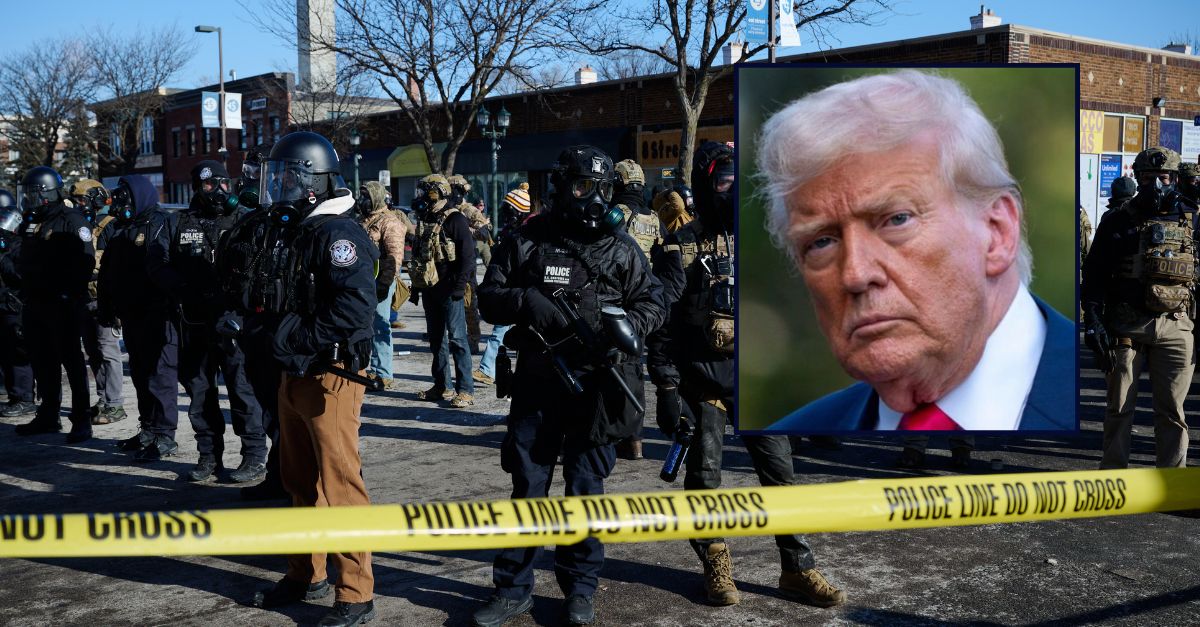
Inset: President Donald Trump walks from Marine One after arriving on the South Lawn of the White House, Tuesday, July 15, 2025, in Washington (AP Photo/Alex Brandon, File). Background: Demonstrators gather in south Minneapolis, Minnesota, on January 24, 2026, after a man is shot and killed by U.S. Immigration and Customs Enforcement agents earlier that morning, according to officials. (Christian Zander/NurPhoto via AP).
A federal judge in New Jersey took the Trump administration to task for directly violating a court order in a case in which an Indian immigrant was transferred to another lockup facility in another state.
The six-page memorandum opinion and order is of a piece with an almost daily drip of district court judges shutting down controversial efforts to reshape how Immigration and Customs Enforcement (ICE) classifies immigrants in order to detain them.
The petitioner, Jagpreet Jagpreet Singh, won habeas corpus release by convincing U.S. District Judge Christine P. O”Hearn, a Joe Biden appointee, that his detention was “blatantly unlawful from the start.”
As in many similar cases, the public record is scant because petitions for the writ of habeas corpus are frequently filed under seal.
What is clear is that Singh entered the country through California in January 2024 and was detained by Border Patrol. He has a pending asylum application but was detained by ICE on Valentine’s Day of this year “in New York while he was driving home from work.”
“Following his arrest, Petitioner was detained at Delaney Hall Detention Facility in Newark, New Jersey, without access to counsel or the ability to make a phone call,” O’Hearn recounts.
On Tuesday, Singh’s attorneys filed the petition. Later that same day, the court issued a text order — a short order comparable to a minute order — requiring ICE to keep the man in the Garden State.
The prior order reads, in full:
In light of the Court’s pending decision and to preserve the status quo, including Petitioner’s continued access to counsel, during the potential briefing and hearing process, and pursuant to the All Writs Act, 28 U.S.C. § 1651, Petitioner shall remain in the State of New Jersey and shall not be transferred outside the State of New Jersey until further order of the Court.
On Wednesday, the Trump administration promptly violated the court’s order by sending Singh to a different facility in New York.
O’Hearn takes stock of the violation in a footnote.
“[T]he U.S. Attorney’s Office disclosed for the first time that ICE had transferred Petitioner outside of New Jersey on February 18, 2026, at approximately 12:30 p.m., notwithstanding this Court’s prior Order enjoining removal from New Jersey which had been entered nearly 22 hours earlier while Petitioner was present in this District,” the footnote begins.
The judge then spends some time criticizing ICE for engaging in over 50 such violations of similar orders over two months alone — and hints that she will consider some sort of corrective action in the future.
From the footnote, at length:
While this Court has, for months, expressed alarming concerns with respect to Respondents’ failure to abide by judicial orders, it is even more so alarmed that it continues to occur given that the U.S. Attorney’s Office just last week admitted that it is aware that ICE has repeatedly violated judicial orders more than fifty (50) times in just the past sixty (60) days. Yet here again, there is a blatant violation of a no removal order. The Court will address the Respondents’ conduct in a separate forthcoming order.
As for the case itself, O’Hearn ordered the U.S. Department of Justice to file an extended answer by Thursday identifying “the specific statutory or other legal authority for Petitioner’s detention; the procedural due process afforded prior to detention; whether a final order of removal exists; any alleged changed circumstances justifying detention; whether Petitioner has received a bond hearing; and the current status of all related immigration proceedings.”
But, the court says, the DOJ only provided an “incomplete” answer and letter that “does not fully respond to the Court’s Order.” Rather, the DOJ likened the arguments and facts in Singh’s case to another immigrant’s case previously ruled on by the same judge.
In that other case, the judge notes, she “rejected” the Trump administration’s oft-litigated efforts to redefine ICE’s detention authority under the Immigration and Nationality Act (INA).
In July 2025, ICE issued the new policy, instructing all agents to deny bond for anyone who entered the country without “inspection,” in a memo that has since opened the floodgates of litigation.
Under the terms of the policy, such immigrants are to be detained “for the duration of their removal proceedings” unless granted parole — a rarer form of release. In real terms, however, the Trump administration has made clear such detentions are intended to be indefinite.
Over the past eight months, in hundreds of district court disputes, judges have considered the interplay and applicability of two distinct INA statutes that outline the government’s detention authority. Many judges have rephrased those statutes using language from a 2018 U.S. Supreme Court ruling penned by Justice Samuel Alito.
In short, the government claims ICE has the authority to subject immigrants to mandatory detention under 8 U.S.C. §1225(b), which applies to “aliens seeking entry into the United States.”
Conversely, advocates for immigrants — as well as most judges who have ruled on the matter — have instead turned to 8 U.S.C. §1226(a), which applies to “aliens already present in the United States.”
Here, the judge says the arguments are more of the same.
“[I]t appears to the Court, at a minimum, that Petitioner is being unlawfully detained under Respondents’ repeated invocation of 8 U.S.C. §1225 because, as set forth in [the aforementioned case], Petitioner was apprehended inside the United States after residing here for an extended period, and therefore he should have been detained under 8 U.S.C. §1226, which requires an opportunity to seek bond,” the order reads.
The judge explicitly likens Singh’s case to hundreds of district court disputes over the past eight months reaching similar conclusions.
“[T]he Court notes that federal courts have in near unanimity similarly rejected the Government’s position in approximately 300 cases to date, a number which climbs with every passing day,” O’Hearn goes on. “[T]he only commensurate and appropriate equitable remedy to even partially restore [Petitioner] is to immediate[ly] release him and enjoin the Government from further similar transgressions.”


