
This article contains discussion of violent hate crimes and murder.
The harrowing hate crime revealed in the flash-forward of the Tip Toe series premiere finally came to pass in the limited series’ finale on October 30, depicting the dizzyingly quick spiral of the final moments of Leo’s (Alan Cumming) life in excruciating detail. Here, Alan Cumming explains why Leo’s murder needed to be shown in full in the interview below, as does series creator Russell T Davies, who explains the inspiration for Tip Toe‘s could-be true story. Warning: Tip Toe finale spoilers ahead.
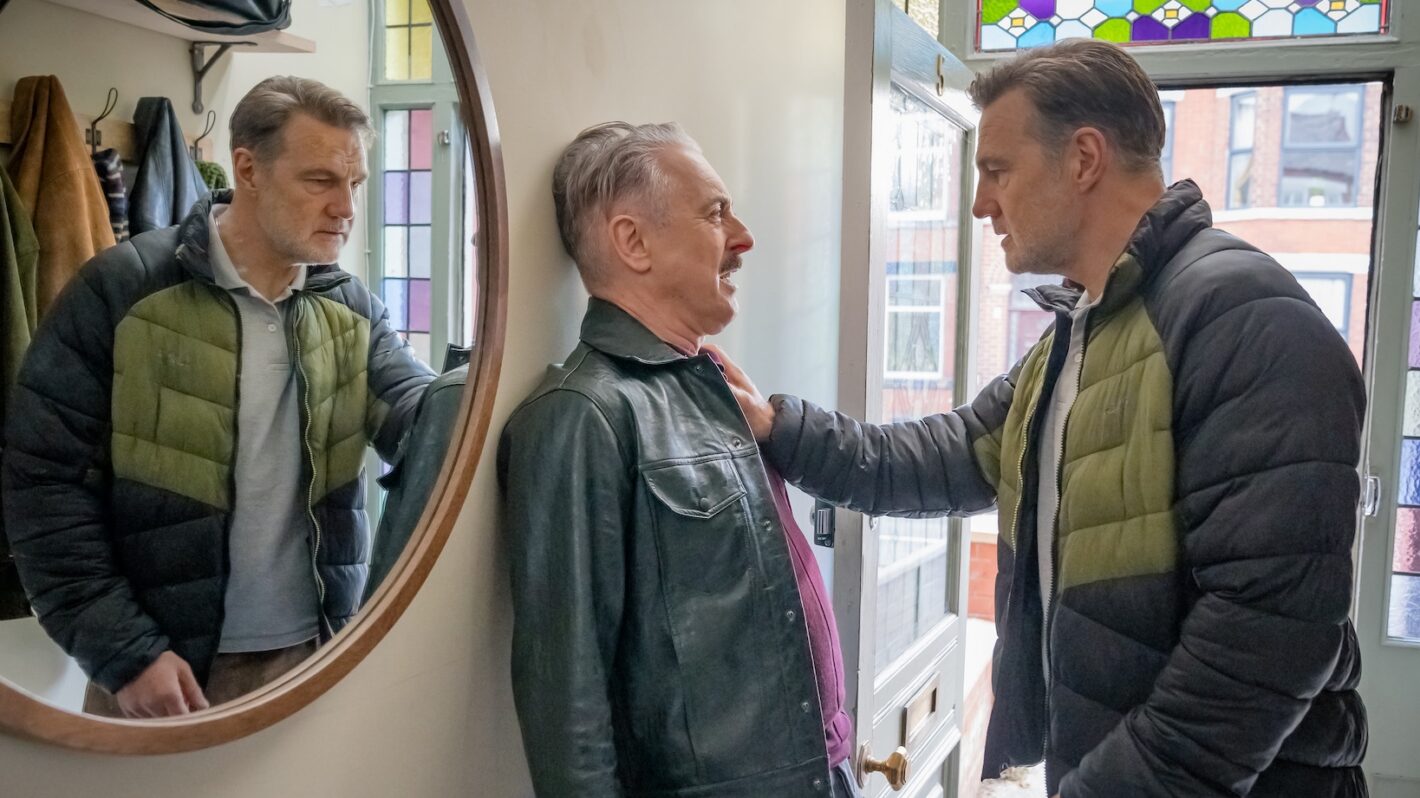
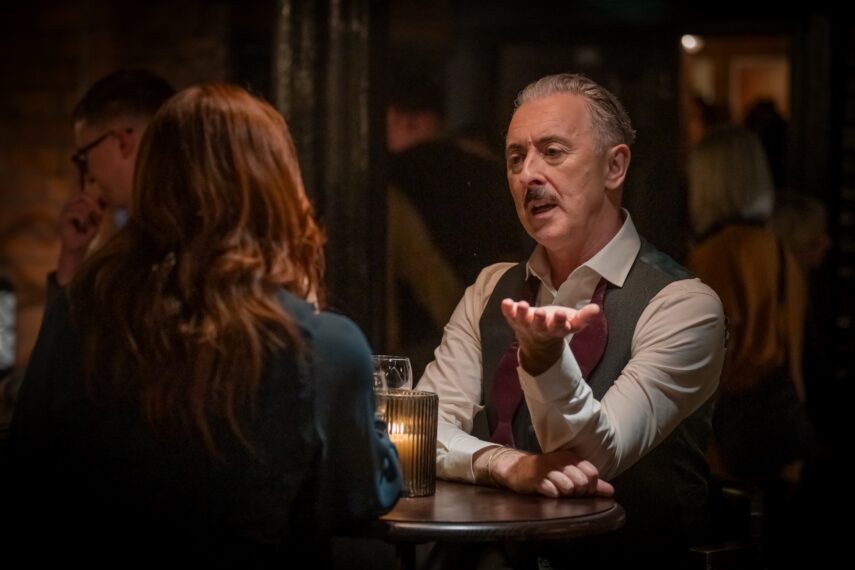
Tip Toe is a harrowing fictional story set in the present day that opens with the reveal of an LGBTQ+ hate crime and then flashes back to show how it happens. It stars Cumming as Leo Struthers, a gay man who owns a queer bar in Manchester and lives next door to a difficult neighbor, Clive Goss (David Morrissey), and his family. Their neighborly relationship is tense from the start, and Clive gets more judgmental of Leo’s life with every detail he learns about it.
Leo, meanwhile, tries to find a way to connect and at times thinks he’s succeeding. The fact that they’ve been neighbors for decades and this is the state of their relationship is a testament to Clive’s small-mindedness. It was a discourse-generating hit when it premiered in the United Kingdom earlier this year, and Starz brought it to U.S. audiences.
Leo is murdered by lynching, but his killers aren’t revealed until the finale. In a horrifying display of toxic masculinity and homophobia, Clive has Leo killed in broad daylight by his eldest son’s group of violent friends who watch sports at their house each week. Clive eggs on the group and ultimately receives the most legal consequences with a mandatory life sentence in prison.
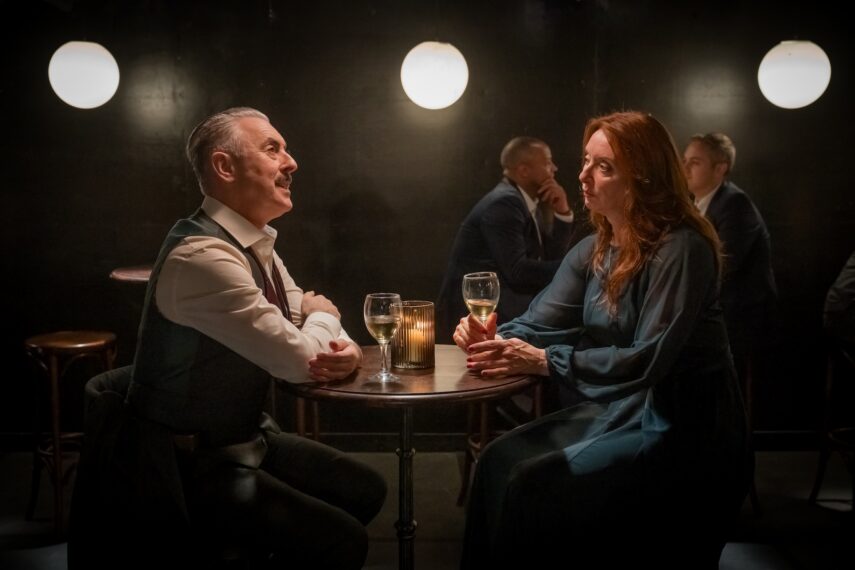
While Tip Toe is not based on a true story, it is inspired by the real-life increase of homophobia, transphobia, and racism in recent years as right-wing extremism as spread globally, and it pulls from the true history of anti-queer lynchings. The series ends with a flashback scene between Leo and his best friend, Stephanie (Elizabeth Berrington), during which Leo asks if queer people are wrong that visibility for their community will lead to acceptance and support.
What if queer and trans people all came out, and getting to know them still didn’t make bigoted people hate them less? It’s a sad, challenging question, but a prescient one. Davies tells TV Insider that this question was the inspiration for the entire series.
Starz
“Leo says it at the end. Actually, Melba [Paul Rhys] says it in Episode 1. It’s a tolling bell all the way through the show,” Davies says. “It’s a worrying thing to say. It’s not something I say happily because I’m not saying that the alternative to that is invisibility at all. But bear in mind, the context of the whole thing, which is for me, my personal context is that I wrote Queer as Folk in 1999, and I’m so proud of that. When I wrote that, if you’d asked me what life would be like in 2026, I would’ve thought that we’d be problem free. I would’ve thought that we’d be in some sort of golden age. I mean, it’s now ridiculous. I am slapping myself on the forehead because no society ever reaches a golden age.”
“It’s very interesting that as gay and queer people, we all look forward to thinking equality and representation and visibility as though that would be an end to our problems, which straight society has never managed an end to its problems,” Davies continues. “And indeed, a lot of the problems with straight society are driving us all towards a Third World War right now in the White House, which is just behind me [Davies was in Washington D.C. at the time of our Zoom interview]. So, it feels remarkably foolish that I personally never looked forward to seeing this coming.”
“Although I’ve got to say, I say that, but actually you can find interviews with me 10 or 15 years old worrying that our rights are paper thin,” Davis clarifies. “It’s always been a worry of mine, so it’s always been ticking away my heart. I never thought it would come so true.”
Here, Cumming explains the Tip Toe finale and why art is an important tool in spreading awareness about real-life violence.
Starz
In the finale’s last scene, Leo asks if queer people were wrong to come out. What are your reflections on that concept?
Alan Cumming: I don’t think he’s saying, “What if we were wrong to come out?” I think he’s saying, “What if we were wrong about the fact that they didn’t like us because we didn’t have visibility because they didn’t know us? They didn’t know who we were. What if they still don’t like us?”
So, it’s not about necessarily about coming out. I feel it’s about, there’s a whole thing about, we used to think that people, if you’re ignorant of something, you are more likely to be scared of it and to hate it. But what if you know it and you still hate it? I think that’s the terrifying thing. And it’s just a way I feel everything, every hatred is taught. And I feel it’s interesting. I’ve got really funny ideas about homophobia to me is kind of, if you think about it like arachnophobia, you can be afraid you have an irrational fear of spiders. That doesn’t mean you hate spiders. You might come to hate spiders because you’re scared of them so much, but you’re scared of them first. The fear is first, the hatred is second, and you learn, the hatred is learned.
I feel that’s the same thing about all the other phobias, homophobia, transphobia, racism, all those things. I think there’s a reason sometimes people are fearful, an understandable reason sometimes, but the hatred is a choice. So that’s what I feel we’ve got to address.
And with Clive, you see throughout this series that he has a fear of unlearning these things. It feels like that fear, he thinks it’s a shield.
Yeah, but in the same way, why do we have queer bars? I mean, you want to belong, you want to have a tribe, you want to feel safe and with people who agree with you and think the same way as you. And so that’s the same thing with Clive. He has found his tribe in that sort of conspiracy theory blame culture of “blame queer people, blame trans people, blame immigrants and refugees.” That’s a very clear tribe right now in both Britain and America, obviously. So yeah, I can understand why people stick to that because you feel you belong.
Starz
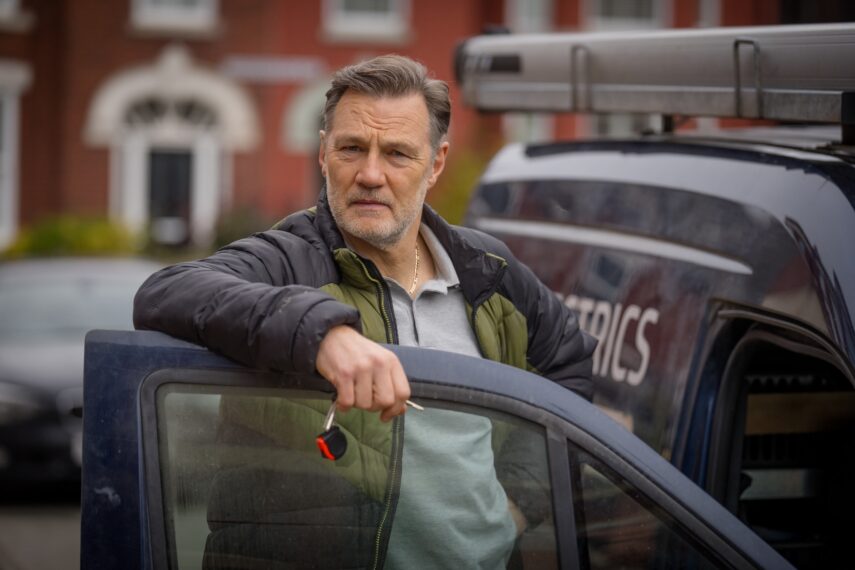
Clive doesn’t seem to believe in anything. He tells you what he doesn’t believe in. He doesn’t believe in COVID, he doesn’t believe in HIV, it’s all fake. He doesn’t trust institutions. What does he believe in? That lack of identity helps the hatred.
Absolutely, because it’s all unknown and fear-based. In a funny sort of way, I feel like he and Leo could be quite good friends. I think probably in some of those chats they have, Clive is more intimate and reveals more about himself than he probably has done to anyone actually. Leo says in the last episode, “We get on quite well.” And of course you think, “No, you don’t,” but they actually have in a way had very intense, intimate talks together, so it’s just horrifying what might have been, and the way that it’s just this confluence of all these things that just go the way it does. But I think that happens.
This is obviously a fiction, and it’s quite a dramatic story, but this happens all the time. People are being lynched all over in America right now, Black people. And violence against queer people has so been on the increase in the last five or six years. So, it’s terrifying that we don’t have more shows like this talking about that and showing people, “Look what’s wrong. Look what’s happening to us. Let’s talk about this. Let’s maybe draw a line in the sand about the hateful rhetoric.”
Starz
I think it’s a very confronting series in an important way. Why do you feel it’s important to show Leo’s murder and in great detail?
Because it shows how things can spiral. Twenty minutes before that, he was in his living room eating a sausage roll and watching tele, and you go into this arena where people are fed misinformation and a machismo as a whole sort of awful combination of things.
The whole way we did it was to say, “Yeah, look at this. Actually look at this. Look how awful this is. Look at this behavior. Look how it spiraled.” Some of these people are good people and they have just been led along by agents of chaos and agents of misinformation and ignorance and violence, and it can happen anywhere, so it’s important. Oh my God, believe me, I find it so disturbing and I find it almost too much, but I think that’s the point because it is too much. It should be too much. It should be f***ing terrifying.
Tip Toe, Streaming now, Starz


