
Jackie, the beloved bald eagle who captivated millions of viewers through a 24/7 livestream at Big Bear Lake in Southern California, has died after a prolonged illness. The Ojai Raptor Center confirmed on Monday, August 11, 2026, that Jackie passed away in the early hours of the morning after more than three weeks of intensive medical treatment. She was approximately 14 years old.
The cause of Jackie’s death was severe, recurring anemia that veterinary specialists were never able to trace to a definitive underlying diagnosis. Despite receiving a life-saving blood transfusion, oxygen therapy, advanced CT imaging, a bone marrow biopsy, and around-the-clock monitoring, her packed cell volume (PCV), which measures the percentage of red blood cells in the bloodstream, fell to critically low levels in her final days. A healthy bald eagle typically has a PCV between 35% and 55%. Jackie’s dropped below 6% on her final Saturday.
Her death marks the end of a remarkable chapter in wildlife broadcasting and conservation. Jackie and her mate, Shadow, had become arguably the most closely followed wild animals on the internet, drawing over a million followers worldwide to the Big Bear Bald Eagle Nest Camera operated by the nonprofit Friends of Big Bear Valley (FOBBV).
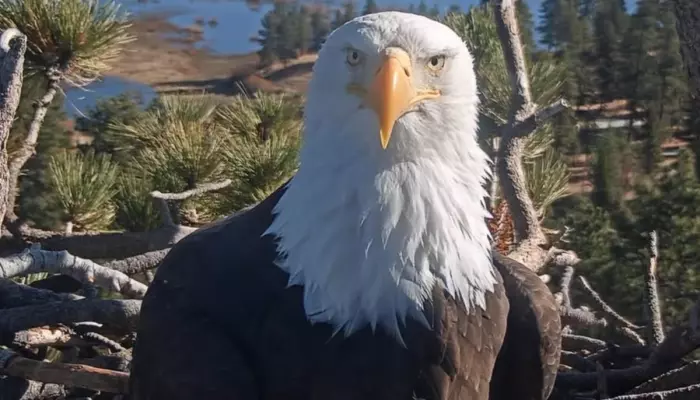
What Happened to Jackie the Big Bear Eagle
Jackie’s medical crisis began in mid-July 2026, when she was spotted on the north shore of Big Bear Lake engaged in a territorial confrontation with two juvenile bald eagles. Duke and Anne Blackwood, a couple who were on their dock near Dana Point Park on the afternoon of July 16, witnessed the altercation and recorded video of it.
The footage showed Jackie using her talons to fend off the younger birds. However, after the encounter, she was unable to fly and remained grounded. Rescuers from the Los Angeles County Department of Parks and Recreation’s San Dimas Raptor Rescue team retrieved her on July 18 and transported her to the Ojai Raptor Center in Ventura County.
Initial physical examinations revealed no broken bones or significant external injuries. However, bloodwork told a different story. Veterinary teams discovered that Jackie was suffering from severe anemia and inflammation affecting her kidneys. Her care team at the Ojai Raptor Center believes she was already sick before the territorial fight, and that her weakened condition is what left her vulnerable to the attack in the first place.
Jackie was admitted under the clinical designation “Patient 26-519,” in accordance with California Department of Fish and Wildlife and U.S. Fish and Wildlife Service regulations that require rehabilitation animals to be publicly referenced only by their intake number, common species name, or scientific name.
#BreakingNews: Big Bear’s beloved bald eagle Jackie has died after weeks of intensive care, the Ojai Raptor Center announced Monday. Jackie had been battling severe anemia after she was found unable to fly near Big Bear Lake. https://t.co/hUiWZ3u1e2 pic.twitter.com/6Pj1d2LhAj
— KTLA (@KTLA) August 10, 2026
The Medical Timeline: Jackie’s Three Weeks in Intensive Care
The following timeline documents the key medical developments during Jackie’s treatment at the Ojai Raptor Center.
July 16, 2026: Jackie is seen on the ground near Dana Point Park on Big Bear Lake’s north shore after a territorial encounter with two juvenile bald eagles. Witnesses video the altercation and report that she appears unwell.
July 18, 2026: Rescuers from the San Dimas Raptor Rescue team retrieve Jackie and transport her to the Ojai Raptor Center. Friends of Big Bear Valley initially cannot confirm whether the rescued eagle is Jackie because she is not banded, but after reviewing photos and videos, the nonprofit says it believes the bird is likely their beloved resident female.
July 21, 2026 (approx.): Jackie receives a life-saving blood transfusion from Spirit, a resident female bald eagle at the California Living Museum (CALM Zoo) in Bakersfield. The Ojai Raptor Center calls the procedure “one important milestone in her treatment.”
July 23, 2026: The Ojai Raptor Center rules out several possible causes of Jackie’s anemia, including lead poisoning, the presence of foreign objects such as fishing hooks, lines, and weights, and rodenticide exposure. Kidney inflammation appears to have improved.
July 27, 2026: Jackie shows encouraging signs of improvement. Her PCV rises from 8% (pre-transfusion low) to 16%. She begins eating on her own, becomes more alert, and is described by her care team as “feisty” during feedings.
Late July 2026: Jackie is moved out of the intensive care unit and into a regular hospital care unit. The Ojai Raptor Center notes this is encouraging but cautions she is not yet out of danger.
Early August 2026: Jackie’s bloodwork shows her PCV has improved to 17%, but the center says she remains a very sick patient with a long recovery road ahead. A definitive diagnosis has still not been determined.
August 4, 2026: The center drops Jackie’s PCV to 13%, signaling that her anemia has regressed following the earlier improvement. Advanced diagnostic testing, including a contrast CT scan and bone marrow biopsy, is ordered. The center also issues a public warning about AI-generated fake images and misinformation circulating about Jackie on social media.
August 7, 2026 (approx.): Jackie’s PCV falls below 10%. She is readmitted to the ICU. A second contrast CT scan and bone marrow biopsy provide additional findings, but specialized lab results remain pending. The center rules out cancer as a cause.
August 9, 2026: The Ojai Raptor Center describes the past 24 hours as “incredibly difficult.” Jackie’s PCV drops below 6%, a critically dangerous level. It recovers slightly to 9% the following day, but her overall condition is described as “unstable” and “extremely serious.”
August 11, 2026: Jackie dies in the early hours of Monday morning. The Ojai Raptor Center announces her passing, and her remains are transferred to the California Department of Fish and Wildlife.
Why the Veterinary Team Could Not Save Her
Despite having access to some of the best avian veterinary expertise in the country, the Ojai Raptor Center’s team was unable to identify the root cause of Jackie’s severe anemia. This was not for lack of effort. The center consulted with specialists across the United States throughout Jackie’s three-week stay, running a battery of tests that successfully ruled out many of the most common causes of anemia in raptors.
Tests confirmed that Jackie’s condition was not caused by lead toxicosis, a widespread problem among birds of prey that ingest lead ammunition fragments. The team also ruled out rodenticide poisoning (from ingesting prey that had consumed rat poison), the presence of ingested fishing gear, and cancer. Her kidney inflammation, which was identified early, appeared to improve during treatment.
What remained was a mystery: something was destroying Jackie’s red blood cells or preventing her body from producing new ones, and the veterinary team could not pinpoint what it was. Her PCV would improve after treatment, then crash again, following a pattern of recovery and relapse that ultimately proved fatal.
The Ojai Raptor Center emphasized throughout that every medical decision was guided by available evidence, Jackie’s welfare, and the center’s responsibility to act in her best interest.
Who Was Jackie? The Background Story
Jackie’s story is inseparable from the story of Big Bear Valley’s bald eagle population and the technology that brought their lives to a global audience.
Bald eagles historically only wintered in Big Bear Valley to access food sources, including waterfowl and fish, that were unavailable at frozen lakes farther north. In 2012, the first bald eagle chick in recorded history hatched in the valley and was successfully raised to fledge, marking a turning point for the local eagle population.
Jackie was believed to be a daughter of Ricky and Lucy, the first nesting pair tracked at the site. After her parents disappeared, Jackie took over the nest around 2016 and initially paired with a male eagle known as Mr. B. Together, they produced two chicks: Big Bear Baby (BBB), who tragically died during a severe rainstorm at six and a half weeks old, and Stormy, who successfully fledged.
In the summer of 2018, a new male eagle arrived and challenged Mr. B for the nest and for Jackie. That eagle was Shadow. He won, and the pair bonded. Their partnership would become one of the most closely watched wildlife relationships on the internet.
Jackie and Shadow’s nesting history together included both triumphs and heartbreak:
- 2019: Their first eaglets together, Simba and Cookie, hatched. Cookie died in May, but Simba fledged successfully in July.
- 2020-2021: Eggs were laid but did not hatch.
- 2022: Spirit hatched in March and fledged in May.
- 2023-2024: Both seasons were unsuccessful, with no eggs hatching.
- 2025: Three eggs hatched in early March. One chick died during a storm that dropped two feet of snow on the area. The surviving eaglets, Sunny and Gizmo, were named through a contest at Big Bear Elementary School that drew over 54,000 submissions. Both fledged in June.
- 2026: Jackie laid two eggs in late January, but ravens attacked and destroyed both on January 30 while the parents were away from the nest. Jackie and Shadow did not give up. Jackie laid a new clutch (two eggs, on February 24 and 27), and two eaglets, Sandy and Luna, hatched in early April. Both fledged by late June.
In total, Jackie and Shadow successfully raised six eaglets to fledging over their years together.
The Eagle Nest Camera and Its Global Audience
The Big Bear Bald Eagle Nest Camera, operated by Friends of Big Bear Valley, was first installed in the fall of 2015 and recorded its first nesting season in 2017. A second, wider-view camera was added in 2021. Both are solar-powered and engineered to be safe for wildlife and the environment.
The cameras sit approximately 145 feet up a Jeffrey pine tree, giving viewers a direct look into the nest and the surrounding territory. The livestream runs 24 hours a day, 365 days a year, and is available for free through YouTube and the FOBBV website.
The Los Angeles Times identified the Big Bear Eagle Nest Camera as the most-viewed year-round nature livestream on YouTube. At any given time during nesting season, thousands of viewers watch simultaneously, and FOBBV’s team of dedicated volunteer eagle observers monitors the stream around the clock, posting daily recaps, identification logs, and educational content.
The camera turned Jackie and Shadow into global celebrities of a kind unique to the internet age. Viewers did not just watch them. They became emotionally invested, celebrating hatches, mourning losses, naming eaglets, and following every feeding, storm, and territorial skirmish in real time. When Jackie was rescued in July 2026, fans around the world followed her medical updates with the intensity normally reserved for human celebrities.
Also Read | Michal Szymanski Juno Temple Husband Background and Quiet Wedding
The Misinformation Challenge: AI Fakes and Social Media Pressure
Jackie’s medical crisis coincided with a troubling modern phenomenon. As her story gained international attention, AI-generated images purporting to show her circulated on social media alongside false rumors about her condition and accusations directed at the Ojai Raptor Center.
On August 4, the center issued a formal public warning. It posted a side-by-side comparison of a real photograph of Jackie and an AI-generated fake image, labeling the latter “AI Fake.” The center wrote that AI tools can now produce photographs, videos, and articles that look authentic but are entirely fabricated, and that rumors were being accepted as fact before accurate information could be shared.
Staff members were also dealing with constant requests for information, repeated phone calls, messages sent to personal social media accounts, and even contact at their homes. The center said these interruptions were creating “significant distractions for the very people whose attention needs to remain on patient care.”
This situation highlighted a growing tension in wildlife conservation in the social media age. Public interest and emotional investment, while often positive forces for conservation funding and awareness, can also generate pressure, misinformation, and hostility that actively hinders the work of rehabilitation professionals.
What Happens to Shadow and the Eaglets Now
Shadow, Jackie’s mate of seven years, was observed by FOBBV volunteers maintaining his presence at the Big Bear nest throughout Jackie’s hospitalization. Sandy and Luna, the pair’s 2026 eaglets, fledged in late June and had dispersed from the nest area by late July, which is typical behavior for young eagles learning to hunt and survive independently.
Bald eagles are documented to re-mate after the death or disappearance of a long-term partner. Whether Shadow will attract a new mate and continue using the Big Bear nest remains an open question that FOBBV and local wildlife biologists will monitor in the coming months and into the next nesting season.
The Friends of Big Bear Valley cameras remain active, and Shadow’s movements continue to be tracked by the organization’s volunteer observers.
Why Jackie’s Story Matters: Conservation and Community
Jackie’s life and death carry significance that extends beyond one eagle.
A Conservation Success Story, With Caveats: Bald eagles were removed from the U.S. endangered species list in 2007 after a dramatic recovery from a low of just 417 known nesting pairs in 1963. By 2021, the U.S. Fish and Wildlife Service estimated more than 316,700 individual bald eagles in the lower 48 states, including over 71,400 breeding pairs. Jackie’s presence at Big Bear Lake was a living symbol of that recovery. However, her death at approximately 14 years old, when bald eagles in the wild can live 20 to 30 years, underscores that individual birds still face serious threats, including mystery illnesses that can stump even the best veterinary teams.
Habitat Protection Achieved in Her Name: Just weeks before Jackie’s death, FOBBV and the San Bernardino Mountains Land Trust announced they had raised the full $10 million needed to purchase Moon Camp, a 63-acre stretch of forested shoreline on Big Bear Lake that was slated for a luxury housing development of 50 custom homes and a marina. More than 25,000 individual donors contributed nearly half the total, and a $5.5 million donation from Anna and Greg Brockman (Greg Brockman is the co-founder and president of OpenAI) pushed the campaign over the finish line. The land will be permanently protected, preserving critical foraging and perching habitat for bald eagles and other wildlife. The decades-long effort to save Moon Camp was championed by Sandy Steers, the longtime executive director of FOBBV, who passed away in February 2026 before seeing the goal reached.
Continued Legacy of Sandy Steers: The preservation of Moon Camp was Steers’ life’s work and main priority before her death. Her colleagues and community members continued the fight in her memory. The successful campaign represents not only a victory for eagle conservation but a tribute to grassroots environmental advocacy sustained over more than two decades.
A Model for Public Engagement in Wildlife: Jackie’s story demonstrated the extraordinary potential of wildlife livestreaming to build public connection with conservation. Millions of people who may never visit Big Bear Lake felt a personal bond with Jackie and Shadow. That bond translated into real conservation dollars when it mattered most. It also, as the AI misinformation episode showed, introduced new challenges that wildlife organizations will need to navigate going forward.
Expert Commentary: Understanding Bald Eagle Anemia
Anemia in bald eagles, a condition in which the body lacks enough healthy red blood cells to carry oxygen to tissues, can be caused by a range of factors. These include lead poisoning (from ingesting ammunition fragments in prey), rodenticide exposure, blood parasites, viral infections, autoimmune conditions, and organ failure.
In Jackie’s case, the most common causes were systematically ruled out through testing. Lead toxicosis, rodenticide, fishing gear ingestion, and cancer were all eliminated. This left the veterinary team working against a condition that defied easy categorization, a scenario that, while uncommon, is not unheard of in raptor rehabilitation.
Packed cell volume is the standard metric used to assess anemia in birds. A healthy bald eagle typically has a PCV between 35% and 55%. Jackie’s PCV fluctuated dramatically during her treatment, from a low of approximately 8% before her blood transfusion, up to 17% during her period of improvement, and eventually crashing below 6% in her final days.
Blood transfusions in raptors are complex procedures that require a compatible donor bird. Jackie’s transfusion was made possible by Spirit, a resident bald eagle at CALM Zoo in Bakersfield, and was described by the Ojai Raptor Center as a life-saving intervention. However, transfusions treat the symptoms of anemia rather than the underlying cause, and without identifying and resolving that cause, the improvement was temporary.
Interesting Facts About Jackie and the Big Bear Eagles
- The Big Bear eagle nest sits more than a mile above sea level in the San Bernardino Mountains, making it one of the highest-altitude bald eagle nests in Southern California.
- Jackie was not banded, which initially made it difficult for rescuers to confirm her identity when she was found grounded in July 2026. FOBBV relied on photos and video comparisons to confirm it was likely her.
- Bald eagles do not develop their distinctive white head and tail feathers until they are 4 to 5 years old. Before then, they are dark brown throughout, which is why juvenile bald eagles are frequently mistaken for other species.
- The Big Bear Valley is recognized as the seventh most biologically diverse ecosystem in the country, home to rare and endangered plant species found nowhere else.
- The Big Bear eagle camera was the first U.S. bald eagle nest camera installed at altitude, and FOBBV describes it as specifically engineered to have zero impact on the eagles or their environment.
- The 54,000 naming submissions for the 2025 eaglets (Sunny and Gizmo) came through a contest held at Big Bear Elementary School, reflecting the deep connection between the eagles and the local community.
Frequently Asked Questions
What was Jackie the Big Bear eagle’s cause of death?
Jackie died of severe, recurring anemia. Her packed cell volume dropped to critically low levels despite receiving a blood transfusion, oxygen therapy, and around-the-clock intensive care at the Ojai Raptor Center. The underlying cause of the anemia was never definitively identified, though common causes including lead poisoning, rodenticide, fishing gear ingestion, and cancer were all ruled out.
When did Jackie the Big Bear eagle die?
Jackie died in the early hours of Monday, August 11, 2026, at the Ojai Raptor Center in Ventura County, California. She had been receiving intensive medical care for more than three weeks.
How old was Jackie the Big Bear eagle?
Jackie was believed to be approximately 14 years old at the time of her death. In the wild, bald eagles typically live 20 to 30 years, though some have been documented living to 38.
What happened to Jackie before she was taken to the Ojai Raptor Center?
On July 16, 2026, Jackie was involved in a territorial confrontation with two juvenile bald eagles near Dana Point Park on the north shore of Big Bear Lake. The encounter left her grounded and unable to fly. She was rescued on July 18 by the San Dimas Raptor Rescue team. While she had no significant physical injuries from the fight, bloodwork revealed severe anemia and kidney inflammation. Veterinarians believe she was already ill before the altercation, which is why she was vulnerable to the attack.
What is Shadow the eagle doing now?
Shadow, Jackie’s mate since 2018, was observed maintaining his presence at the Big Bear nest throughout Jackie’s hospitalization. Bald eagles are known to re-mate after the loss of a partner, and wildlife biologists will monitor whether Shadow attracts a new mate in the coming nesting season. FOBBV’s cameras remain active.
What happened to Jackie and Shadow’s 2026 eaglets?
Jackie and Shadow’s 2026 eaglets, Sandy and Luna, successfully fledged (took their first flights) in late June 2026. They had dispersed from the nest area by late July, which is normal for young bald eagles learning independence.
What is the Moon Camp conservation effort?
In mid-2026, Friends of Big Bear Valley and the San Bernardino Mountains Land Trust raised $10 million to purchase Moon Camp, a 63-acre property on Big Bear Lake that was planned for a 50-home luxury housing development. The purchase permanently protects critical bald eagle habitat. More than 25,000 donors contributed, and a $5.5 million donation from Anna and Greg Brockman (co-founder of OpenAI) completed the fundraising.
Where can I watch the Big Bear eagle nest camera?
The Big Bear Bald Eagle Nest Camera is operated by Friends of Big Bear Valley and streams 24/7 on YouTube and at friendsofbigbearvalley.org. The nonprofit also publishes daily recaps and educational content about the eagles.
Also Read | “Keffe D” Davis: Tupac Shakur Murder Trial Details, Evidence, Timeline and Witnesses
Last Updated on August 11, 2026 by 247 News Around The World

