
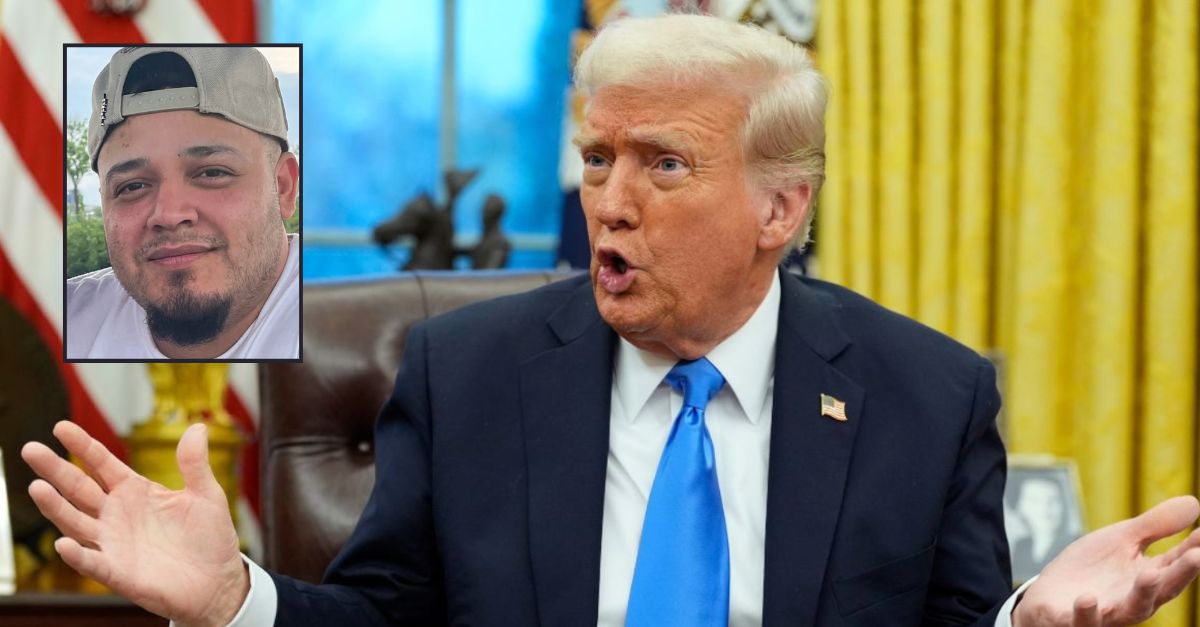
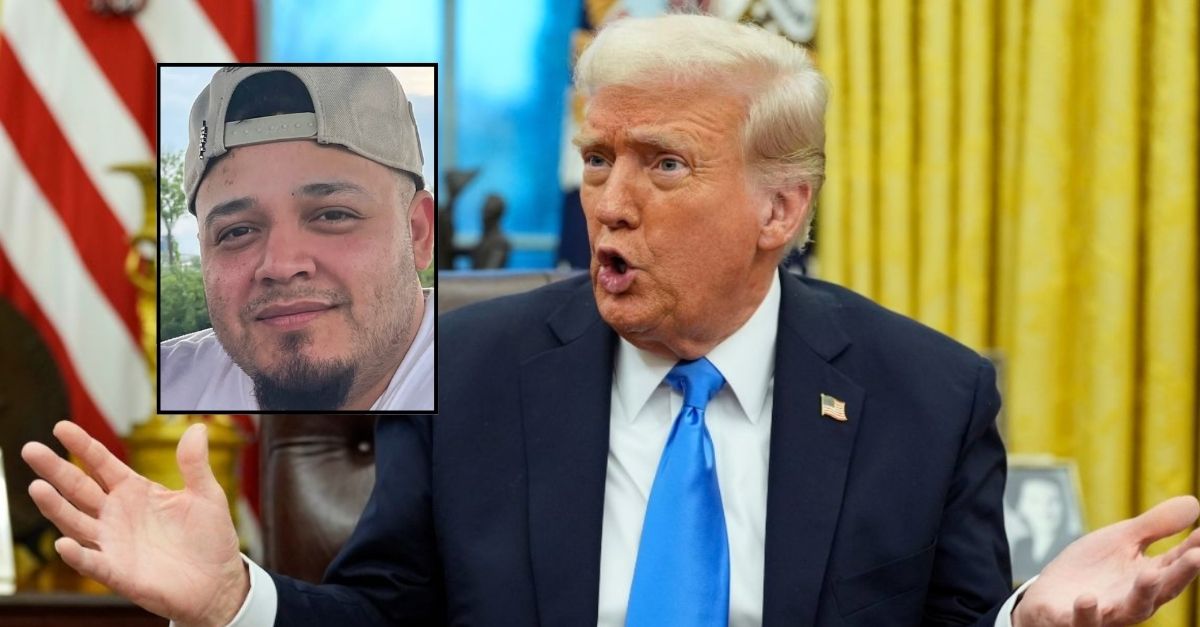
Inset: Kilmar Abrego Garcia in an undated photo (CASA). Background: President Donald Trump speaks with reporters in the Oval Office at the White House, Tuesday, Feb. 11, 2025, in Washington, D.C. (Photo/Alex Brandon).
A Maryland federal judge handling the civil case of wrongly deported Salvadoran citizen Kilmar Abrego Garcia ordered his “immediate release from ICE custody” Thursday, slamming the Trump administration for holding him “without lawful authority,” “affirmatively” misleading the court on Costa Rica”s willingness to accept him as a refugee, and concluding an order for his removal from the U.S. does not exist.
U.S. District Judge Paula Xinis granted Abrego Garcia’s petition for release, noting he will remain subject to the conditions he faces in a criminal human smuggling case in Tennessee, a prosecution that the defendant claims was vindictively brought because his civil case brought embarrassment upon the U.S. government.
Xinis, a Barack Obama appointee, in a 31-page opinion explained that the “basic fact” she had to decide was whether there actually was a removal order under the Immigration and Nationality Act that justified Abrego Garcia’s deportation to a third country — that is, a country where he is not a citizen.
The judge found that “no such [removal] order exists for Abrego Garcia” and that the federal defendants, DHS Secretary Kristi Noem, ICE, and U.S. Attorney General Pam Bondi, “never produced an order of removal despite Abrego Garcia hinging much of his jurisdictional and legal arguments on its non-existence.”
In this case, the government floated its intentions to deport Abrego Garcia to African countries, whether Uganda, Eswatini, Ghana, or Liberia, even as the plaintiff — wrongfully removed to a notorious prison in El Salvador earlier this year and then returned to the U.S. to face criminal charges — expressed a willingness to self-deport to Costa Rica.
A significant portion of Xinis’ ruling focused on the Trump administration’s refusal to send Abrego Garcia to Costa Rica, despite Costa Rica’s own stated willingness to accept him as a refugee.
The judge began by pointing out that, during an Oct. 10 evidentiary hearing, Deputy Assistant Director of ICE Enforcement and Removal Operations John Schultz — “[c]ontrary to the Court’s order” — was “not prepared at all to discuss Costa Rica’s offer to accept Abrego Garcia as a refugee.”
Love true crime? Sign up for our newsletter, The Law&Crime Docket, to get the latest real-life crime stories delivered right to your inbox.
And yet, in November, the Trump administration “[o]ddly” filed court documents under seal claiming that Costa Rica had reversed course on this stance, in a declaration from ICE Acting Assistant Director for the Removal Division Johnathan Cantú.
Once Cantú was put on the witness stand on Nov. 20, the judge said, “it became evident that once again, Respondents defied this Court’s orders.”
“They simply refused to prepare and produce a witness with knowledge to testify in any meaningful way,” the judge said. “Cantú candidly admitted, for example, that he had no prior involvement in Abrego Garcia’s case and spent approximately five minutes preparing to testify.”
“Then at the hearing, Respondents showcased Cantú’s ignorance about the content of his Declaration pertaining to Costa Rica. As the pointed questions of Respondents’ counsel made clear, Cantú’s lack of knowledge was planned and purposeful,” Xinis added.
Just one day after Cantú’s testimony, Costa Rica’s Minister of Public Security Mario Zamora Cordero confirmed to the Washington Post that there was no 180 — and the judge took note.
“Ultimately, Respondents’ calculated effort to take Costa Rica ‘off the table’ backfired,” Xinis summarized. “Within 24 hours, Costa Rica, through Minister Zamora Cordero, communicated to multiple news sources that its offer to grant Abrego Garcia residence and refugee status is, and always has been, firm, unwavering, and unconditional.”
The judge interpreted this series of events as no mere stonewall, but the government “affirmatively” misleading the court through “misrepresentation,” crediting the plaintiff’s claims that the Trump administration lied about Costa Rica as a removal option to instead try to send him to Liberia.
“This time, when the Court sought information about Liberia and Costa Rica so to fairly assess the validity of Abrego Garcia’s claims, Respondents did not just stonewall. They affirmatively misled the tribunal. They announced that Liberia is the only viable removal option because Costa Rica ‘does not wish to receive him,’ and that Costa Rica will no longer ‘accept the transfer’ of him,'” the court said.
“But Costa Rica had never wavered in its commitment to receive Abrego Garcia, just as Abrego Garcia never wavered in his commitment to resettle there,” Xinis went on.
Taken together, the judge said, the government’s conduct ran counter to the notion that ICE detention was necessary and warranted to swiftly effect Abrego Garcia’s removal to a third country.
“Respondents’ persistent refusal to acknowledge Costa Rica as a viable removal option, their threats to send Abrego Garcia to African countries that never agreed to take him, and their misrepresentation to the Court that Liberia is now the only country available to Abrego Garcia, all reflect that whatever purpose was behind his detention, it was not for the ‘basic purpose’ of timely third-country removal,” Xinis concluded, ordering Abrego Garcia’s “immediate release” from ICE custody.
Read the whole opinion here.


