
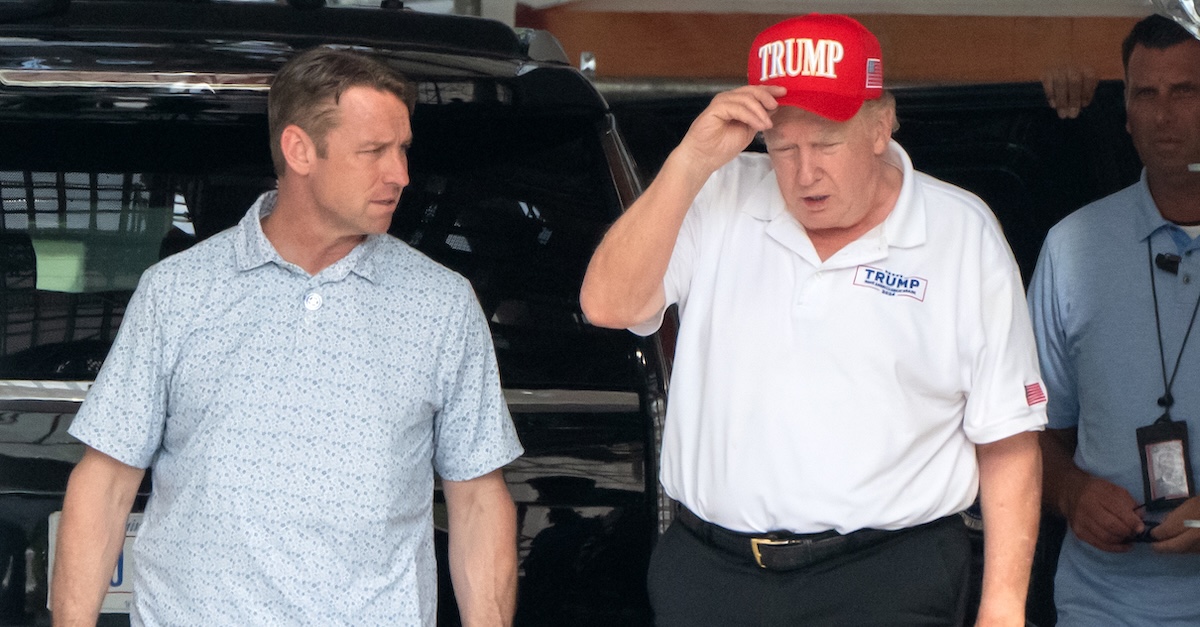
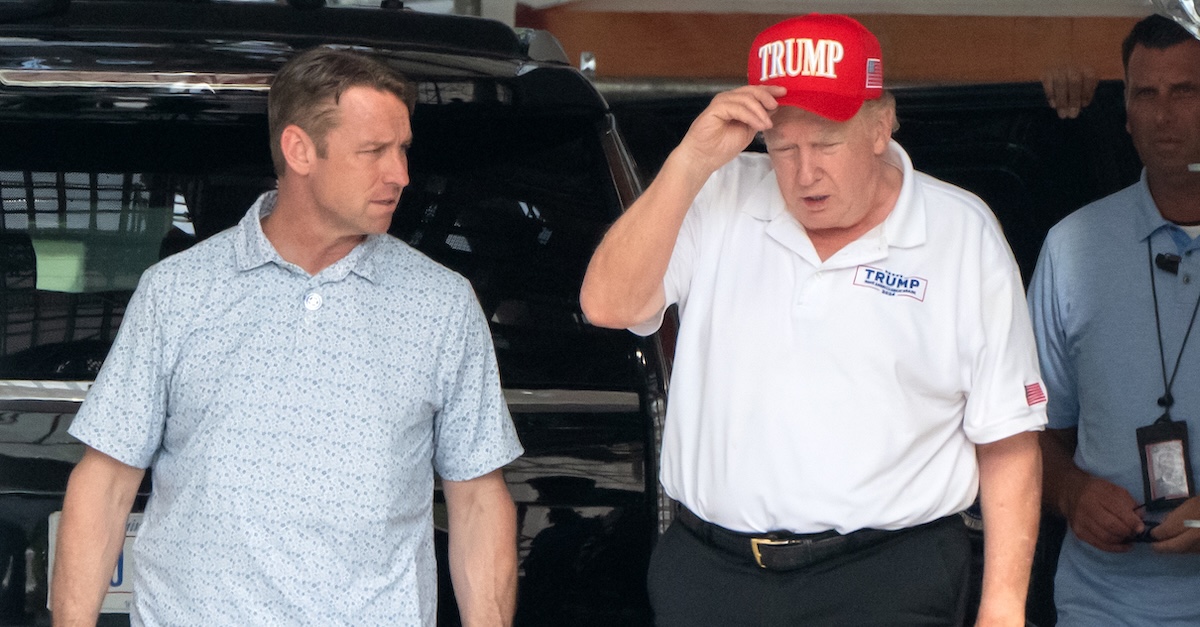
President Donald Trump, right, walks at the North Portico of the White House, Saturday, July 11, 2026, in Washington (AP Photo/Mark Schiefelbein).
A federal judge found Monday that President Donald Trump”s private lawyers and high-ranking attorneys within his administration were all involved in a “non-adversarial, collusive” lawsuit to improperly force the IRS into a $1.776 billion “settlement” that “had no viable basis in law or fact.” And in the case of one attorney, it meant a referral to the Florida Bar for potential discipline.
In late May, 35 former federal judges asked U.S. District Judge Kathleen Williams to “reopen” the civil lawsuit that Trump brought against the IRS. Trump had moved to voluntarily dismiss the lawsuit just when it seemed Williams — a Barack Obama appointee who has also overseen cases involving the “Alligator Alcatraz” detention facility — might rule that there was no case or controversy before her.
Williams had reasoned that the two parties, Trump and the government he heads, were on the same side when it came to the $1.776 billion “Anti-Weaponization Fund” for the president’s allies and tax probe immunity for his family.
On Monday, Williams wrote that it was “risible to suggest that there was ever adverseness between the Parties,” and that the lawsuit was plainly brought for an “improper purpose,” just like Trump’s failed, “frivolous,” and costly RICO lawsuit against Hillary Clinton.
“The Parties here are not private actors to a mine-run dispute, recounting their proficiency in the art of the deal they negotiated. Lead Plaintiff and Defendants are public servants—the pinnacle of the Executive Branch—sworn to uphold the law, faithfully perform the duties of their office, and protect the interests of the American public. The issue before the Court is whether, instead, they ignored ethical norms, court rules, and legal authority to manipulate the judicial process. The issue is whether they did so to gild their efforts to gain unprecedented access to the public fisc with the patina of legitimacy,” the judge said.
For Williams, the monthslong “silent docket” on the government’s end spoke volumes. The DOJ, led by Acting Attorney General Todd Blanche, “never appeared, never challenged Plaintiffs’ claims, and never filed a single pleading” even though there were lines of attack.
“And while it is true that President Trump had a legal right to bring a suit for the unlawful disclosure, any remedy would be circumscribed by the legal guardrails applicable to all litigants: the statute of limitations, naming the appropriate defendant, and pleading special recoverable damages. Notably, had President Trump (and his then-lawyers Alina Habba and Todd Blanche) brought this lawsuit in a timely fashion while he was a private citizen, this litigation understandably might have been resolved in a 109-day time span,” the judge wrote. “But that is not what happened. Instead, President Trump did not pursue his claims until he once again occupied the White House and had appointed his former lawyer, and the former lawyer of persons who are putative beneficiaries of the ‘Anti-Weaponization Fund’ to prominent positions in the DOJ. These officials then negotiated on behalf of the United States, with his current lawyers, including his former White House Counsel to reach a ‘settlement.'”
Williams’ order arrives at a pivotal moment as Blanche’s confirmation as attorney general is at stake this week. The judge ordered the clerk to mail a copy of the order to the State Bar of New York, where Blanche faces an ethics investigation. She ordered the same in Washington, D.C., for Associate Attorney General Stanley Woodward, a former Mar-a-Lago case lawyer like Blanche and also a defense attorney for Jan. 6 defendants; both lawyers signed the “settlement” agreement.
“Ultimately, the DOJ has endeavored to justify its position to create the appearance of a case or controversy ‘resolved’ under the aegis of the Court. But the Parties, most of whom are government actors, did not engage in any public discussion or judicial review regarding their ‘unusual’ arrangement and whether they were legally adverse; indeed, they actively avoided such an undertaking,” Williams said, before turning her attention to Trump’s private lawyers Alejandro Brito and Daniel Z. Epstein.
Brito, already representing Trump in defamation lawsuits against the BBC, New York Times, and the Wall Street Journal in Florida, was referred to the Florida Bar as a sanction.
Pointing out that million-dollar “deterrent” sanctions under Rule 11 in the Clinton RICO suit didn’t stop Trump from “cynically” using another federal lawsuit to “achieve a predetermined outcome,” the judge hit Brito where it arguably hurts an attorney the most, referring him to the bar for “its consideration, review, and determination as to whether any disciplinary action is appropriate in light of the findings and rulings made in this Order.”
Law&Crime reached out to Brito for comment, but he did not immediately reply.
As for Epstein, a “former White House Senior Associate Counsel and Special Assistant to President Trump from 2017 until 2020,” Williams ordered that he won’t be granted pro hac vice permission to appear in the Southern District of Florida for “one year or until further order of this Court.”
“Notably, Mr. Epstein was never counsel of record in this case; the Complaint’s signature block identified him as counsel for Plaintiffs but represented that his pro hac vice application was ‘forthcoming.’ Since no such application was filed with the Court, and since, in other matters pending in Florida and elsewhere, Mr. Epstein sought pro hac admission within weeks of filing the complaint, the Court can only surmise that Mr. Epstein was aware that he would never need to appear and litigate the merits of Plaintiffs’ claims,” Williams sharply stated.
A spokesman from Trump’s legal team issued a statement saying the president “continues to hold those who wrong America and Americans accountable.”
“The IRS wrongly allowed a rogue, politically-motivated employee to leak private and confidential information about President Trump, his family, and the Trump Organization to the New York Times, ProPublica and other left-wing news outlets, which was then illegally released to millions of people,” the statement said.


