
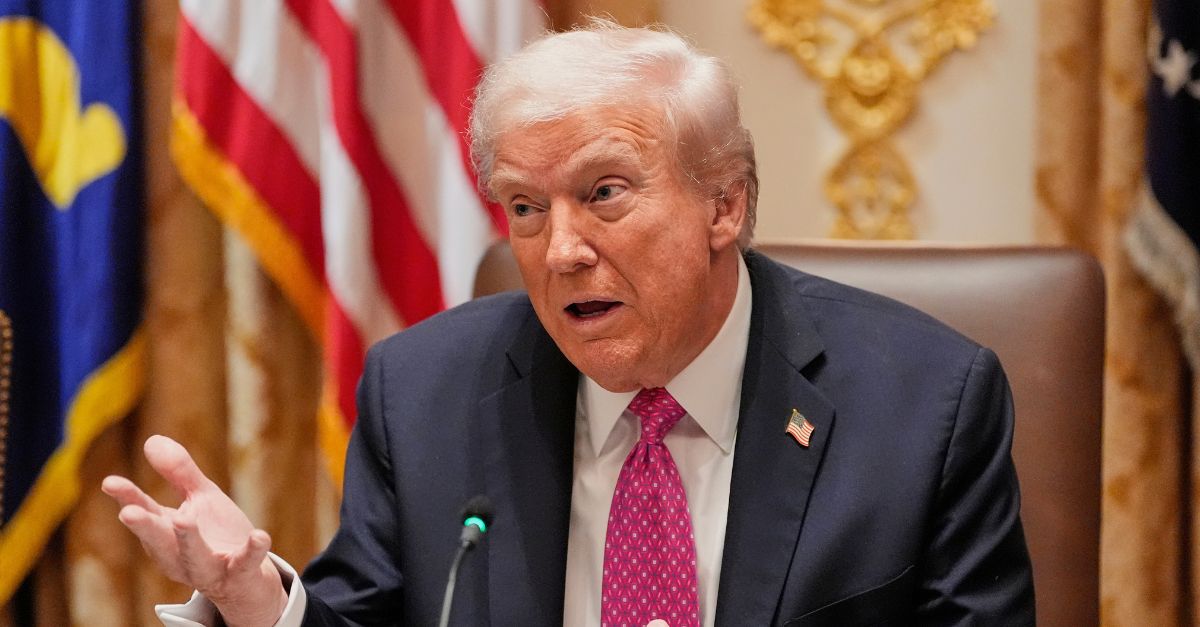
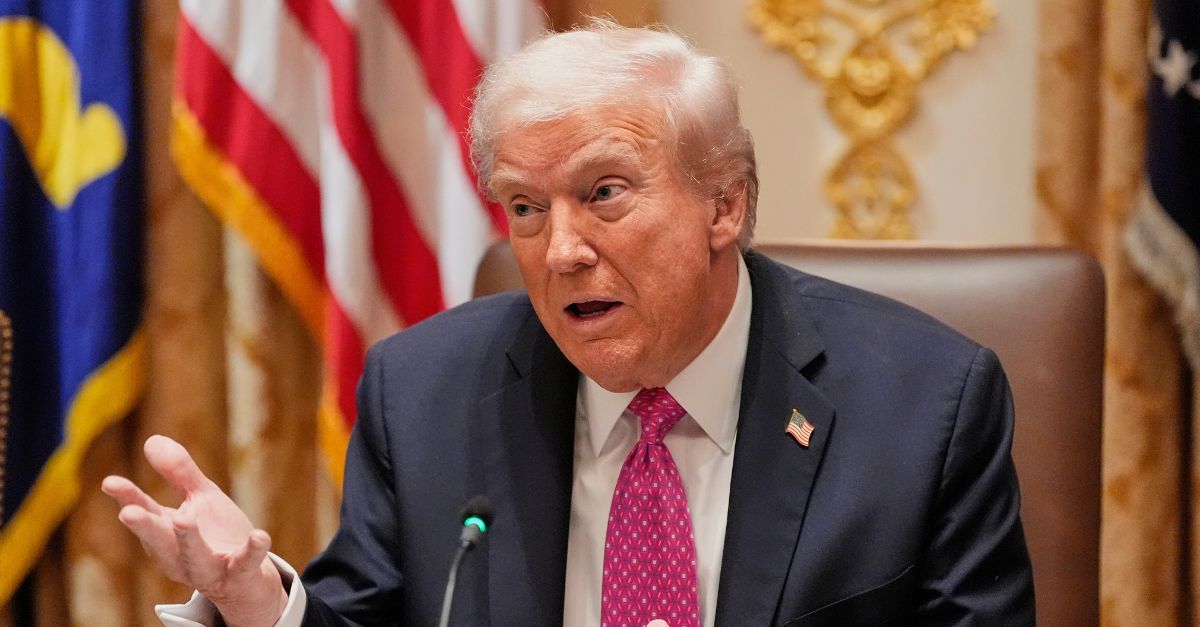
President Donald Trump speaks in the Cabinet Room of the White House, Friday, Oct. 17, 2025, in Washington (AP Photo/Alex Brandon).
The Trump administration is yet again “unlawfully” trying to impose a tariffs regime that will result in harm and “unnecessary additional costs” for U.S. businesses, a lawsuit filed Friday alleges.
In April, the U.S. Supreme Court ruled that President Donald Trump had no authority to impose tariffs under the International Emergency Economic Powers Act (IEEPA). Undeterred, the 45th and 47th president quickly issued new tariffs under Section 122 of the Trade Act of 1974 – which are statutorily limited to 150 days in duration.
The end date for that 150-day timeline is July 24. This week, Trump announced a third iteration of tariffs – under Section 301 of the Trade Act. Such tariffs are premised on allegations of foreign forced labor.
Now, small businesses say this tertiary effort is more of the same.
Love true crime? Sign up for our newsletter, The Law&Crime Docket, to get the latest real-life crime stories delivered right to your inbox.
“The sequence and structure of those measures, as well as Administration statements, show that the Section 301 Action was designed to preserve substantially the same broad tariff regime that this Court and the Supreme Court have held Congress did not authorize under IEEPA and Section 122,” the plaintiffs say in a 33-page complaint filed with the U.S. Court of International Trade.
The lawsuit alleges the 301 tariffs are a doomed-to-fail attempt to recreate the “sweeping” tariffs regime already twice rejected by the courts – noting that the new tranche of import duties was timed to go into effect just as the time-limited slate of tariffs expired.
“[T]he timing, scope, and rate structure of the final action, support the inference that the Section 301 tariffs, by design, replace the invalidated global tariff regime rather than constitute measures selected to obtain elimination of identified economy-specific practices,” the lawsuit goes on.
The plaintiffs say it was not only Trump’s own words that led to this conclusion – but also his foremost economic official.
From the complaint, at length:
Treasury Secretary Scott Bessent has insisted that these new policies will result in “virtually unchanged tariff revenue” following the Supreme Court’s IEEPA ruling and the impending expiration of the Section 122 surcharge, claiming that “the tariff rates are going to go back to exactly where they were” and projecting that “there’s going to be a de minimis decline in tariff revenue” in 2026 under the new Section 301 tariffs…
[The U.S. Trade Representative (USTR)] determined the tariff rates first—calibrated to replicate the invalidated IEEPA rates—and assembled economy-specific findings afterward to justify them. The Action’s coverage likewise tracks the value of U.S. imports rather than any explained distinction in the forced-labor-import practices of covered and noncovered economies: USTR selected 60 economies collectively accounting for approximately 99.4 percent of U.S. imports by value, without explaining why trade volume bears on whether an economy’s alleged practices warrant tariffs or whether those tariffs would eliminate those practices.
The plaintiffs, a spice importer and high-end watch importer, say the statute being cited by the Trump administration simply does not do – and is not meant for – what the government claims.
“Section 301 is a targeted, country-specific and practice-specific remedial authority,” the filing goes on. “It permits the Trade Representative to act only upon a determination that a particular act, policy, or practice of a foreign country is unreasonable or discriminatory and burdens or restricts United States commerce…It is not a freestanding authorization to tax substantially all imports from substantially all trading partners at rates selected to replicate the invalidated IEEPA tariff regime rather than to eliminate identified foreign practices.”
Moreover, the plaintiffs say, the Section 301 announcement fails even on its terms.
Again the filing, at length:
Defendants did not explain how near-uniform ad valorem duties of 10 to 12.5 percent on substantially all merchandise from approximately 60 economies—duties calibrated to restore the rate structure and preserve substantially the same tariff revenue from the invalidated IEEPA tariffs and expired Section 122 tariffs and imposed without regard to the distinct circumstances of each economy—are designed to eliminate any identified foreign practice. Instead, the Section 301 Action imposes a general import tax that Section 301 does not authorize.
The plaintiffs insist the new tariffs are “arbitrary and capricious” under the Administrative Procedure Act and are asking the business-specific court to certify a class of aggrieved businesses, set aside the tariffs, enjoin the enforcement and/or collection of import duties, and for refunds of any such duties already collected.
The post ‘Not a freestanding authorization to tax’: Trump’s latest tariffs are just as illegal as the ones SCOTUS ‘invalidated’ and another court must say so: Lawsuit first appeared on Law & Crime.


