

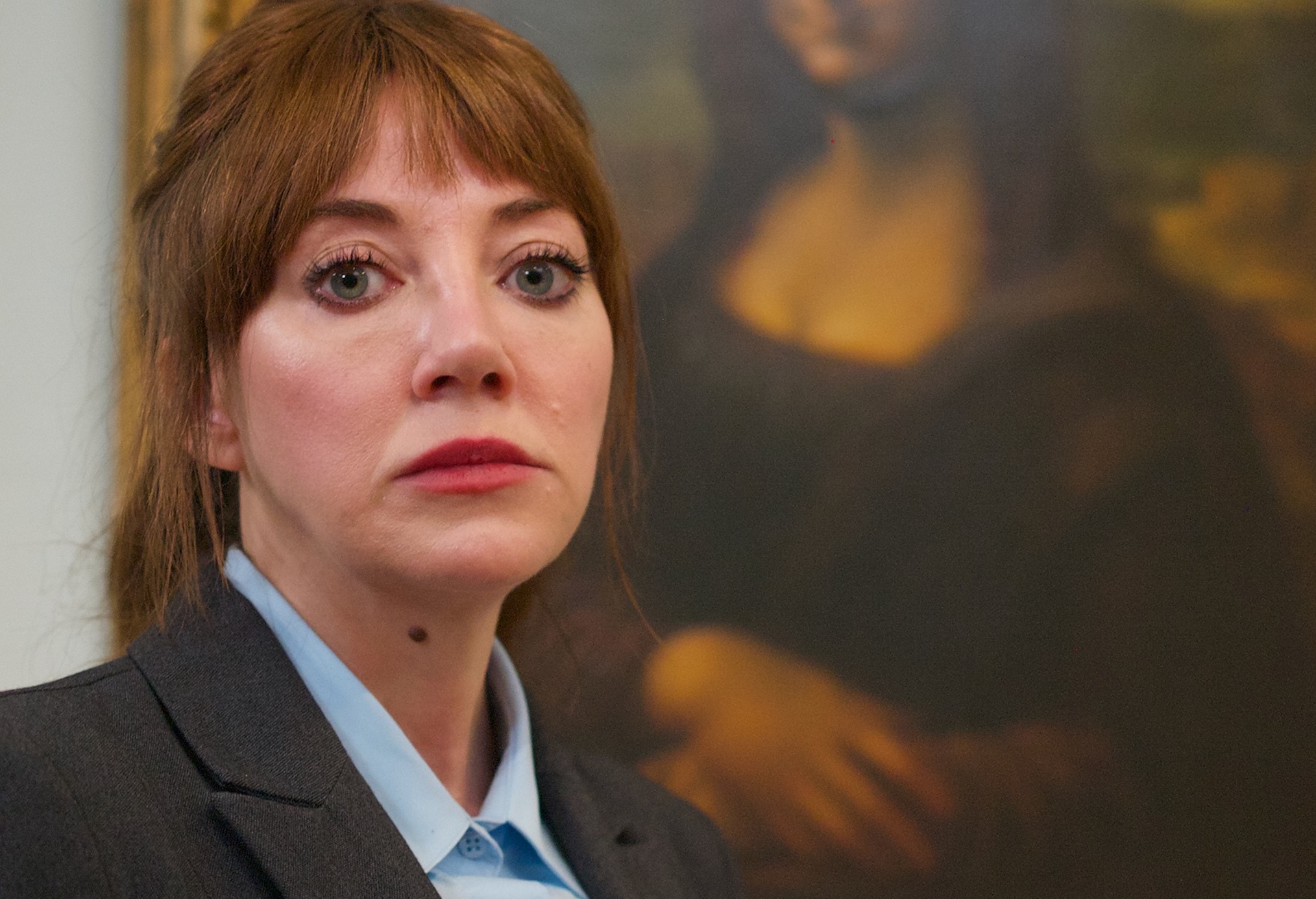
Philomena Cunk (Diane Morgan) has made a career out of asking some of the most absurd questions imaginable, usually to people who have spent their entire lives studying the subjects she knows absolutely nothing about.
Created by Charlie Brooker, the hilariously ill-informed investigative reporter has spent years confusing historians, academics, and other unsuspecting experts with bizarre questions, questionable historical facts, and a complete inability to recognize just how ridiculous she sounds. And she does it all without cracking a smile.
From Cunk on Britain and Cunk on Earth to Cunk on Life and the upcoming Cunk on Cinema, she’s tackled everything from the dawn of civilization to modern culture.
With that in mind, we’re looking back at some of Cunk’s most baffling, inappropriate, and downright WTF questions, along with the unfortunate experts who had to figure out how to answer them.
“What was the world like before Newton discovered gravity? Was everything just floating up to the sky?”
Cunk posed this question to mechanical engineer Dr. Shini Somara, who patiently explained, “Well, gravity was always there.” Naturally, Cunk had a follow-up observation: “So he just took the credit for it.”
“In medieval times, there were lots of paintings of Jesus. How did he find the time to pose for the artist? What was his availability like?”
While discussing medieval religious art with Professor Laura Ashe, Cunk raised an important scheduling question about Jesus and his apparent availability for portraits. “Well, he was everywhere, always,” Ashe responded. “Figuratively speaking.”
“How did Sir Walter Raleigh invent the potato?”
Cunk credited Sir Walter Raleigh with one of history’s greatest culinary achievements, but her expert wasn’t quite ready to give him the recognition. “He didn’t invent the potato,” responds Professor Ashley Jackson. “I don’t think anyone actually has ever invented a root vegetable because they’re obviously being cultivated and used by people living in the Americas.”
“Galileo’s full name really Galileo Figaro Magnifico, wasn’t it? That’s what it says in ‘Dominican Rhapsody.’”
Cunk turned to Queen’s “Bohemian Rhapsody” for a little historical context on the famous astronomer, apparently taking the song’s lyrics as biographical fact. Professor Jim Al-Khalili. wasn’t convinced, responding, “I’m not sure that’s right.”
“Why did they call World War I ‘World War I’? It’s quite pessimistic numbering, isn’t it? Or did they just know it was the start of a franchise?”
Cunk questioned the rather ominous branding of the First World War, wondering whether historians had already anticipated a sequel. Professor Ashley Jackson explained, “At the time they weren’t numbering the wars, although I think that in the First World War, the idea of it being a Great War denoting the sheer scale of the conflict, the, um, the casualty rate was already becoming used quite a lot.”
“What the f**k is this?”
While discussing the painting The Triumph of Death by the Flemish Renaissance master Pieter Bruegel the Elder with Professor Joanna Woodall of the Courtauld Institute of Art, Cunk dispensed with the usual academic analysis and simply asked, “What the f**k is this?”
“Which was more culturally significant: the Renaissance or ‘Single Ladies’ by Beyoncé?”
Honestly, a valid question. Even Martin Kemp, a professor emeritus of the history of art at the University of Oxford, admitted to being a member of the BeyHive. “They both have their period; they both have their time.”
“Have you heard of DNA? Do we all have DNA? Or do some of us have D or A, but not both?”
Cunk posed this question to theoretical physicist Professor Jim Al-Khalili during the Cunk on Life special. To his credit, he took the question seriously and answered professionally. She then asked whether he could tell just by looking at her if she had DNA, before launching into an absurd story about her “mate Paul” attempting to inject his own DNA into a grapefruit.
“How did being shot in the head affect Lincoln’s ability to lead?”
While discussing the presidency of Abraham Lincoln, Cunk posed the question to political scientist Dr. Brian Klaas, who responded, “Well, it ended it, because he died about 12 hours after he was shot.” Apparently needing further clarification, Cunk asked, “So, he couldn’t carry on?” to which Klaas replied, “No, not as a corpse, unfortunately.”
Cunk on Cinema, November 15, Netflix


