
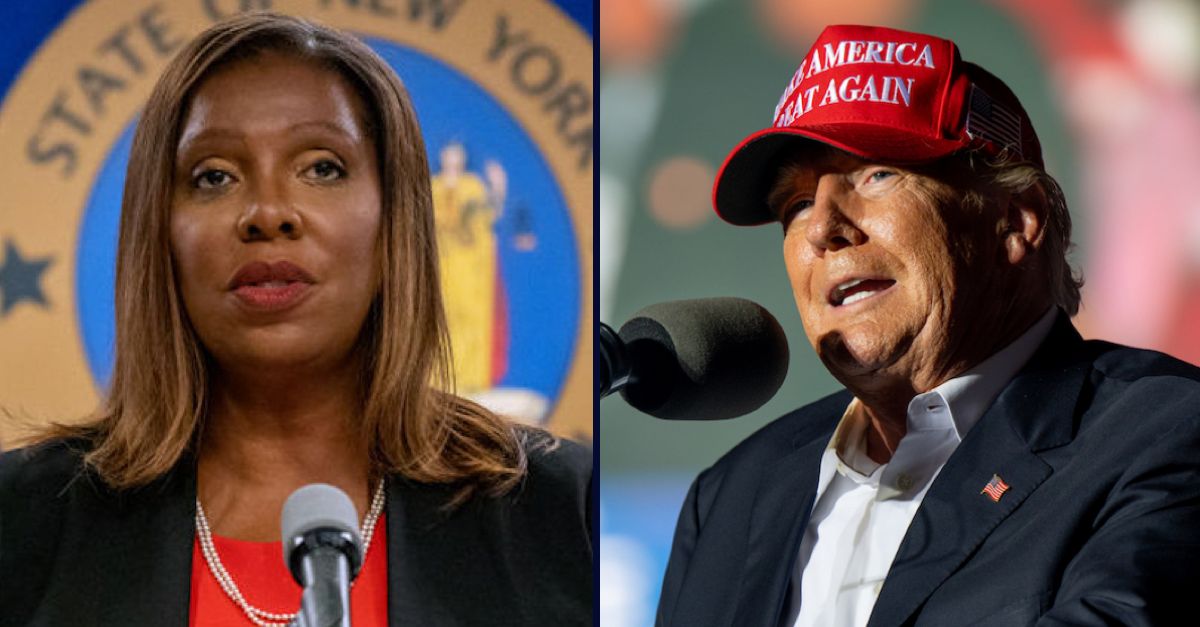
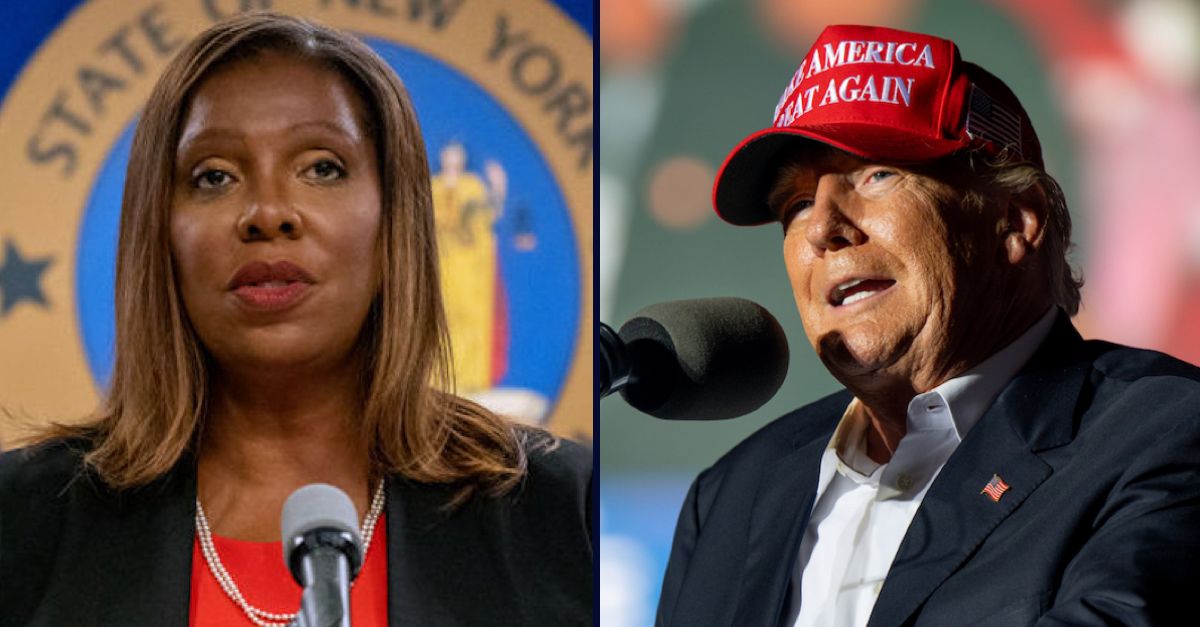
Left: New York Attorney General Letitia James speaks during a press conference regarding former US President Donald Trump and his family’s financial fraud case on September 21, 2022 in New York (photo by YUKI IWAMURA/AFP via Getty Images). Right: Donald Trump speaks at a ‘Save America’ rally on October 22, 2022 in Robstown, Texas (photo by Brandon Bell/Getty Images).
The Trump administration is unlawfully trying to cut “critical,” congressionally-approved renewable energy and infrastructure funding, a lawsuit filed in federal court on Wednesday alleges.
On the first day of his second term, President Donald Trump issued an executive order aimed at promoting the hydrocarbon industry and defunding renewable energy initiatives created under the Inflation Reduction Act (IRA) and Infrastructure Investment and Jobs Act (IIJA).
Since then, various agencies, including the Department of Energy (DOE) and the Office of Management and Budget (OMB) have worked to effectuate the executive order by “eliminating entire programs” created under those Biden-era laws, according to the litigation.
Now, in a 73-page lawsuit led in part by New York Attorney General Letitia James, several states say the government is violating the Constitution, federal law, and acting in excess of its authority.
The focus of the litigation is a list of projects marked for cuts by the DOE. The plaintiffs say the projects were first singled out in a March 2025 “kill list” and their elimination was formalized in a May 2025 memorandum “announcing that DOE would subject previously funded projects to a nebulous and opaque ‘review’ process.”
The government shutdown offered leverage for the Trump administration to finally put its plan into action, the plaintiffs say.
“In early October, as the Administration sought a cudgel to wield in budget negotiations, Defendants deployed this unlawful policy as an opportunistic way to hurt the Administration’s political enemies and those associated with them,” the complaint reads. “In addition to advancing this short-term goal, Defendants’ deployment of the DOE Memo advanced the core purpose articulated since Day 1 of the Trump Administration: the undermining and effective repeal of energy and infrastructure legislation.”
In real terms, the targeted grant funds run the gamut and include programs related to electric grid modernization, updating building codes, wind energy, solar energy, clean hydrogen energy, fuel cell and other vehicle technology development, decarbonization efforts, and various kinds of research funding, according to the lawsuit.
To hear the plaintiffs tell it, the funding cuts at issue are “arbitrary and capricious,” a term of art sourced from the Administrative Procedure Act (APA) which refers to agency actions that go too far while simultaneously eschewing formal, mandatory processes.
First, the plaintiffs say the DOE memo “is irreconcilable with the statutory directives” in the relevant laws passed by Congress because it relies on “vague and unexplained references” to policies which are not once mentioned in the laws in question. The lawsuit secondarily argues the memo relies on standards for which neither DOE nor OMB provided “reasoned or reasonable explanations.”
“Third, the DOE Memo’s vague and opaque criteria created the opportunity for the Administration’s unjustifiably partisan plan to punish Blue States through DOE’s rushed and chaotic termination of statutorily mandated programs,” the filing goes on. “This type of biased agency action is ‘precisely the type of agency action that would’ result in a violation of the arbitrary and capricious standard.”
The plaintiffs say the abrupt funding cuts have resulted in construction and research being halted in the middle of projects, forced layoffs, and states left without the ability to continue infrastructure updates.
At the heart of the matter are the twin issues of long-term affordability and reliability, the states say.
“Americans from coast to coast are feeling the impacts of rising utility bills and strained energy grids,” James said in a press release. “Instead of lowering costs and strengthening our infrastructure, this administration is actively sabotaging investments in our communities. As much as this administration may want to punish states it disagrees with, Congress holds the power of the purse. New Yorkers and all Americans deserve relief from crushing costs and confidence that their jobs will not be eliminated on a political whim.”
The lawsuit strikes a blow for the separation of powers, at length:
In our constitutional system, only Congress has the power to appropriate funding, and to define if and how federal programs are administered. It is the President’s duty, after that legislation is signed by the Executive, to execute those laws. He has no power to undo them, whether piecemeal or in their entirety. Indeed, the President’s authority is at its lowest ebb when he acts in direct contravention of express congressional authority. Here, Defendants set out to eliminate congressionally authorized programs and to unilaterally rescind appropriations associated with what the Administration derided as the “Green New Scam.” The DOE Memo provided a convenient and opaque mechanism for executing that plan.
“The plan violated the Constitution and the Administrative Procedure Act in numerous respects,” the filing goes on. “This lawless action should be declared unlawful, set aside, and enjoined to the fullest extent possible.”
In total, 13 states, one business and a development-focused California sub-agency are parties to the litigation, which names Secretary of Energy Chris Wright as the lead defendant. The plaintiffs are asking a judge to enter an injunction restoring the relevant funding cuts and to “hold unlawful and set aside,” or vacate, the DOE memo.


