

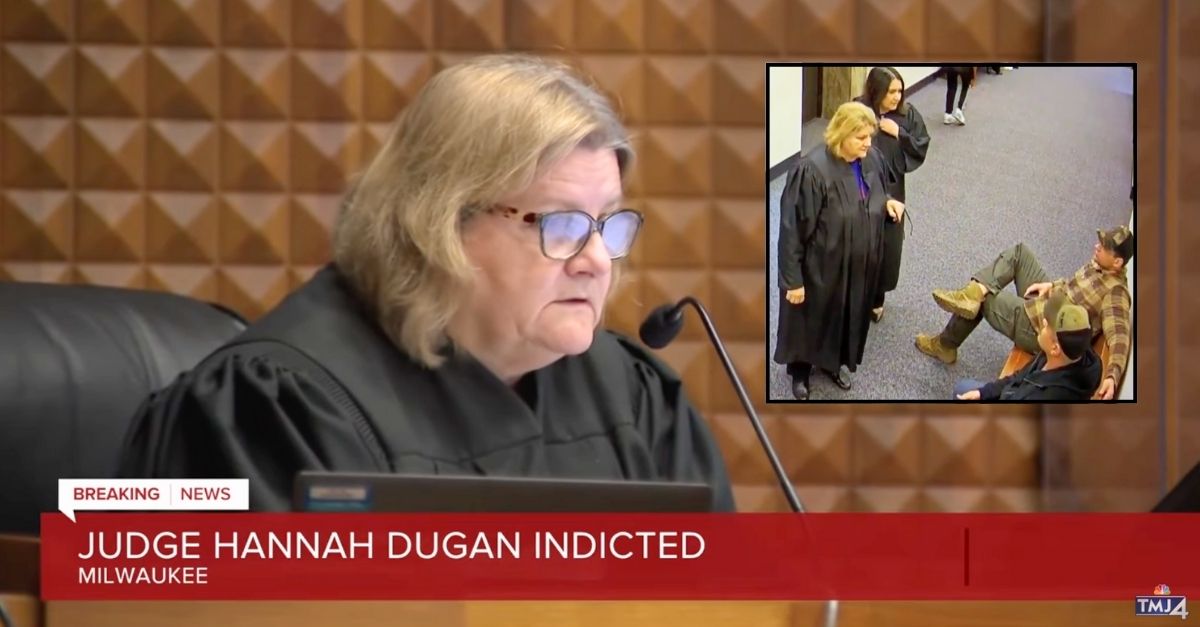
Background: Milwaukee County Judge Hannah Dugan in court (WTMJ/YouTube). Inset: Surveillance video shows Milwaukee County Judge Hannah Dugan speaking with ICE agents before Eduardo Flores-Ruiz’s detainment (WDJT/YouTube).
Hannah Dugan — the former Wisconsin judge who was found guilty last year of impeding ICE during a courthouse arrest — has been ordered to pay a $5,000 fine, rather than serve any prison time or probation for obstructing federal agents.
“For several reasons, prison is not necessary to satisfy the statutory purposes for sentencing,” U.S. District Judge Lynn Adelman said before sentencing Dugan on Wednesday, according to local ABC affiliate WISN.
“This is a defendant who made a bad decision in the moment,” Adelman said. “She appreciated the wrongfulness of her conduct, but this is nevertheless a few minutes of conduct for a person that has dedicated her life in service to the needy.”
Dugan, 67, was indicted last year for helping an immigrant named Eduardo Flores-Ruiz evade ICE officers shortly after he appeared in her Milwaukee County Circuit courtroom in connection with a domestic abuse case. Federal prosecutors alleged during her trial that Dugan impeded ICE agents during the attempted courthouse immigration bust by helping Flores-Ruiz, a Mexican national who was facing misdemeanor battery charges, leave through a jury door after a hearing.
Dugan was accused of “falsely” telling ICE agents they needed to obtain a judicial warrant to take Flores-Ruiz into custody. The incident occurred on April 18, 2025, and Dugan was charged in a criminal complaint less than a week later and formally indicted in May 2025. A federal jury found Dugan guilty in December 2025 of one count of obstructing or impeding a proceeding before a department or agency of the United States, a felony. Jurors found her not guilty of one count of concealing an individual to prevent his discovery and arrest, a misdemeanor.
Covering the sentencing from inside the courtroom, WISN reports Dugan as saying, “For nine years as a judge I have strived to do my best to uphold justice, to uphold our laws and constitution, to have a courtroom of decorum and safety. I worked hard to uphold these duties every day and I had those same intentions on that day.”
Dugan reportedly added, “I’ve been cast as both a scofflaw and a hero. I am neither, I am a public servant who was just trying to do my job,” according to WISN.
“My acts that day were consistent with the expressed administrative and community concerns for our state courthouse,” Dugan said. “My judicial acts were not done with any malicious intent.”
Federal prosecutors told the court that Dugan’s actions amounted to an “abuse of trust” and asked that her sentence reflects that, according to Spectrum News 1 Wisconsin.
Dugan’s defense attorneys and the U.S. Justice Department filed dueling court memos ahead of the sentencing hearing, arguing for vastly different punishments.
Prosecutors said Dugan’s obstruction of ICE agents “was a serious offense, and it warranted a correspondingly serious sentence,” while her defense attorneys claimed the DOJ is using her case to “scare and cast public shame” on others like her who may act “contrary to ICE enforcement at county courthouses.” They wanted Dugan to be sentenced to time served after spending less than a day in custody.
“Hannah Dugan for nearly seven decades has been an exemplary member of this community,” her defense team said in its sentencing memo. “She, of course, has no prior criminal record; the offense was isolated and unique; and there is no possibility of her repeating it. She was handcuffed and shackled during her arrest, photographed publicly by plan, and intentionally shamed from coast to coast by the leadership of the U.S. Department of Justice and FBI. There is no need for further deterrence, either specifically or generally.”
The DOJ believed “a serious sentence” was necessary to “reaffirm a foundational principle of our criminal justice system: no one is above the law, particularly those entrusted with administering it,” according to the department’s sentencing memo. “Anything less risks sending the opposite message — that personal loyalties, subjective viewpoints, or self-interest can supersede legal duty,” the memo said.
Prosecutors argued that judges are “entrusted with tremendous discretion, but there is a line they cannot cross,” according to the DOJ. “They may disagree with the law, question policy, or sympathize with those who appear before them. But they cannot use the power of judicial office to obstruct federal law enforcement officers to help someone evade arrest,” prosecutors said. “The defendant crossed that line.”
The DOJ stated that Dugan’s “lack of remorse or sense of accountability” also warrants a sentence that reflects the “serious nature of her conduct” and its broader impact on the justice system. Dugan’s team, meanwhile, said she had been “punished enough,” per their sentencing memo.
“Whether deserved or not, the ongoing residual effect was to force Hannah Dugan into life as a recluse,” her lawyers said. “Based on actual threats and a legitimate fear of those threats against her and those associated with her, she moved out of her home. She gave up her usual life of attending community events, including public religious services. Security measures needed to be taken before she could travel, even to her required court proceedings in this case. These effects will persist well into the future regardless of the sentence this court imposes.”
Dugan’s attorneys added, “The nine-year judicial career of Judge Dugan (and almost 40-year legal career) came to an end because of approximately five minutes of immediate reactions to learning that an ICE enforcement action was to take place on the sixth floor near her courtroom.”
Prosecutors countered by saying Dugan was ultimately “entrusted with authority and responsibility that few citizens possess” and “rather than honoring those obligations, she used her position to interfere with the lawful administration of justice,” according to the DOJ’s sentencing memo. “That betrayal magnifies the seriousness of the offense,” the memo stated.
“This is not a case involving a momentary lapse in judgment followed by reflection or remorse. Instead, the defendant has continued to characterize her conduct, which a jury found criminal beyond a reasonable doubt, as appropriate, justified, and legally permissible,” prosecutors said. “To be clear, the government does not seek punishment for the defendant’s exercise of her constitutional right to trial. Rather, the Court simply should consider the defendant’s continued minimization of her conduct and persistent refusal to acknowledge wrongdoing when evaluating the need to promote respect for the law.”
Dugan’s legal team filed a motion for a new trial in late January, claiming that recent court cases, including one in November 2025, established a “common-law privilege” that bars civil arrests inside courthouses. “This privilege specifically precludes ICE courthouse arrests for deportations or removal,” the motion said. Federal prosecutors insisted that was not the case with Flores-Ruiz.
“Arrests at the courthouse are a common practice and can be made in a public hallway with or even without a warrant based on probable cause,” the DOJ said in its response. “Because she knew ICE could operate in the hallways, Dugan prepared a sign for her courtroom door, stating that if any attorney, witness coordinator, or court official felt unsafe coming to court in person, they could request to appear by Zoom.”
A federal judge ruled last month that Dugan’s conviction would not be overturned. She plans to appeal her case to the 7th Circuit Court of Appeals.
Dugan was facing up to five years in prison, but prosecutors noted in their memo that the average sentence imposed is 16 months. Dugan’s lawyers submitted nearly 20 letters of support for a sentence of time served. The DOJ did not recommend a specific sentence, only that it be “serious.”
“As former ambassador and mayor Tom Barrett wrote in his letter to the court, the guilty verdict in this case alone caused Hannah Dugan to resign her judicial position: ‘For her, it was an extraordinarily deep price to pay,'” her team’s memo concluded. “Joseph Wall, referring to the intentional and unnecessary public humiliation of Dugan’s arrest, echoes the sentiment that she already has been punished enough.”


