
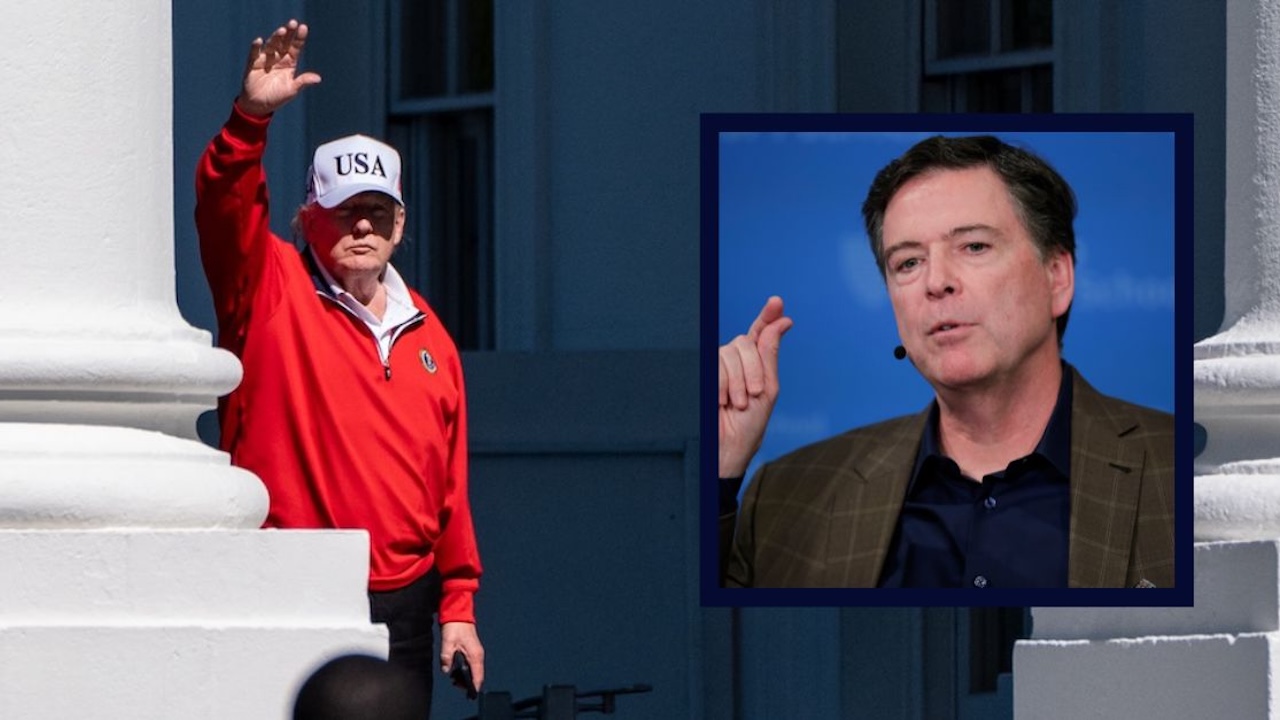
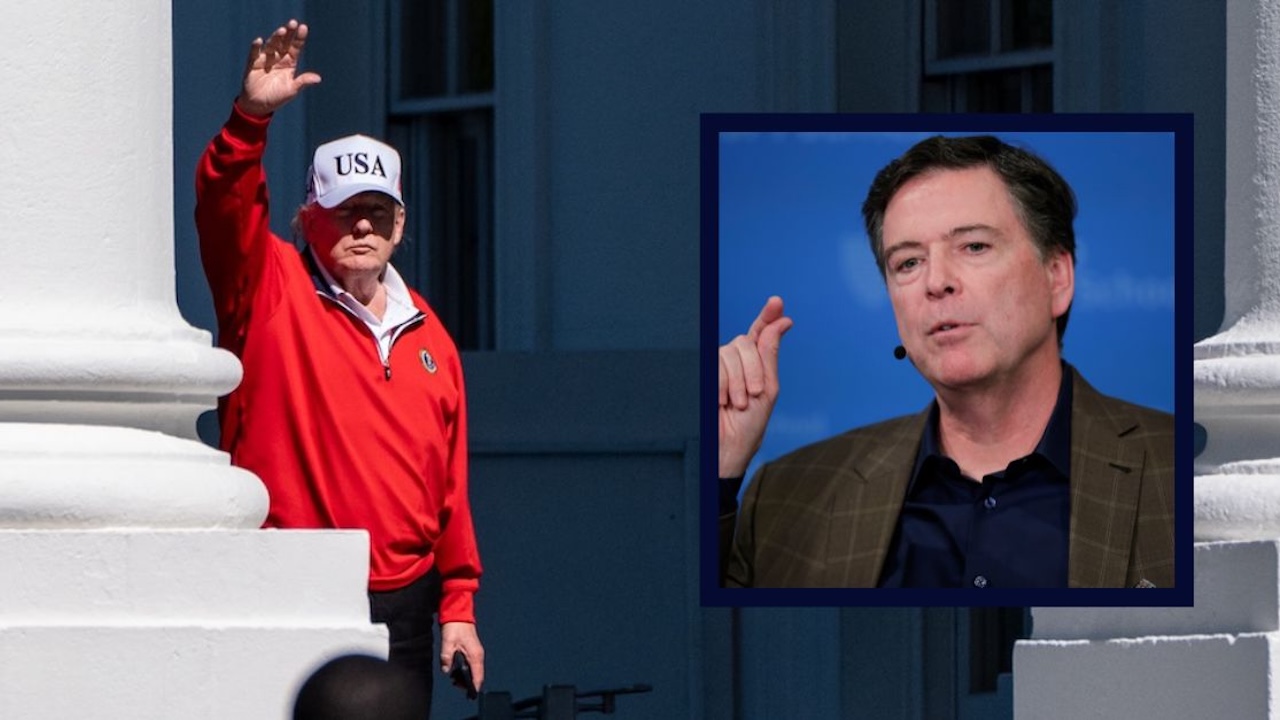
Main: President Donald Trump waves as he arrives at the White House, Sunday, May 31, 2026, in Washington, D.C. (AP Photo/Alex Brandon). Right inset: Former Director of the Federal Bureau of Investigation James Comey speaks at Harvard University’s Institute of Politics’ JFK Jr. Forum in Cambridge, Mass., Feb. 24, 2020 (AP Photo/Charles Krupa, File).
With a false statements indictment dismissed and a separate “8647” seashells threats case pending, James Comey revealed that the Trump DOJ has a third criminal case against him out of Washington, D.C. — one the ex-FBI director says should also be dismissed.
When Comey posted on Substack about the charges and proclaimed his innocence on Monday — the same day a federal judge ordered his fired daughter’s reinstatement with back pay — he said the Espionage Act case “would almost be funny if it wasn’t such an appalling abuse of the Department of Justice.”
Soon, it became clear why Comey spoke up when he did.
U.S. District Judge Trevor McFadden had ordered the case unsealed, noting the defendant asked for that result and that the DOJ didn’t oppose it — a “significant” factor.
Love true crime? Sign up for our newsletter, The Law&Crime Docket, to get the latest real-life crime stories delivered right to your inbox.
The judge, one of President Donald Trump’s appointees, also mentioned that Comey has already filed a motion to dismiss a criminal information the DOJ filed under seal on Oct. 5.
That date — representing 10 years from the “last overt act during the existence” of the alleged conspiracy to leak classified information to The New York Times — and the government’s chosen “charging instrument” are notable.
On Oct. 16, Comey filed a motion to dismiss, arguing that the extended 10-year statute of limitations has already run on the alleged Oct. 5, 2016, offense because a grand jury never indicted him.
“The criminal information charging Mr. Comey should be dismissed as time barred. Section 19 of the Internal Security Act gives the government an extended ten-year limitations period which to charge Section 793 offenses. But as Section 19 unambiguously states, the government may invoke that extended period only by obtaining a grand jury indictment,” the motion said. “A criminal information—which the government can issue unilaterally without grand jury involvement—does not suffice.”
The motion added that the Trump administration’s “unusual and improper approach to charging” Comey for an offense two different prosecutors declined to pursue is a “fatal problem” for the case.
Documents show that Acting Deputy Attorney General R. Trent McCotter and Associate Deputy Attorney General Aakash Singh — high-ranking DOJ lawyers, but not prosecutors in U.S. Attorney Jeanine Pirro’s office — filed the criminal information.
Three special assistant U.S. attorneys are also on the case: Patrick Hopple, the U.S. Department of Homeland Security’s deputy general counsel; Justin Meckler Silverberg; and Dustin Farahnak.
According to the government, Comey is “mistaken.”
“Congress didn’t need the word ‘information’; it had no reason to write it,” the DOJ said, disputing that only an Espionage Act indictment — not a criminal information — gets a 10-year extended statute of limitations “window.”
In a post on X, the DOJ stated that filing a “criminal information to toll the statute of limitations is a widely recognized practice in federal court” that has “been approved by multiple Circuit Courts of Appeals.”
The post Trump DOJ’s ‘unusual and improper approach’ could be a ‘fatal problem’ for unsealed third case against James Comey first appeared on Law & Crime.


