
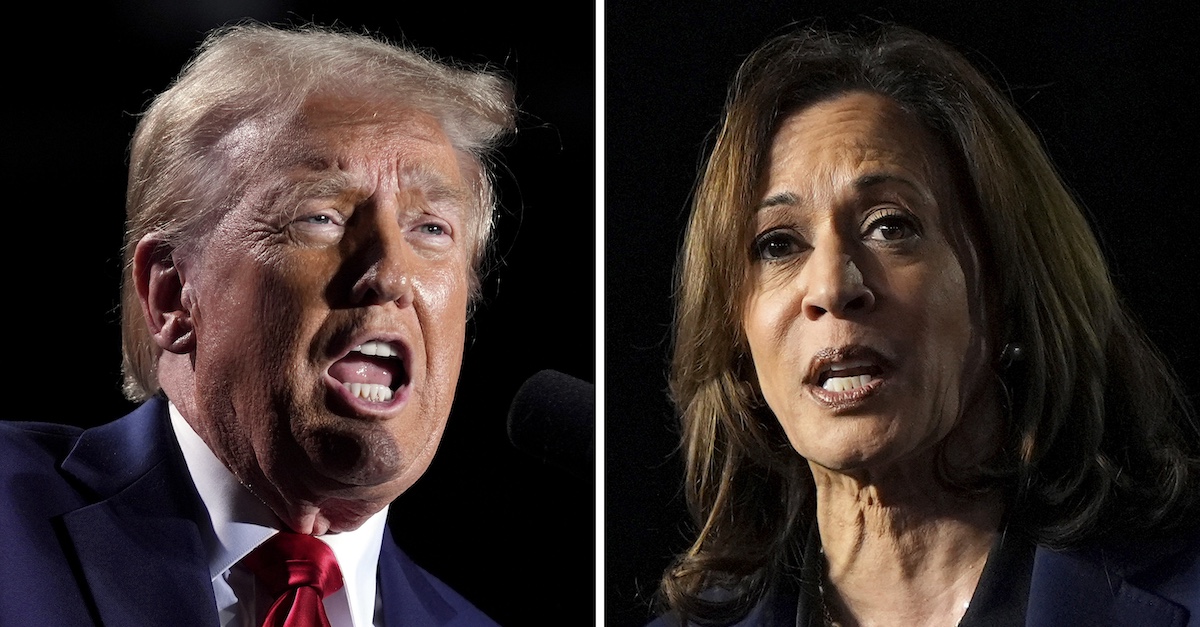
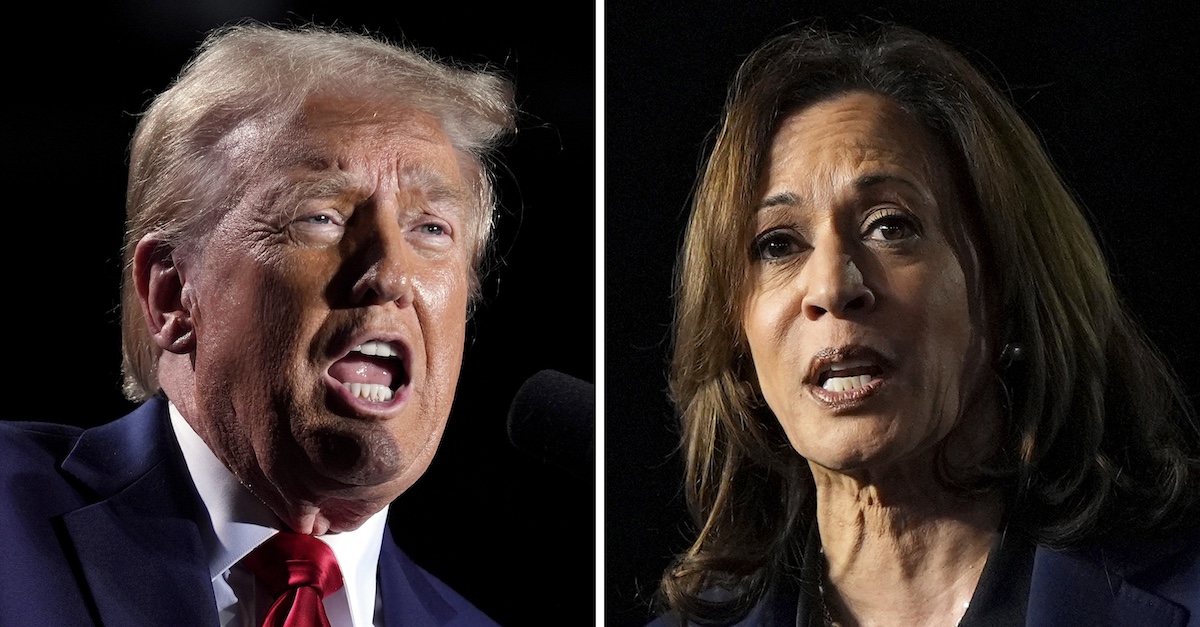
This combination of file photos shows then-Republican presidential nominee Donald Trump, left, speaking at a campaign rally, Oct. 18, 2024, in Detroit, and former Democratic presidential nominee Vice President Kamala Harris, right, speaking at a campaign rally in Green Bay, Wis., Oct. 17, 2024. (AP Photos/ Evan Vucci, Susan Walsh).
After making a couple of additions to his appellate squad, President Donald Trump went to the 3rd U.S. Circuit Court of Appeals and claimed he”s immune from the exonerated Central Park Five’s defamation lawsuit — and he doesn’t seem to think falsely accusing them of killing someone is an issue.
In July 2025, Trump filed an appeal insisting that a Pennsylvania federal judge erroneously refused to throw out a case stemming from a 2024 debate with then-Vice President Kamala Harris.
Antron Brown, Kevin Richardson, Raymond Santana, Korey Wise and Yusef Salaam filed suit quickly after the debate, pointing out that Trump “falsely stated that Plaintiffs killed an individual and pled guilty to the crime.” In 1989, the then-teenagers were wrongly accused of raping Trisha Meili as she jogged in Central Park in New York City. The five, also accused of attacking two men that same night, said cops coerced false confessions.
“While in police custody, Plaintiffs were each separately subjected to hours of coercive interrogation, under duress, with no attorney present and often without a parent or guardian present,” their lawsuit said. “Plaintiffs all initially denied having any knowledge of the Central Park assaults. However, after hours of interrogation, four of the Plaintiffs agreed to provide written and videotaped statements in which they falsely admitted to having been present during the assaults.”
The Central Park Five faced trials, maintained their innocence, were convicted by juries in 1990 and were sent to prison, only to be exonerated decades later after the real attacker, Matias Reyes, admitted to the crime against Meili and DNA “conclusively” proved that Reyes was the “true perpetrator,” court documents said.
The five did not plead guilty and were not accused of killing anyone — yet, during the nationally televised presidential debate with Harris, Trump said: “They admitted — they said, they pled guilty. And I said, well, if they pled guilty they badly hurt a person, killed a person ultimately.”
The remarks were a response to Harris’ statement that throughout his life and career, Trump has “attempted to use race to divide the American people,” and that an example of this was the “full-page ad” he placed in the New York Times and elsewhere in 1989 “calling for the execution of five young Black and Latino boys who were innocent — the Central Park Five — took out a full-page ad calling for their execution.”
In his prior responses to the lawsuit, Trump attempted to grapple with the “killed a person” statement, but not in his latest brief.
The brief acknowledged that there was no killing, but reduced the defamation claim to “two words” — “pled guilty”:
During that debate, Vice President Harris falsely accused President Trump of using “race to divide the American people.” To support that empty charge, she invoked a newspaper advertisement President Trump had taken out thirty-five years earlier, after a brutal rape and assault was committed in Central Park. The advertisement concerned the five men—Appellees here—who had confessed to police but had not pleaded guilty in court. President Trump responded that Harris had to reach back “many, many years” because there was “nothing” to support her present accusation. Recalling the events surrounding the advertisement, he stated: “I said, well, if they pled guilty, they badly hurt a person, killed a person ultimately. And if they pled guilty—then they pled, we’re not guilty.”
Those sentences are the entire basis for this meritless suit. Appellees wrongly claim that the President’s use of “pled guilty,” rather than “confessed,” defamed them, placed them in a false light, and intentionally inflicted emotional distress. They further wrongly allege that those two words caused “post-traumatic stress disorder,” “neck pain,” “shortness of breath,” “trembling,” “numbness,” and other injuries.
Calling these claims “ridiculous,” Trump asked the 3rd Circuit to find that Pennsylvania’s Uniform Public Expression Protection Act (UPEPA) — an anti-Strategic Lawsuit Against Public Participation (anti-SLAPP) statute — grants him “immunity” from federal “litigation targeting speech on matters of public significance and threatening to chill participation in public debate.”
“The district court’s reasoning was truly bizarre,” the Trump brief said of U.S. District Judge Wendy Beetlestone’s decision not to apply UPEPA in federal court. “That was error.”
When the judge refused to toss the case, she wrote Trump’s “statement must be construed as one of fact, not opinion.”
“In fact, none of [the Central Park Five] pleaded guilty and none of them were charged with killing anyone,” said the judge, a Barack Obama appointee.


