
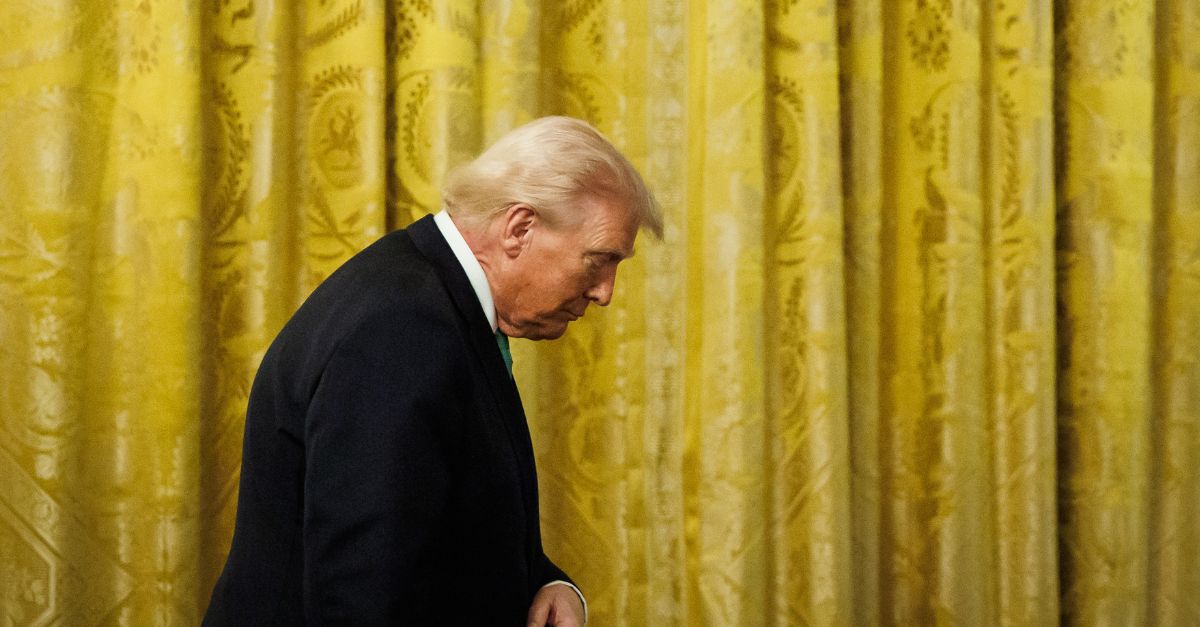
U.S. President Donald Trump leaves a St. Patrick”s Day event in the East Room of the White House on March 17, 2026, in Washington, D.C. (Photo by Samuel Corum/Sipa USA)(Sipa via AP Images).
The U.S. Department of Justice will not be able to access the names of election workers in Fulton County during the 2020 election, a federal judge ruled on Tuesday in a blow to the Trump administration.
In a 28-page order, U.S. District Judge William M. Ray II, who was appointed by President Donald Trump during his first term in office, quashed a subpoena issued for such records earlier this year.
In May, attorneys for the county that became the epicenter of 2020 election-related controversies in the Peach State characterized the North Carolina-issued grand jury subpoena as an “unprecedented” effort to “target and harass the President’s perceived political enemies” due to lingering bitterness over his loss to Joe Biden there.
The county noted that Trump “continues to disparage” people like “election officials, poll workers, and volunteers” in Georgia while “he perpetuates his false claim that they ‘stole’ the 2020 election.”
“The most disturbing manifestation of the President’s retaliation is his targeting of Fulton County poll workers,” the motion to quash reads. “To be clear, the President’s tactics to punish and harass his perceived enemies have caused immense harm.”
Now, the court has sided with the plaintiffs, calling the breadth of the information requested by the subpoena “staggering.”
The judge says Georgia’s “most populous county” is being asked to provide “personal identifying information on what would amount to thousands of employees and volunteers who participated in election day activities, the counting of votes, and any audit or recount.”
The court contrasts the would-be burden on the county with the need asserted by the Trump administration, and finds the government’s reasons substantially lacking due to the lapse in the statute of limitations “on any alleged crime related to the 2020 Election.”
“[I]nvestigation into these alleged offenses is now ‘stale,'” the court order reads. “Without a showing that the subpoenaed information will result in a prosecutable crime, the Court finds the DOJ’s need for the subpoenaed information to be questionable, at best.”
The government, for its part, attempted to “revive” the statute of limitations in both its opposition to the motion to quash and a subsequent motion to enforce the subpoena, but the court found each of those arguments was unconvincing.
“The DOJ contends that ‘[a]ny subsequent criminal acts, or acts in furtherance of a criminal conspiracy, would restart the limitations period,'” the order explains. “In the DOJ’s view, the possibility of criminal obstruction creates a timely offense. However, as Fulton County pointed out at the hearing and in its subsequent briefing, [U.S. Supreme Court precedent] forecloses this argument.”
The court also rejected the government’s argument relying on a related case in which FBI agents seized several hundred boxes of ballots, ballot images, tabulators, and voter rolls.
In that case, a different judge declined to immediately return those materials to Fulton County because “a witness told [an FBI Special Agent] that some of the ballot images may have been modified as recently as January 11, 2024.”
“[I]t is not clear how poll workers from November 2020 would have anything to do with alleged alterations in January 2024,” Ray continues. “To the Court, it seems that if the ballots were altered in 2024, that would be a crime (if it were a crime) independent of anything that happened in 2020.”
While the DOJ argued the subpoena was “the next step in the normal investigative process,” as investigators sought “records identifying persons with relevant knowledge,” the court strongly disagreed.
From the order:
So, is there anything wrong with the DOJ using the Grand Jury to subpoena these records from Fulton County? In this Court’s view, yes. These records, even if they lead to the DOJ finding individuals who worked for Fulton County in the 2020 Election who support the theory that the 2020 Election was not fair, would not lead to information that could be used to charge anyone with anything, at least not any viable charge.
“It is true that the Grand Jury works with the DOJ and the applicable United States Attorney to investigate alleged criminal actions, but that does not give the DOJ the right to use the Grand Jury to do whatever the DOJ wants,” the order continues. “Given the low need for the subpoenaed information and the highly burdensome nature of the disclosure of the same, the Subpoena is unreasonable and must be quashed.”
The order also needles Trump himself for his long-held beliefs about fraud during his 2020 electoral loss.
“Why is the DOJ seeking this information?” the judge asks before answering. “It argues that it is engaged in legitimate law enforcement activities. Against that claim is the fact that it has long been the view of the current President of the United States, both before and after he was elected in the 2024 General Election, that he was denied re-election to a second consecutive term in 2020 due to election fraud.”


