
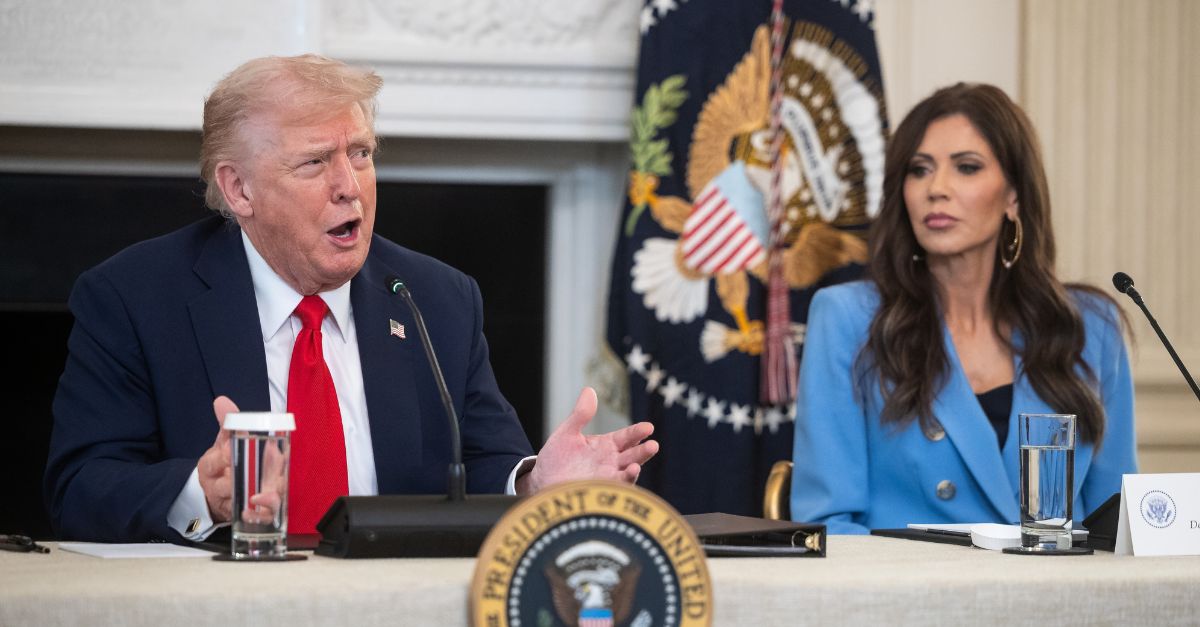
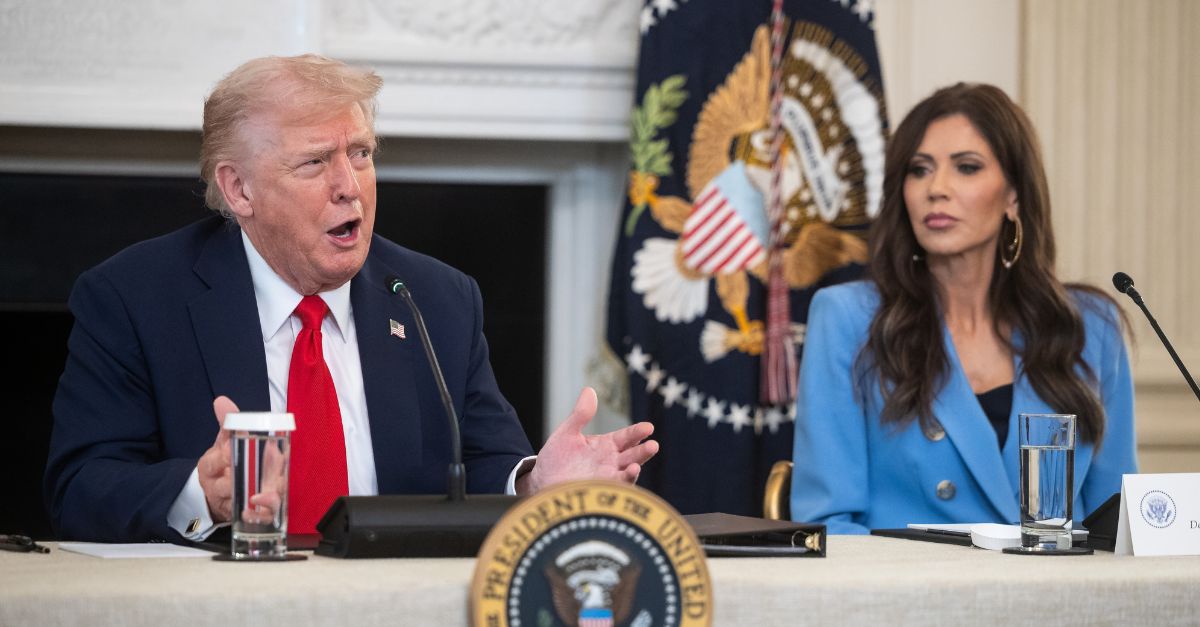
President Donald Trump speaks alongside Homeland Security Secretary Kristi Noem during a roundtable about antifa in the State Dining Room at the White House Oct. 8, 2025 (Francis Chung/POLITICO via AP Images).
The Trump administration must turn over documents and video footage from an Illinois detention facility run by Immigration and Customs Enforcement (ICE), a federal judge ruled this week.
The underlying litigation was filed on Oct. 30, 2025, premised on alleged violations of the Fifth Amendment due to confinement conditions at the ICE facility in the Chicago suburb of Broadview.
The lawsuit also alleges First Amendment violations over access to counsel, as well as various alleged violations of due process, internal ICE rules, and the Administrative Procedure Act (APA), the federal statute that governs the behavior of administrative agencies.
On Thursday afternoon, in a bench ruling, U.S. Magistrate Judge Laura McNally granted several discovery motions filed by the plaintiffs seeking to pull the curtain back on the controversial lockup facility.
During the digital motion hearing, the judge appeared to be perturbed by the way the U.S. Department of Justice was dealing with the case, according to a courtroom report by the Chicago Sun-Times.
The federal government, represented by Ifeanyi Mogbana, argued the information sought by the plaintiffs would have come out during depositions, pushing back on an earlier motion to compel.
“These kinds of answers are not helpful,” McNally told the DOJ lawyer. “You”ve had notice of this motion for weeks.”
In ruling against the government, the court accepted the notion that ICE had failed to abide by the discovery process so far.
Earlier this month, the court found the plaintiffs are entitled to “records of informal policies and guidance governing attorney access, conditions, and voluntary departures,” according to a minute order filed on the case docket. That data is due by Friday.
The judge’s latest ruling entitles the plaintiffs to vast troves of discovery including data on detention, compliance with a previously issued temporary restraining order, document retention practices, other similarly situated immigration detention facilities in the region, and highly sought video footage from inside Broadview itself.
The beleaguered agency synonymous with immigration enforcement has until Feb. 16 to produce most of the outstanding discovery.
Specifically, the next tranche of information provided to the plaintiffs must include answers to questions about who is in charge at Broadview and what is planned for the facility should another large group of detainees arrive there, McNally ruled on Thursday.
The court’s order, however, was not an unalloyed win for the plaintiffs. The judge denied one of the plaintiffs’ requests as too broad.
Represented by Alexa Van Brunt of the MacArthur Justice Center during the hearing, the plaintiffs accepted the ruling.
The plaintiffs’ lawyer further requested “some kind of affirmation that the government is looking for these documents” because she said they had received some documents that referred to other documents which had yet to be produced.
“Right now, I don’t think they are, and we are missing a lot of evidence,” Van Brunt said.
The lawsuit was originally filed last fall amid a spate of protests targeting the facility. Specifically, the lawsuit alleges that when detainees requested “basic necessities” — like medicine, toothpaste, and soap — from ICE, officers responded “with threats, abuse, or contempt.” The filing goes on to allege many detainees report “being belittled or ignored by officers when they asked for food and water.”
In November, ICE admitted that 13 days’ worth of video footage from inside the facility had “been irretrievably destroyed and therefore cannot be produced on an expedited basis or at all.”
The plaintiffs, for their part, said they are “in the process of hiring an IT contractor” who will work with ICE’s discovery liaison and attorneys “to attempt to work through issues concerning the missing video, including whether any content is able to be retrieved.”
The missing footage will be pursued, at least in some fashion, the status report says, but the plaintiffs are concerned with getting their hands on the footage that is still readily available.
Now, the clock is ticking on that request.


