
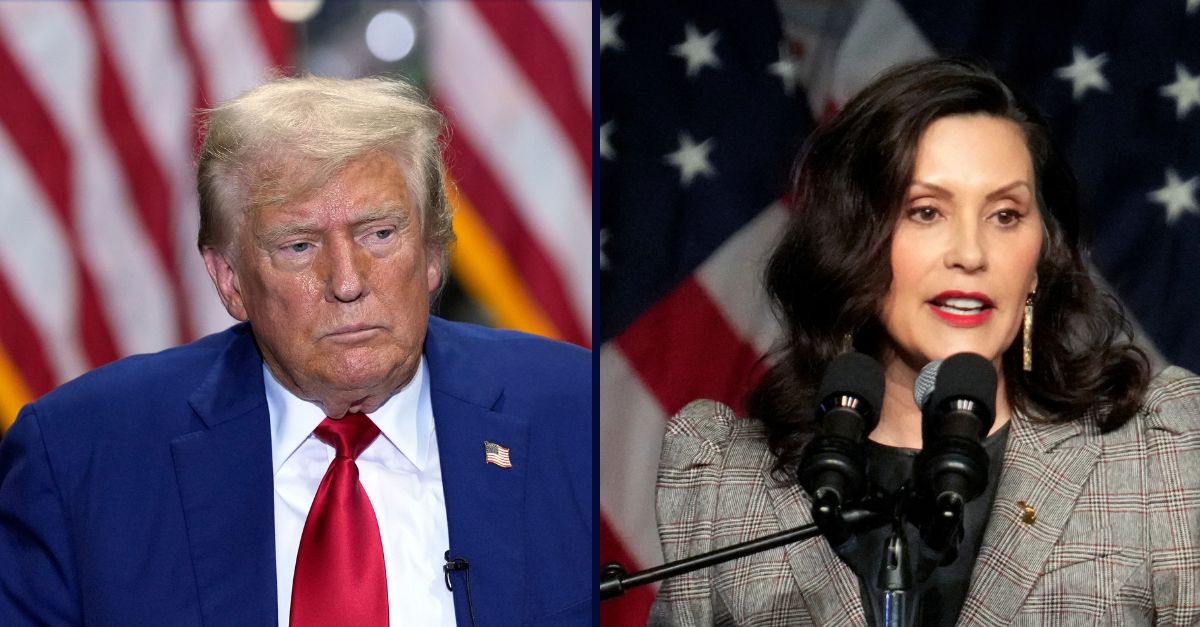
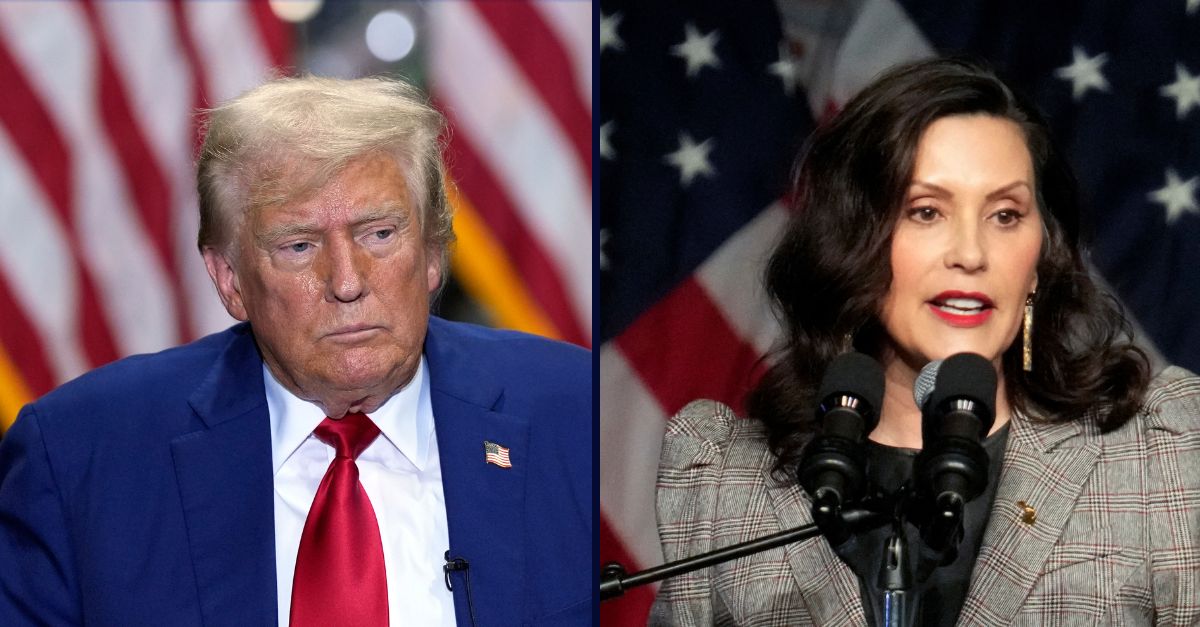
Left: President Donald Trump listens at a business roundtable discussion at a campaign event at Precision Components Group, Monday, Aug. 19, 2024, in York, Pa. (AP Photo/Julia Nikhinson). Right: Gov. Gretchen Whitmer speaks at the NAACP Detroit branch Fight for Freedom Fund dinner in Detroit, Sunday, May 19, 2024 (AP Photo/Paul Sancya).
A federal court of appeals has blocked the Trump administration from accessing unredacted voter rolls in Michigan.
In September 2025, the U.S. Department of Justice sued the Wolverine State and its top voting official, Secretary of State Jocelyn Benson, for access to the sensitive voter registration list.
The government”s 19-page complaint alleged violations of a litany of federal laws including the National Voter Registration Act (NVRA), Civil Rights Act of 1960, and the Help America Vote Act (HAVA).
In November 2025, Michigan filed a motion to dismiss. Along the way, the state received assistance via amicus briefs and motions to intervene filed by the League of Women Voters, the Democratic National Committee, and others.
In February, Chief U.S. District Judge Hala Y. Jarbou, a Trump appointee, dismissed the lawsuit for “failure to state a claim.”
“[T]he Court’s conclusion that the voter registration list is not subject to disclosure is based on the statutory text,” Jarbou wrote. “HAVA, the NVRA, and the CRA do not allow the United States to obtain the records at issue in this case.”
The Trump administration, in turn, appealed and moved to expedite the briefing schedule, hoping for the ruling to be quickly overturned.
Now, instead, the U.S. Court of Appeals for the 6th Circuit has affirmed the lower court’s ruling on the basis that the government aimed to use the statutes in direct contravention of their purpose.
The 2-1 opinion penned by Circuit Judge Andre Mathis, a Joe Biden appointee, does not mince words over this apparent discord.
“Congress enacted Title III of the Civil Rights Act of 1960 to help end voting discrimination,” the opinion begins. “Title III of the Act gave teeth to prior civil-rights legislation by empowering the U.S. Attorney General to obtain certain state voting records so that he could investigate potential violations and enforce federal election law. Back then, the government used this power to ensure that everyone who had the right to vote could freely exercise that right. But today, the government invokes Title III for an inverse purpose—to ensure that some people have not voted.”
The appeals court notes that Benson did provide the government the public version of the state’s voter rolls, but “refused to go any further” because she believed the DOJ “had no statutory authority to demand the sensitive, unredacted voter information it sought.”
In ruling against the Trump administration, the majority explains how states “do most of the heavy lifting in overseeing federal elections” and do so via authority granted to them under the U.S. Constitution.
“But Congress also has a role to play,” the majority writes before launching into a description of the statutes at issue in the case.
In sum, the appellate court finds the case to hinge upon what Title III actually commands — specifically, what the statute means when it says records and papers subject to the law must be “made available for inspection, reproduction, and copying” if DOJ makes a “demand in writing” that specifies “the basis and the purpose” for the inspection.
In the present case, the court determined the records are not subject to Title III because — citing another relevant section of the operative statute — they did not “come into [Benson’s] possession.”
“Benson did not acquire, obtain, or receive the qualified voter file from a third party,” the opinion continues. “Instead, Michigan officials created it themselves. Indeed, Michigan law directs the secretary of state to ‘establish’ and maintain the qualified voter file. So it is an internally generated electronic database, not a record acquired from an outside source. … Thus, the qualified voter file did not ‘come into [Benson’s] possession’ as that term is ordinarily understood.”
The opinion offers an example, at length:
An example from oral argument helps to prove the point. A baker may purchase ingredients from a grocery store (flour, eggs, etc.) and then proceed to bake cakes. It would be rather strange to say that the baker has “come into” possession of the cakes after pulling them out of the oven. True, the baker did “come into” possession of the ingredients she used to make the cakes by acquiring those items from the grocery store. But the baker did not “come into” possession of the cakes—she created them.
“Title III’s narrow text cannot withstand the weight of the government’s broad request,” the majority concludes.


