
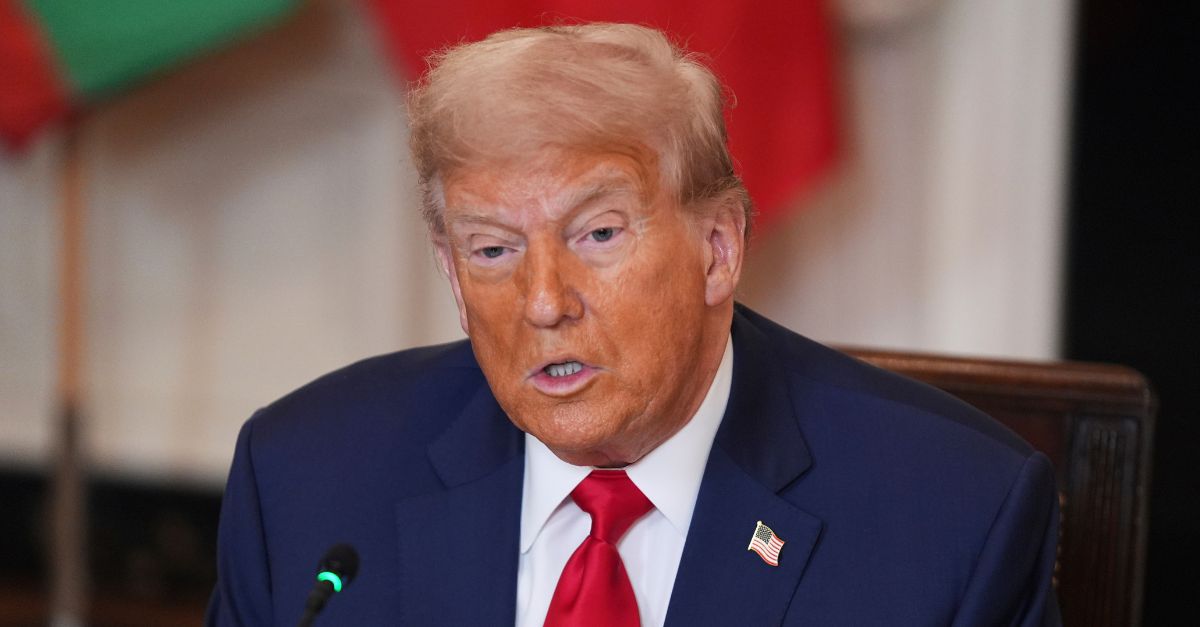
President Donald Trump speaks during a lunch with African leaders in the State Dining Room of the White House, Wednesday, July 9, 2025, in Washington (AP Photo/Evan Vucci).
A federal court in Manhattan chided the Trump administration on Thursday for trying to dodge discovery obligations in a collection of consolidated lawsuits over terminated grant awards issued by the National Endowment for the Humanities (NEH).
In a 32-page opinion, U.S. District Judge Colleen McMahon, a Bill Clinton appointee, issued a victory for the plaintiffs and a loss for the government. The court granted several motions to compel discovery filed by the plaintiffs in two consolidated cases and overruled a series of objections lodged by the U.S. Department of Justice.
The ruling takes the Trump administration to task for its discovery-related behavior so far and warns the government that discovery violations going forward could result in punishment.
“The Court reminds the parties that compliance with discovery obligations “is not optional or negotiable,'” the opinion reads. “It is also well-recognized that ‘…a district court has wide discretion in sanctioning a party for discovery abuses.’ The Court will not hesitate to impose sanctions should any party fail to comply with its discovery obligations or the Court’s discovery directives.”
The underlying litigation began in May, when several “preeminent” humanities associations filed a lawsuit against the agency for rescinding “hundreds of millions of dollars” in grants for projects and research – funds appropriated by Congress for such purposes. Days later, a guild specifically representing authors affected by the grant rescissions filed a separate lawsuit along much the same terms.
In sum, the plaintiffs alleged a myriad of constitutional and statutory violations – including claims that the NEH had violated the First Amendment, acted in excess of any cognizable power and authority, and serially ran afoul of the Administrative Procedure Act (APA), the federal law governing the behavior of administrative agencies.
The lawsuits were then joined.
Motions practice on discovery issues began in earnest over the summer but quickly took a turn toward the dramatic when the DOJ suggested a decidedly limited scope of discovery.
The plaintiffs strongly opposed that idea.
In a terse endorsement, the judge agreed.
“The government is NOT correct that this is a case in which we are limited to the administrative record,” a September docket entry reads. “It is primarily (though not exclusively) a first amendment lawsuit, as to which discovery is entirely appropriate.”
More back-and-forth motions ensued for months as the plaintiffs tried, and failed, to get government officials on the record.
Earlier this month, one group of plaintiffs filed a letter motion to compel. The filing complains of repeat discovery violations and alleges the NEH has violated a court order meant to effectuate discovery compliance.
The letter motion reads, in relevant part:
Plaintiffs … submit this letter to notify and seek relief from the Court regarding Defendants’ refusal to comply with the Court’s orders regarding discovery. This Court ordered months ago that the record in this matter would not be limited to an administrative record and that [humanities association] Plaintiffs would be permitted to take full discovery as relevant to their constitutional claims. And yet, Defendants continue to insist that they presumptively need not produce records or information beyond the administrative record, and Defendants are refusing to participate in standard discovery of the named Defendants.
In a corresponding memorandum of law in support of the motion to compel, the plaintiffs restate their allegations in simple terms.
“The Government is refusing to comply with this Court’s directives regarding the Administrative Record and discovery,” the memo reads.
To hear the plaintiffs tell it, they need to depose several members of the U.S. Department of Government Efficiency (DOGE) and the NEH. Additionally, the plaintiffs insist the government has been unwilling to perform relevant document searches at other implicated agencies. Finally, the plaintiffs allege the administrative record is far from complete.
In real terms, the plaintiffs allege the government has provided a total of “27 NEH” documents and is resisting providing anything more.
In her Thursday order, McMahon rubbished the idea that the amount of documents the government provided would satisfy the discovery needed in the case.
“Where the record itself shows that the materials considered by those who made the decision have not been produced, judicial review cannot proceed on the ‘whole record’ as required by the APA,” the judge explained. “As in [the relevant case law], the problem for the Government lies in the fact that the administrative record, as currently designated, does not reflect ‘all documents and materials directly or indirectly considered’ in connection with the cancellation of 1,400 grants.”
The judge goes on like this, at length:
Whether the current 27-document “administrative record” reflects all documents and materials that Defendants directly or indirectly considered is not an inquiry that ends with mere record certification. Consistent with [aforementioned case law], the Court concludes that discovery beyond the administrative record is warranted. The Court cannot meaningfully discharge its duty of review under the APA by accepting at face value an administrative record whose completeness or candor is in genuine doubt.


