
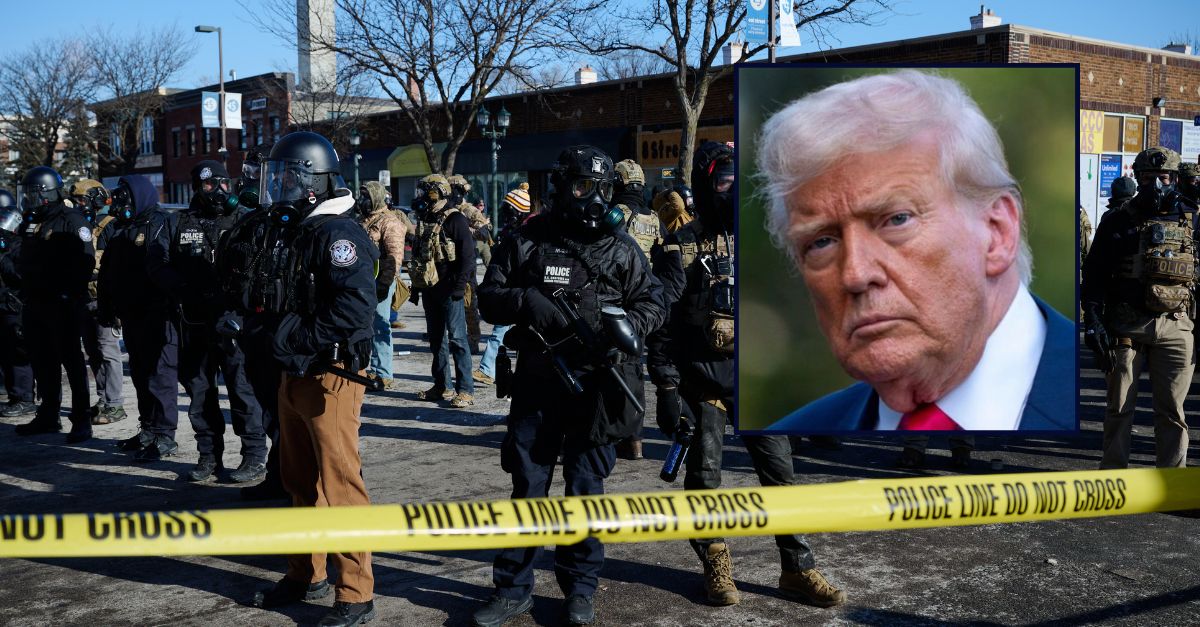
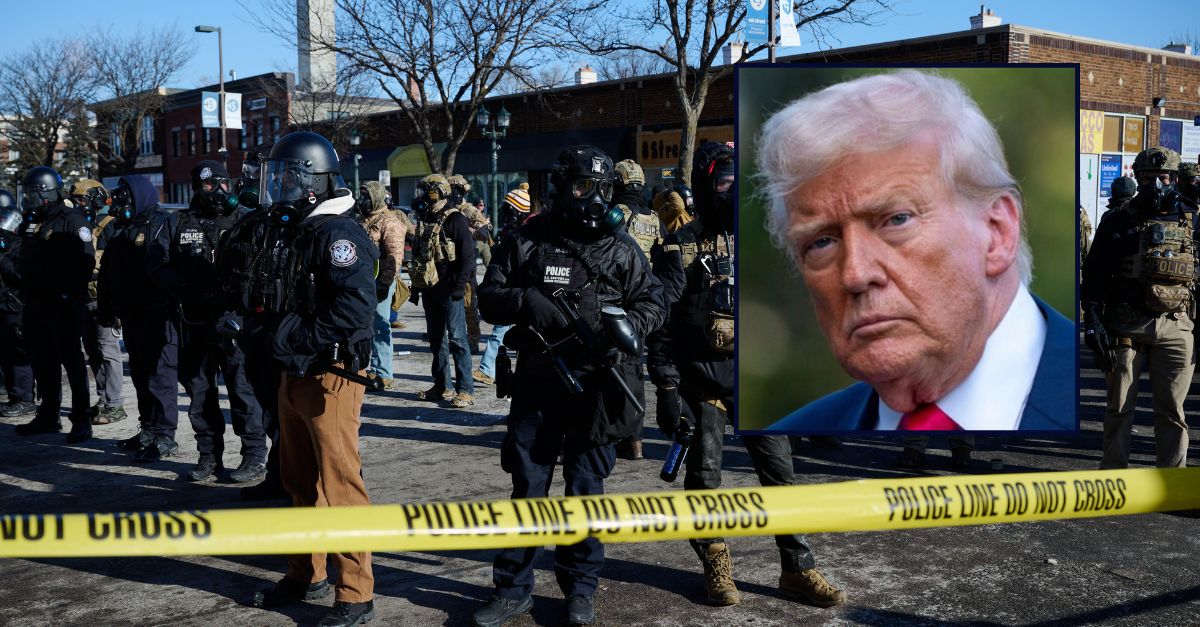
Inset: President Donald Trump walks from Marine One after arriving on the South Lawn of the White House, Tuesday, July 15, 2025, in Washington (AP Photo/Alex Brandon, File). Background: Demonstrators gather in south Minneapolis, Minnesota, on Jan. 24, 2026, after a man is shot and killed by U.S. Immigration and Customs Enforcement agents earlier that morning, according to officials. (Christian Zander/NurPhoto via AP).
For the second time in as many weeks, the Trump administration lost the argument over indefinite detention of immigrants in a ruling that cabins the authority of Immigration and Customs Enforcement (ICE).
On July 8, 2025, ICE issued the new policy, instructing agents to deny bond for anyone who entered the country without “inspection,” in a memo that has since opened the floodgates of litigation as dozens of detained individuals have filed petitions for a writ of habeas corpus.
Under the terms of the policy, such immigrants are to be detained “for the duration of their removal proceedings” unless granted parole – a rarer form of release. In real terms, however, the Trump administration had made clear such detentions are intended to be indefinite.
On Wednesday evening, a 2-1 panel on the U.S. Court of Appeals for the 11th Circuit rejected the government”s novel interpretation of the Immigration and Nationality Act (INA), reinforcing a circuit split and setting up a glide path for the U.S. Supreme Court to resolve the issue.
The policy in question comes from a long-standing section of the INA that says certain immigrants “shall be detained for a proceeding.” Historically, this statute has only applied to immigrants stopped at the border. Now, however, the Trump administration says immigrants detained in the country “may not be released from ICE custody.”
Since last summer, in hundreds of disputes before district courts, judges have considered the interplay between — and applicability of — two distinct statutes outlining the government’s detention authority, using language from a 2018 U.S. Supreme Court ruling.
The government claims ICE has the authority to subject immigrants to mandatory detention under 8 U.S.C. §1225(b), which applies to “aliens seeking entry into the United States.”
Advocates for immigrants — as well as most judges who have ruled on the matter — have instead turned to 8 U.S.C. §1226(a), which applies to “aliens already present in the United States.”
Notably, 425 district court judges, including many appointed by President Donald Trump himself, have rejected ICE’s position about its detention authority, according to a rolling analysis of court rulings by Politico’s Kyle Cheney.
Now, settling the dispute at the 11th Circuit, at least, an appeals court has, for the second time, ruled against ICE’s position.
The majority opinion frames the question as “whether unadmitted aliens found in the interior of the United States are eligible for bond while they go through immigration proceedings.” The opinion quickly notes that for “nearly thirty years,” the answer has been “yes.”
Recently, of course, the Department of Homeland Security (DHS) issued a “new reading” that would mean such immigrants “must be detained without the possibility of bond,” the opinion explains.
Then, the court elaborates on the real-world implications of the case before them – immigrants taken into custody by ICE who were told they would be “detained without the possibility of a bond hearing.”
The majority does not waste time in rejecting the redefinition:
We are unpersuaded by the Government’s re-interpretation of § 1225(b)(2)(A). That provision limits no-bond detention to applicants for admission who are “seeking admission,” and on the facts of this case, neither Petitioner was seeking lawful entry into the United States after inspection by an immigration officer when he was arrested, nor was either Petitioner taking any cognizable step to obtain the rights and privileges of lawful entry. In fact, neither Petitioner was pursuing any object, let alone “lawful entry,” when he was detained following a traffic stop.
To hear the majority tell it, the “text and statutory structure of the INA” as well as the “long history of detention across our immigration laws and the congressional purpose” of the law “yield the conclusion that no-bond detention generally applies to arriving aliens seeking lawful entry to the country, and not to aliens who are simply present here.”
In other words, the 11th Circuit has rejected the government’s efforts to conflate the phrases “applicant for admission” and “seeking admission” – both of which appear in the text of §1225(b).
“[T]he statute defines ‘applicant for admission’ to be a passive condition, and ‘deems’ an alien to be an applicant merely by arriving or being present in the United States without having been admitted,” the court explains. The majority goes on to define the second phrase, without the help of the statute, as “indicating an affirmative step of search or pursuit.”
The court added that the process of seeking admission “is a legally salient act under the INA.”
“The consequences of doing so stretch beyond securing a right to enter or remain in the United States,” the majority explains. “This tees up a legal fiction of considerable importance in the INA – an alien may be lawfully present in the United States, but nevertheless not ‘admitted.'”
The court then offered the upshot of this understanding, at length:
Petitioners do not fall within the scope of § 1225(b)(2)(A). All agree that Petitioners satisfy the first condition of being “present in the United States without having been admitted,” because they were discovered in the interior but were never granted lawful entry. However, on this record, we cannot also say that they were “seeking lawful entry after inspection and authorization by an immigration officer” when they were detained. Petitioners were not applying for entry in any literal sense when they were detained following a traffic stop, nor were they taking any cognizable step to obtain the rights and privileges of lawful entry. They were only present in the country.
Another section of the analysis rubbishes an even newer argument offered by the Trump administration. In defending the policy, the DOJ has taken to arguing that detained immigrants put themselves into the “seeking admission” category by failing to self-deport.
“[S]eeking relief from removal is not the same thing as seeking admission,” the appeals court says. “[T]he notion that contesting one’s removal under [the INA] constitutes ‘seeking admission’ profoundly oversimplifies the manner in which removal may be contested.”
In reaching its conclusion, the 11th Circuit implicitly rejected pro-detention analyses issued by the 5th Circuit and 8th Circuit. The dissent, for its part, complained that the majority ignored how those two circuits defined the operative phrases.
But, for the majority, the answer to the question is in the law itself.
“Simply put, the language that Congress has chosen to use does not grant to the Executive unfettered authority to detain, without the possibility of bond, every unadmitted alien present in the country,” the opinion goes on. “Nowhere in the text, structure, or history of the INA does that reading find steady footing.”


