
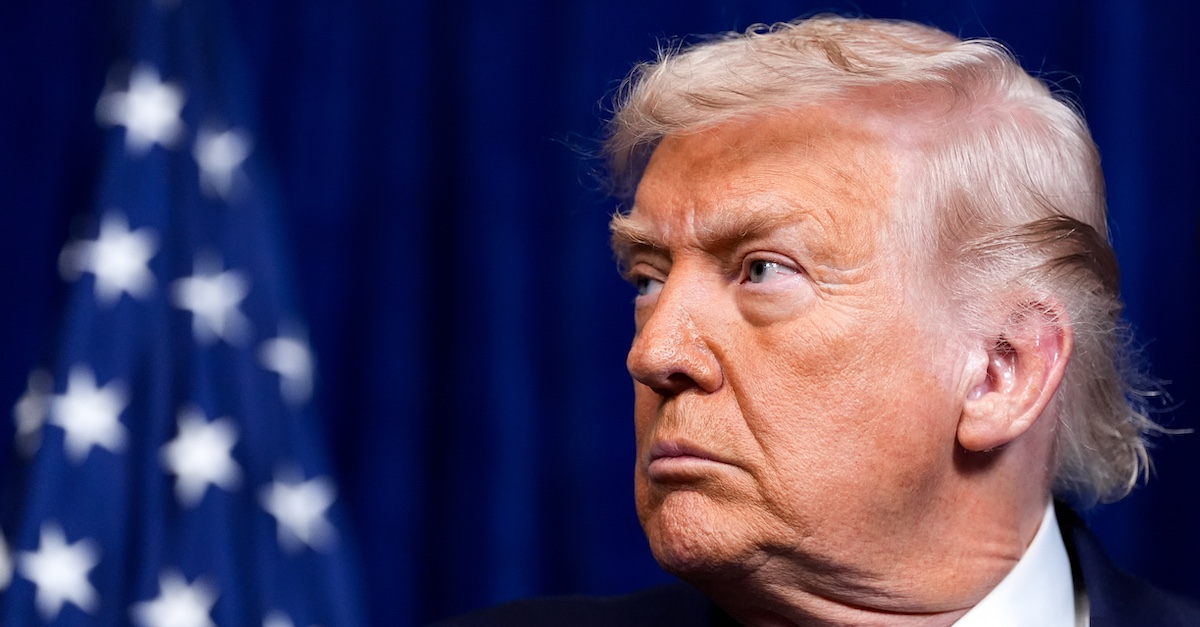
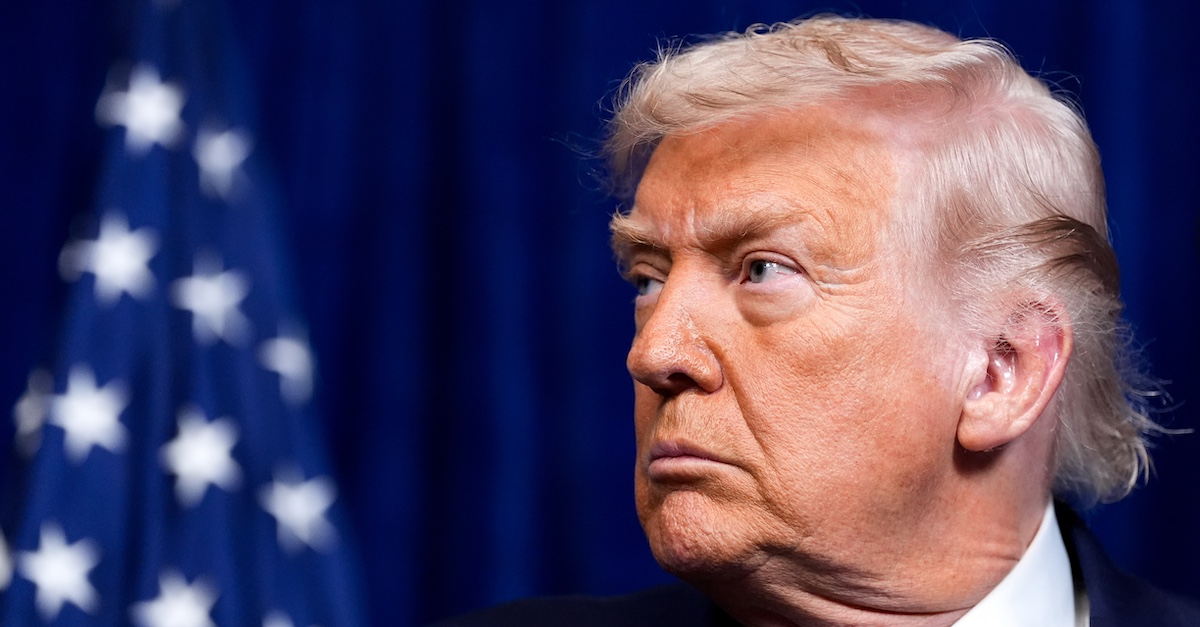
President Donald Trump attends a joint news conference with Ukraine”s President Volodymyr Zelenskyy following a meeting at Trump’s Mar-a-Lago club, Sunday, Dec. 28, 2025, in Palm Beach, Fla. (AP Photo/Alex Brandon).
The Trump administration looks primed for a major loss in its efforts to erase from the books a nearly 30-year-old settlement agreement that keeps in place stringent court-mandated oversight on the treatment of immigrant children in federal custody.
The U.S. Court of Appeals for the 9th Circuit heard oral arguments on Tuesday from the U.S. Department of Justice defendants and the technical plaintiffs in the case. The federal government, of course, is the moving party now challenging the decades-old settlement.
Attorneys for both sides were quizzed by the three-judge panel sitting in Seattle, but the lion’s share of judicial disdain and skepticism seemed to be reserved for the Trump administration.
At one point, the government’s attorney attempted to offer wry commentary on the staying power of the settlement agreement.
“The plaintiffs got more than they bargained for in 1997 — which was a five-year that was then extended indefinitely,” he said.
One of the judges took issue with that framing.
“Well, it wasn’t extended indefinitely,” she said. “It was extended until certain regulations compliant with the agreement were enacted.”
The underlying litigation is something of a perennial fixture on the federal docket when President Donald Trump is in the White House.
In June 2018, at the height of the family separation crisis, the DOJ under Jeff Sessions moved for an exception to the settlement agreement — which a judge denied the next month. Then, the first Trump administration tried to end the settlement agreement entirely — and failed in turn.
Under the terms of the 1997 Flores settlement agreement, immigrant children must be held at “state-licensed” facilities — treated properly and humanely — before being released into the custody of family members or guardians “as expeditiously as possible.” The settlement is named after Jenny Lisette Flores, a 15-year-old detainee on whose behalf the American Civil Liberties Union (ACLU) and the Center for Human Rights and Constitutional Law sued in 1985.
For years, the administration of the settlement has been in the hands of Chief U.S. District Judge Dolly Gee, a Barack Obama appointee.
Last year, the Trump administration began trying to scrub away Flores yet again. By last summer, Gee again rubbished the notion — categorizing the government’s arguments as “deja vu.”
“The court remains unconvinced,” Gee wrote in August 2025. “There is nothing new under the sun regarding the facts or the law.”
Brett Shumate, appearing for the DOJ, did not get a sentence out before he was interrupted by one of the judges who took note of Gee’s frustration with the government’s repeated efforts in the case.
“Basically the government has come up with a lot of different reasons it doesn’t want to follow the settlement agreement, it doesn’t have to, it’s not meaningful,” the judge said. “Is it the position of the current administration that it’s not gonna follow whatever we say about the settlement agreement — it’s gonna go ahead and do what it wants? Is that a fair statement?”
The government attorney disagreed.
“Our position in this case is that the Flores consent decree is a binding court order but it should be terminated,” Shumate said. “We think it’s time for this important aspect of federal immigration policy to finally be returned to the executive branch.”
To hear the government tell it, the major reasons to end Flores are three-pronged. Shumate said the DOJ’s three major arguments are that there is “no underlying violation of federal law,” that “there is no end in sight,” and “there is no jurisdiction.”
As the attorney attempted to launch into his speech again, he was sidelined by another judge who asked him to explain what he meant when he said there was no violation of federal law.
“Our argument is that there is no, not currently, any underlying violation of federal law, and therefore the agreement must be terminated,” Shumate said.
The thrust of the government’s argument is that the Department of Homeland Security (DHS), in 2019, instituted a series of regulations — which the attorney referred to as “durable remedies in place.”
Those regulations have not been allowed to take effect because they are insufficient under the Flores agreement, the DOJ argued.
“What we’re asking for is the court to allow those regulations to take effect and for the settlement agreement to no longer micromanage in a key aspect of federal immigration policy,” Shumate said.
The Flores agreement was reached to correct a number of deficiencies regarding the detention of immigrant children. The government says it has a suite of reforms that can bring DHS into compliance on its own — without the judiciary’s further involvement. Shumate says this is necessary due to the history of the case itself.
The government actually won before the U.S. Supreme Court in 1992 on distinct questions of due process rights. The nation’s high court then remanded the case to the lower courts to reach a final decision — but the two sides settled before a ruling on the merits.
Now, the government believes it is entitled to craft immigrant child detention policy in line with the Supreme Court’s guidance.
“If you terminate the consent decree, the regulations will be allowed to take effect,” the government attorney explained.
So, taking the opportunity, one of the judges pushed Shumate on a series of hypotheticals about what such a policy might entail — in a clear attempt to highlight what she saw as “substantial” and “serious” problems with due process rights for children detained in so-called “family centers.”
The results were disastrous for the government.
“Does DHS have any regulations that accompanied children have to have some sort of hearing to see if they should be release to people outside of these quite restrictive detention facilities?” the judge asked.
Shumate answered in the negative — saying that was one of the reasons the 2019 DHS programs were never instituted.
“You’ve said that a lot of the reason you are doing this is to discourage families from coming in the first place,” the judge went on. “So, you’re basically punishing children because their parents brought them. And they’re going to be in these very destructive facilities. You’re saying there’s no constitutional problem there? Or what?”
The government attorney, back on his heels, tried to answer: “Your honor, I understand that the detention of children at the border is a controversial policy issue but that’s a policy decision that needs to be made by policy makers.”
Interjecting and waving one hand, the judge said: “You’re saying there’s no possible constitutional problem however you keep the children, whether you let them out or not, and whatever conditions you keep them in. There’s not a constitutional problem — is that what you’re saying?”
“I’m not saying that,” Shumate shot back, sounding a bit exasperated. “I’m saying the plaintiffs have not alleged or brought that type of claim here. They’ve litigated this case for 30 years on the premise that—.”
The judge again cut the government attorney off to say: “Of course they have. That’s what they’ve been trying do to get the agreement enforced by demonstrating that these things are happening.”
Chris Perez and Jerry Lambe contributed to this report.


