
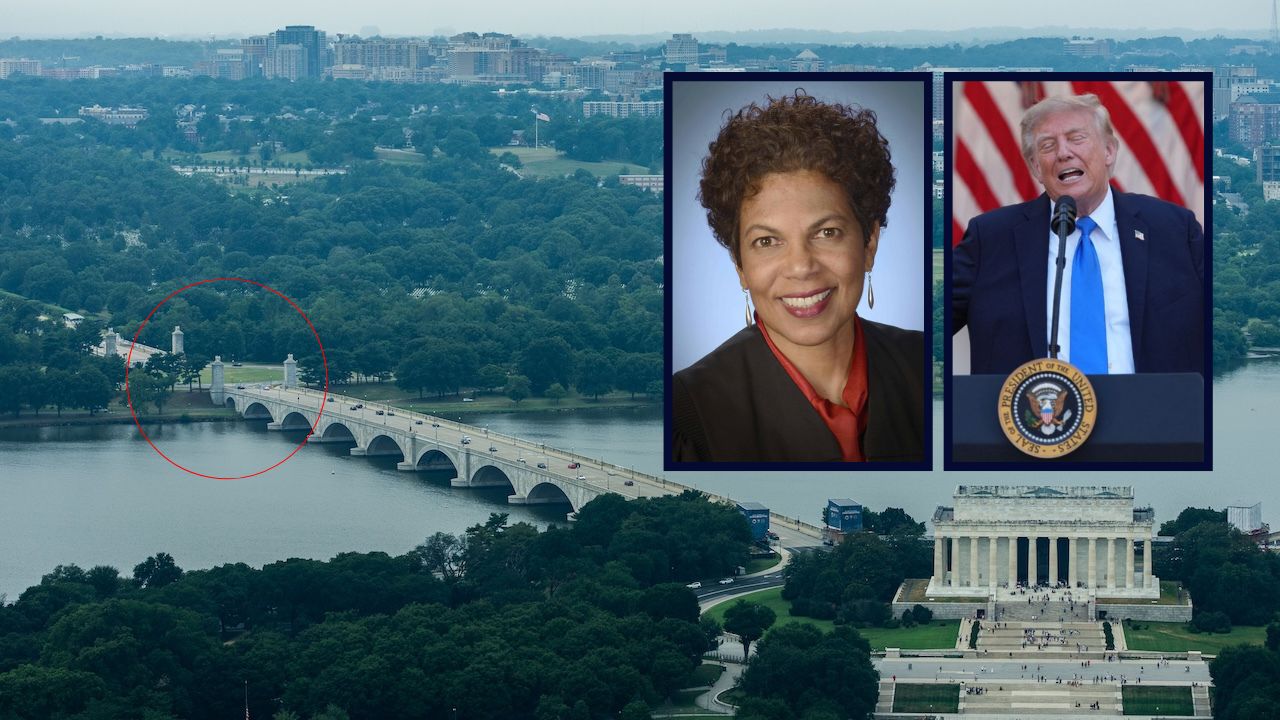
Main: Memorial Circle, where President Donald Trump has proposed building an arch to commemorate the United States’ 250th anniversary, the Arlington Memorial Bridge and the Lincoln Memorial are seen from the Washington Monument, Thursday, July 9, 2026, in Washington (AP Photo/Julia Demaree Nikhinson). Left inset: U.S. District Judge Tanya Chutkan (U.S. District Court for the District of Columbia). Right inset: President Donald Trump speaks during an event with Republican lawmakers in the Rose Garden of the White House, Wednesday, Sept. 2, 2026, in Washington (AP Photo/Alex Brandon).
Vietnam veterans who sued over President Donald Trump’s “Great Triumphal Arch” have asked a federal judge to issue an injunction quickly —no later than one day before “construction may start” — so the project doesn’t become a ballroom-like “fait accompli.”
Represented by Public Citizen Litigation Group, plaintiffs Michael Lemmon, Shaun Byrnes, Jon Gundersen and architectural historian Calder Loth said in an 18-page memorandum on Thursday that the Trump administration is “rapidly” moving toward constructing the arch and the National Park Service (NPS) signaled in a notice that construction may begin at Memorial Circle as soon as Nov. 5.
That is why they are asking U.S. District Judge Tanya Chutkan to issue a preliminary injunction by Nov. 4.
Love true crime? Sign up for our newsletter, The Law&Crime Docket, to get the latest real-life crime stories delivered right to your inbox.
“Defendants have barreled ahead, doing site testing, drawing architectural plans, and seeking approvals from commissions populated by friends of the administration. Yet, throughout this time, Defendants have failed to obtain (or even to seek) approval from the one body that, by law, must authorize the project: Congress,” the memo said.
The plaintiffs said that they “regularly visit the area” to “honor the service” of “comrades-in-arms who are buried” at Arlington National Cemetery.
According to the complaint, the arch “will inflict profound harm […] by interfering with a symbolic landscape that holds great personal meaning” — “destroy[ing]” an “unobstructed view” of a sight line “designed to represent the unification of the Nation following the Civil War.”
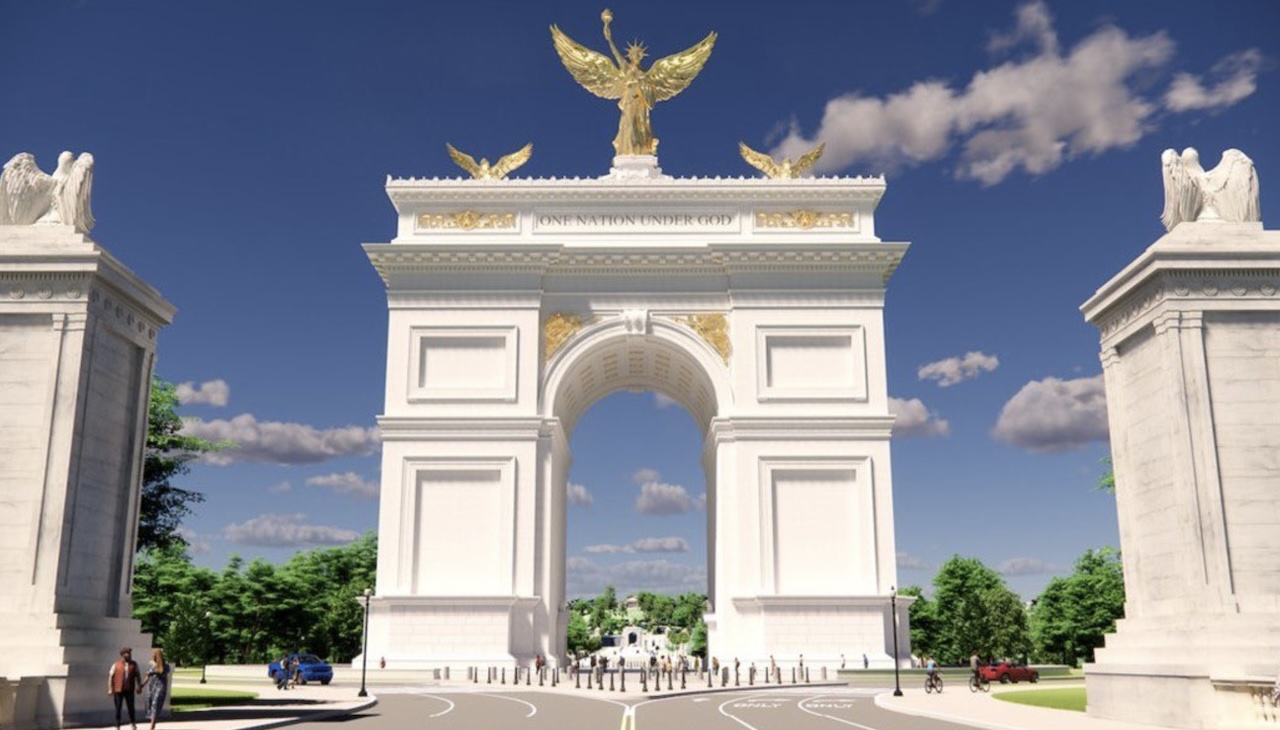
An artistic rendering of the arch-to-be shared by Secretary Doug Burgum (Department of Interior).
To support their case that the defendants’ “plans are unlawful,” the plaintiffs said NPS’ “own assessments” have “revealed that the arch will have significant adverse effects on more than 40 historical sites” — and yet they “have not faltered in their commitment to build the arch.”
The filing then took aim at the “sole source of legal authority” cited for constructing the arch for America’s 250th anniversary, saying that it can’t be right that the Act of Feb. 24, 1925, to build the Arlington Memorial Bridge “authorize[d] a massive monumental arch to commemorate a national anniversary that, at the time of the statute’s enactment, lay more than a century in the future[.]”
“The bridge was completed over ninety years ago, in accordance with the statutory requirements. And while plans from 1924 included two columns (but not an arch), the Commission that Congress authorized to design the bridge removed them, and the project was completed without them,” the plaintiffs said. “Defendants’ contention that the statute authorizes limitless initiation of new Executive projects, at whatever cost, indefinitely into the future, is entirely untethered from the Act’s text.”
Chutkan, a Barack Obama appointee who presided over special counsel Jack Smith’s since-dismissed Jan. 6 prosecution of then-candidate Trump, now faces a request not to allow the Trump administration to “blaze ahead.”
“This Court should enter a preliminary injunction blocking Defendants from beginning construction on Memorial Circle in the hope that they can render the arch a fait accompli before this Court has made a final determination whether Defendants’ project is unlawful,” the filing added, referring to the Supreme Court’s ballroom decision as a “cautionary tale.”
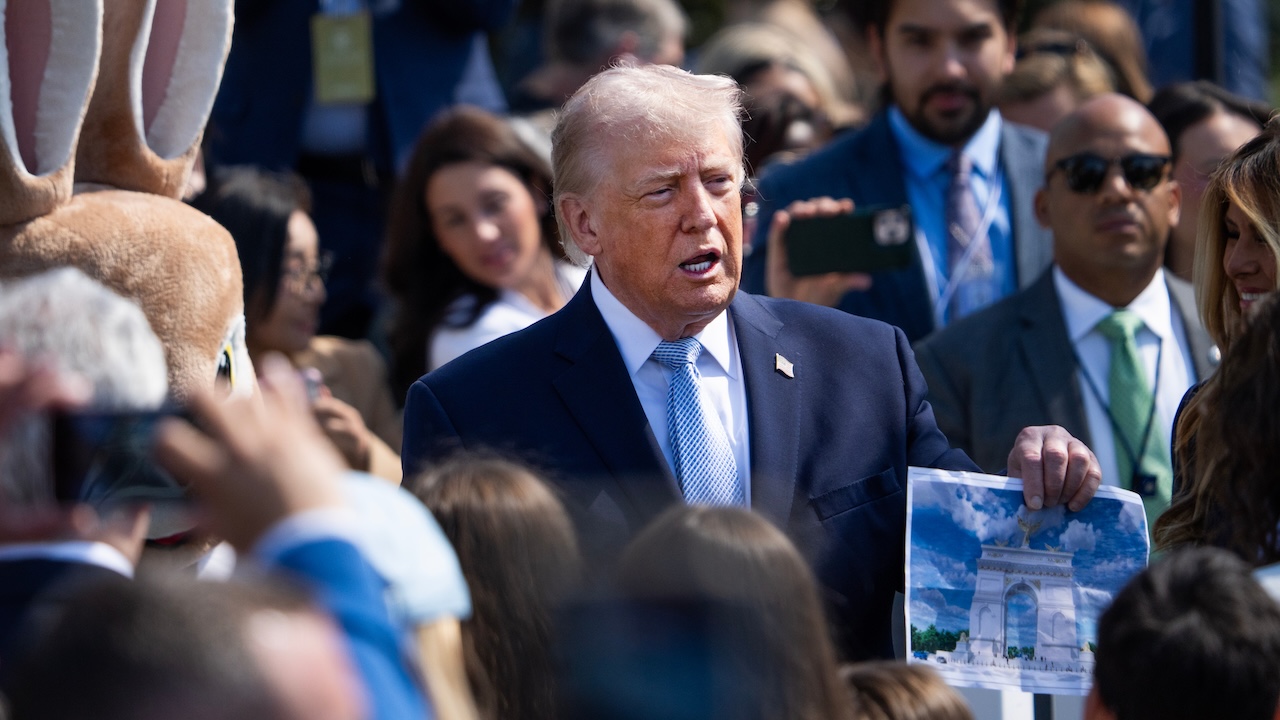
President Donald Trump holds a picture of the proposed Triumphal Arch, on the South Lawn during the White House Easter Egg Roll on Monday, April 6, 2026 (Tom Williams/CQ Roll Call via AP Images).
Public Citizen attorney Wendy Liu said in a statement that the “law is clear” on the point that “Trump’s arch cannot move forward without congressional approval.”
A separate pending federal lawsuit filed in Virginia by the Arlington County Board focused on Trump’s “surprise” after-the-fact ballroom-esque announcement that the arch would also be a “top grade Military Complex/Triumphal Arch” to “house, store, and have the rapid ability to use large numbers of drones, plus Snipers.”
That was also proof that the construction project will “cause significant harm to Arlington County and its residents,” the suit said.
The post Challengers of Trump’s ‘Great Triumphal Arch’ tell ballroom ‘cautionary tale,’ ask judge not to let president ‘blaze ahead’ first appeared on Law & Crime.


