
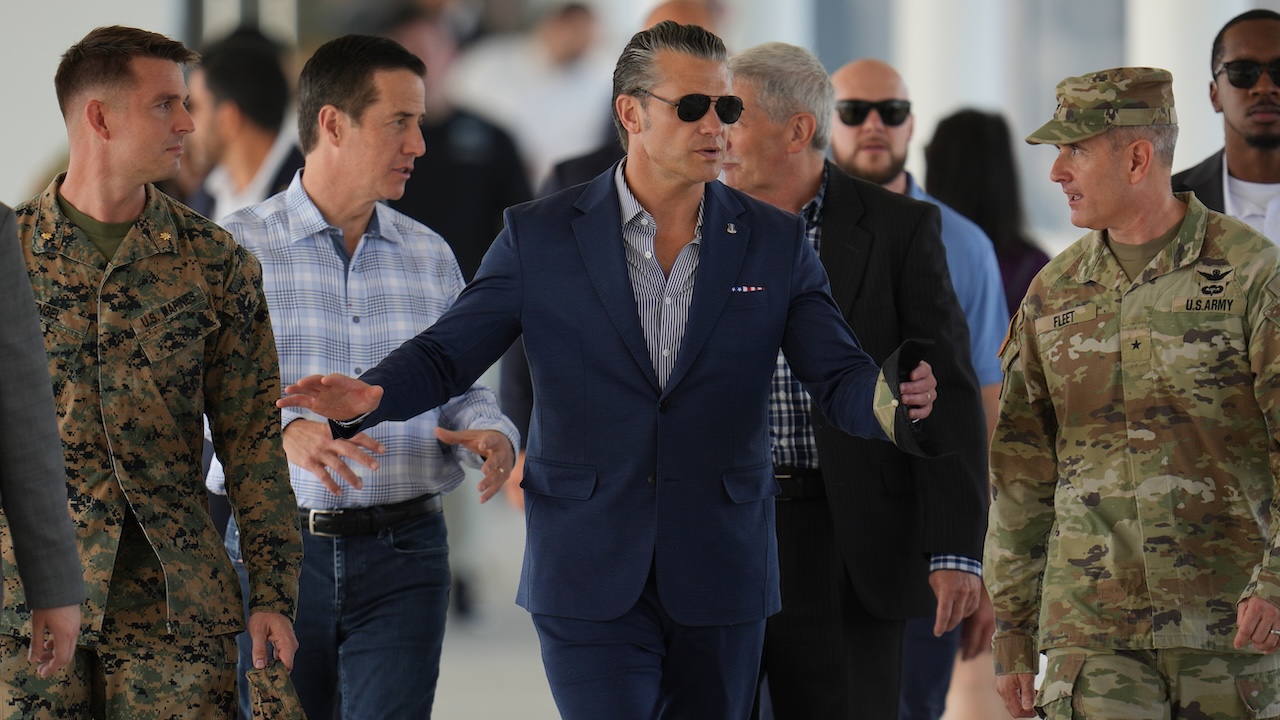
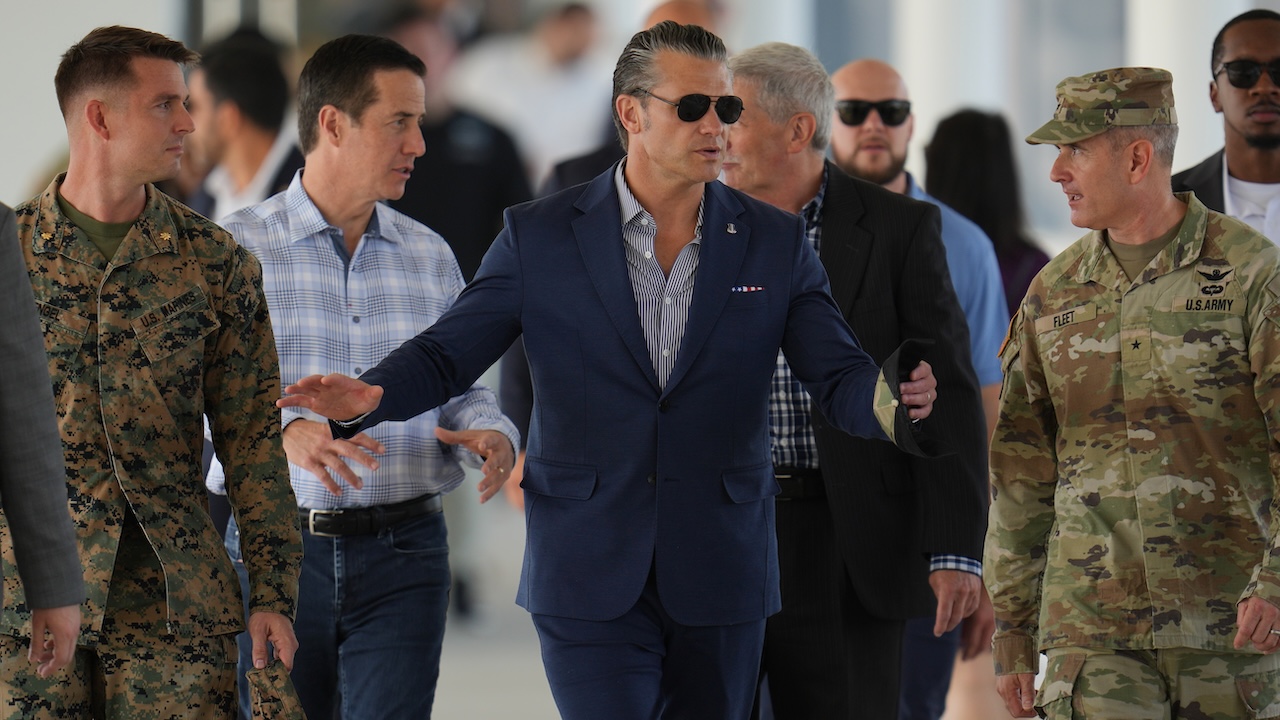
U.S. Defense Secretary Pete Hegseth arrives to observe a U.S.-sponsored multinational military exercise in Panama City, Thursday, Aug. 13, 2026 (AP Photo/Matias Delacroix).
Defense Secretary Pete Hegseth raised “deeply sobering” concerns about military contractor Anthropic’s use restrictions on its AI model “did not transgress any limits” on his authority when he excluded Claude from the supply chain, a federal appellate panel ruled in a 2-1 decision on Friday.
When the U.S. Court of Appeals for the District of Columbia Circuit held oral argument in May, it was clear that U.S. Circuit Judge Gregory Katsas and U.S. Circuit Judge Neomi Rao were leaning one way, while U.S. Circuit Judge Karen LeCraft Henderson stood alone in calling Hegseth’s action “just a spectacular overreach by the department.”
On Friday, Katsas led the majority opinion, which his fellow Donald Trump-appointed colleague Rao joined, leaving the George H.W. Bush-appointed Henderson with the lone dissent.
Love true crime? Sign up for our newsletter, The Law&Crime Docket, to get the latest real-life crime stories delivered right to your inbox.
“This case raises profoundly difficult questions about the appropriate military uses of an almost unimaginably powerful new technology. The Secretary raises the deeply sobering prospect of overly constrained AI models shutting down unexpectedly and thus causing important military operations to fail,” Katsas said, adding that Anthropic likewise “raises the deeply sobering prospect of unconstrained AI models hallucinating inappropriate targets for lethal military force.”
“Both possibilities present obvious national-security concerns. But in our Republic, it is the President and the Secretary of War who must determine how best to balance the competing risks,” Katsas and Rao decided. “In doing so here, the Secretary did not transgress any limits on his authority under the Supply Chain Security Act or the Constitution.”
The Defense Department had argued that any procedural errors were harmless and Hegseth’s determinations reflected his “considered national-security judgment,” to which the appellate judges should show deference. Anthropic, on the other hand, told the D.C. Circuit that the “textbook retaliation” campaign supported by falsehoods was evidence that this was “a supply-chain risk designation in search of a justification.”
Trump and Hegseth moved to sever all ties with the AI contractor in late February, posting that Anthropic was “WOKE” and “sanctimonious” for believing its model Claude could not and should not be used for “autonomous lethal warfare and mass surveillance of Americans.”
Anthropic CEO Dario Amodei had made a public statement explaining why he believed the “two exceptions” to Claude’s use matter at an “existential” level, and Trump responded by “directing EVERY Federal Agency in the United States Government to IMMEDIATELY CEASE all use of Anthropic’s technology.”
The designation of Anthropic as a “supply-chain risk and threat to national security” came days later.
Katsas and Rao saw no reason to question Hegseth’s conclusions, saying the “record in this case amply supports” that he “reasonably feared that Anthropic might manipulate Claude’s design to prevent it from performing national-security functions that the Department deems contractually authorized and necessary.”
“We reject these challenges. The Department had ample support for its conclusion that the continued integration of Claude into the Department’s information systems, by the Department or its contractors, presented a statutorily covered national-security risk,” the majority concluded. “As Anthropic admits, the company encodes restrictions into Claude that prevent the model from performing tasks that Anthropic wishes to prevent.”
Henderson, in a short dissent, said the Federal Acquisition Supply Chain Security Act (FASCSA) didn’t empower Hegseth’s designation.
“The Department here made good on its promise to designate Anthropic a supply chain risk after Anthropic declined the Secretary’s ultimatum to replace its use restrictions on Claude with a general provision permitting ‘all lawful uses,'” Henderson said. “But suppose the Secretary tells Anthropic’s presumed replacement to change its AI-use policies to permit any ‘functions that the Department deems necessary’ or it will share the same fate as Anthropic.”
“According to today’s decision, that contractor will have a choice: Agree to the Secretary’s demands or risk being designated a national security threat under FASCSA,” she added. “I cannot agree that this is the scenario the Congress had in mind when it enacted FASCSA.”
The post ‘Did not transgress any limits’: Appeals court backs Pete Hegseth’s ‘deeply sobering’ concerns about ‘almost unimaginably powerful’ tech first appeared on Law & Crime.


