
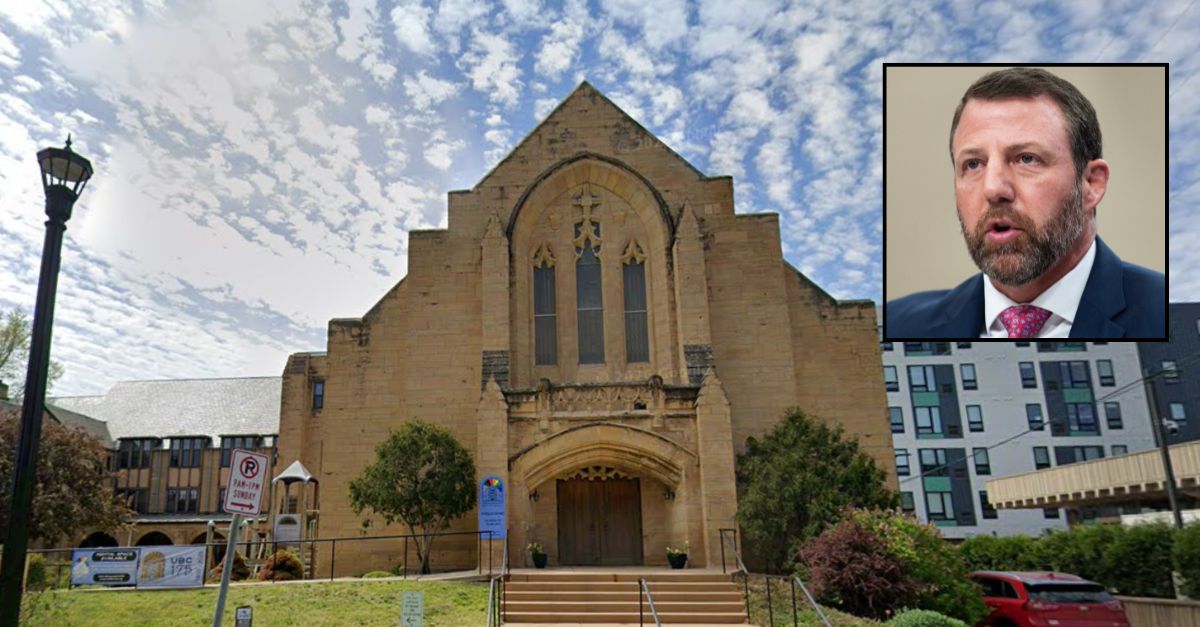
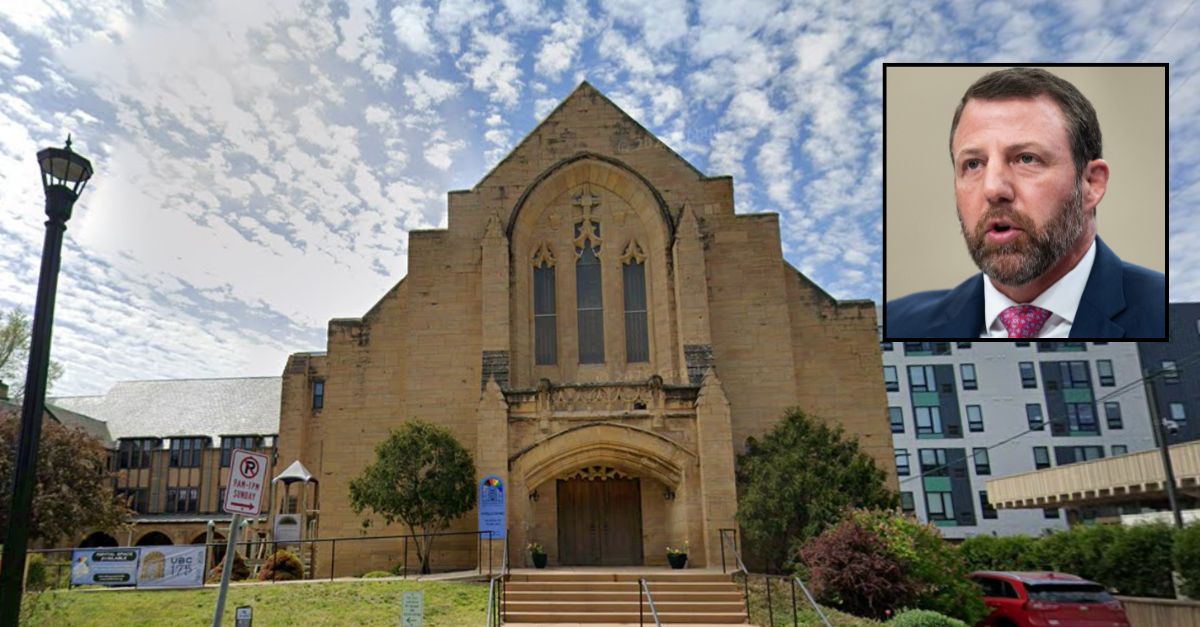
Background: University Baptist Church in Minneapolis, Minnesota (Google Maps). Inset: Department of Homeland Security Secretary Markwayne Mullin testifies during the House Appropriations Subcommittee on Homeland Security hearing titled “Oversight Hearing – Department of Homeland Security,” in Rayburn building on Thursday, June 25, 2026. (Tom Williams/CQ Roll Call via AP Images).
A judge is demanding that the Trump administration explain itself after federal agents apparently violated a court order not to conduct surveillance inside places of worship.
U.S. District Judge F. Dennis Saylor wants answers from the Department of Homeland Security (DHS) and its leaders, including DHS head Markwayne Mullin, as to “why they should not be held in contempt for violating the preliminary injunction” he set in place in February.
The case boils down to religious freedoms protected by the Religious Freedom Restoration Act (RFRA) and the First Amendment that groups have argued DHS and its subagency, Immigration and Customs Enforcement (ICE), have broken in their apparent attempts at immigration enforcement in the U.S.
Love true crime? Sign up for our newsletter, The Law&Crime Docket, to get the latest real-life crime stories delivered right to your inbox.
In July 2025, religious groups such as New England Synod and the Evangelical Lutheran Church in America filed a complaint in Massachusetts alleging that — through a new rescission of a “prior sensitive locations policy” — DHS was running afoul of the RFRA and the Constitution.
As the complaint noted, instead of avoiding enforcement actions at places of worship “[t]o the fullest extent possible,” the January 2025 policy asks DHS agents to use “individual discretion” guided by “common sense.”
“For Plaintiffs and their members, the present threat of surveillance, interrogation, or arrest at their houses of worship means, among other things, fewer congregants participating in communal worship; a diminished ability to provide or participate in religious ministries; and interference with their ability to fulfill their religious mandates, including their obligations to welcome all comers to worship and not to put any person in harm’s way,” the religious groups wrote. “Defendants’ rescission of longstanding protections for houses of worship and other sensitive religious locations is not just harmful and un-American; it violates federal law.”
The religious groups sought a preliminary injunction, and though DHS responded that same summer maintaining that the plaintiffs were not actually harmed by their actions, Saylor found that such a court order was warranted.
If the “freedom to believe,” as well as worship and attend religious gatherings, should be interfered with by the government, “it is only in relatively extreme circumstances, such as an immediate threat to public safety,” the judge wrote this past February. “The routine enforcement of the immigration laws does not involve such a threat, and cannot justify the harm to religious freedom posed by the new policy.”
The case continued on, and in the meantime, another case was born.
According to a new motion filed by the religious groups, DHS effectively admitted to violating the preliminary injunction in a series of filings in an ongoing criminal proceeding in Minnesota. As Law&Crime previously reported, in those documents filed earlier this month, DHS said an ICE agent took part in “boxing/sparring practice” during a mixed martial arts meeting called “Left Jab” at University Baptist Church in Minneapolis in May.
“Due to the physicality of the event, [the undercover agent’s] concealed body-worn audio recorder erroneously fell to the floor of the gymnasium near the end of the training,” an investigative note in one document reads. “[The undercover agent] briefly left the gymnasium, realized she no longer had the device, and returned to the gymnasium to retrieve the device from the floor.”
The undercover agent was “surveilling and recording attendees in the church gymnasium for approximately two hours,” the motion contends. The filing adds, “the gymnasium is located within the church building, immediately below the sanctuary.”
In that same investigation, DHS also filed court records that show ICE agents were conducting surveillance “in the area of the University Baptist Church” and photographing license plates in April.
“[An agent] drove through the library parking lot to check which vehicles had departed once the individuals exited the church,” the second DHS filing reads. “Three of the vehicles had departed. Registration checks were conducted on those vehicles.”
The religious groups said DHS’s actions were “blatant and repeated” and caused “harm to fundamental rights of religion and expressive association.” They asked for “expedited consideration” of their motion for the agency to respond.
According to the docket, DHS has until Friday to give the jurist answers, and a hearing has been scheduled for Sept. 4.
The post Judge demands answers from Trump admin over its apparent violation of court order while surveilling church first appeared on Law & Crime.


