
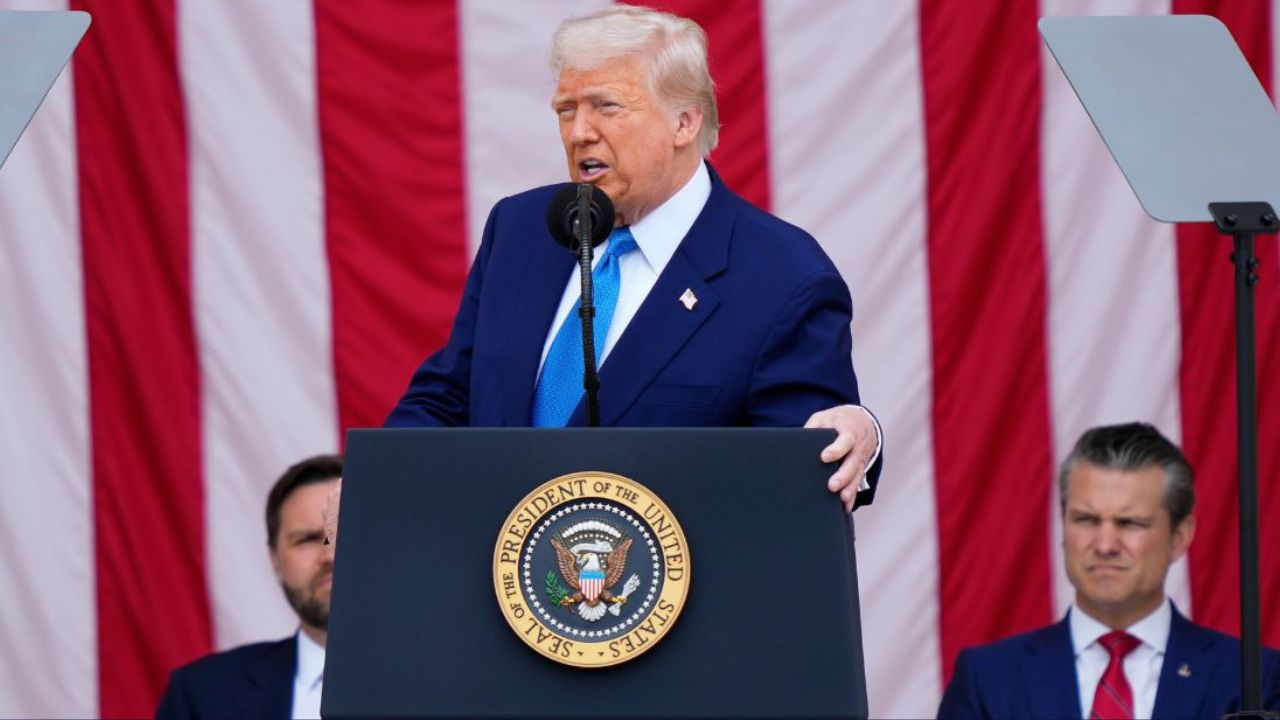
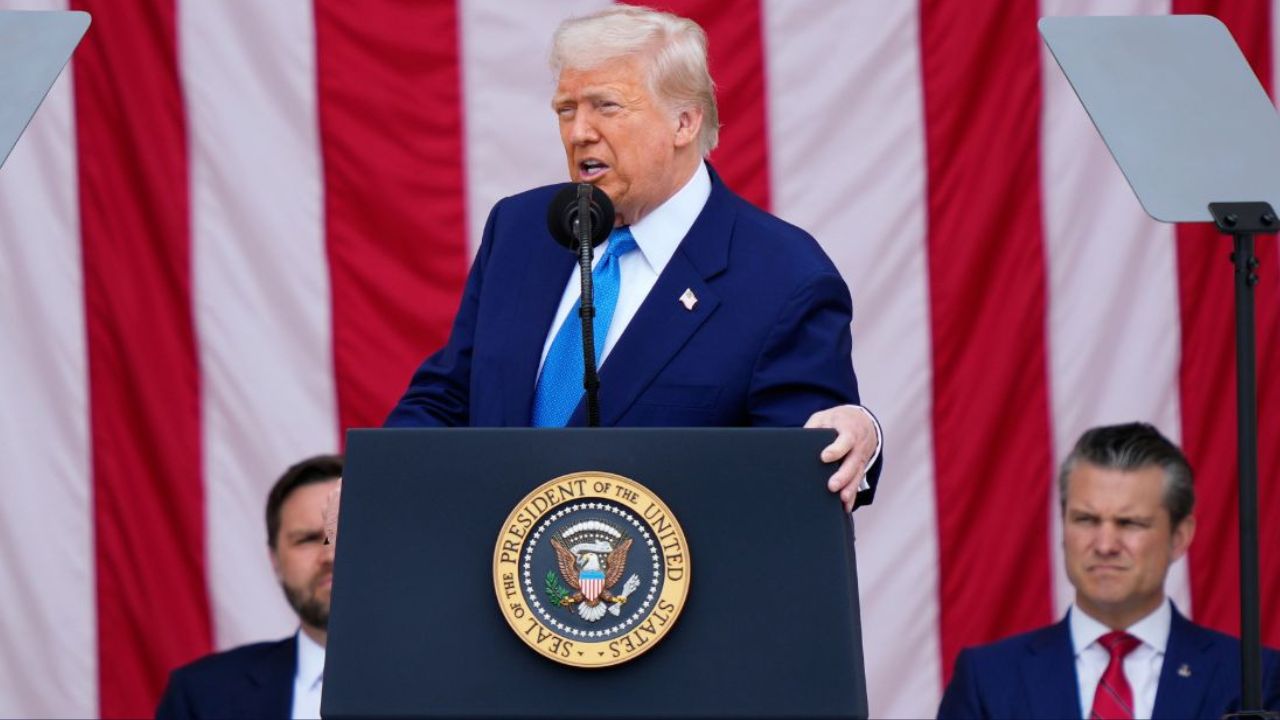
President Donald Trump delivers the Memorial Day Address at the 157th National Memorial Day Observance at Arlington National Cemetery, Monday, May 26, 2025, in Arlington, Va., as Vice President JD Vance and Secretary of Defense Pete Hegseth, right, look on (AP Photo/Julia Demaree Nikhinson).
A federal judge in Manhattan repudiated an effort by the Trump administration to reconsider an order requiring the government to reveal its justification for fatal attacks on boats in the Caribbean.
In a 16-page ruling issued Tuesday, U.S. District Judge Paul Engelmayer, a Barack Obama appointee, flatly rejected various arguments advanced by the U.S. Department of Justice for keeping an Office of Legal Counsel (OLC) memo on the subject — as well as basic information and arguments about the memo — entirely under wraps.
In August 2025, operating on a presidential directive authorizing military force against “foreign criminal groups,” the Department of Defense (DOD) began attacking boats it claimed were trafficking drugs into the country. Some 234 people have been killed in those attacks, and the government has not provided evidence conclusively proving its claims, according to the underlying lawsuit filed by the American Civil Liberties Union and other groups.
Love true crime? Sign up for our newsletter, The Law&Crime Docket, to get the latest real-life crime stories delivered right to your inbox.
Litigation began in December 2025 after the ACLU filed a Freedom of Information Act (FOIA) request. In denying the request, and thus withholding the OLC memo in full, the DOD cited three separate exemptions to the nation’s premier government transparency law.
During motions practice, the parties considered two exemptions. In theory, these concessions would have allowed for a limited release of the OLC memo with redactions after the document was reviewed by the judge. The government, however, said one of those exemptions meant it could still withhold the OLC memo in full by citing a form of executive privilege.
In late September, Engelmayer rubbished the government’s position as relying on “secret law.” In a lengthy order, the court directed the government to provide the OLC memo for review behind closed doors, as well as arguments specific to the executive privilege question, before making a final decision on disclosure.
Earlier this month, the government asked the judge to revise the order to get rid of the “requirement for the government to identify all persons who have been given access to the OLC Memorandum.”
Engelmayer said that information was necessary “to assess defendants’ representations that access to the Memo has been limited and that the Memo has not been meaningfully disseminated beyond the President’s inner circle.”
The DOJ had argued the privilege in question could not be waived, that the court’s request was “based on a misapprehension of the law,” and was therefore “not germane” to the case at all.
But the judge was not having it.
“The Court’s order thus gave defendants—assuming their representations were true—a straightforward path to victory in this litigation: submit information that, by defendants’ account, was readily available and stood to support their position,” the order reads. “The defendants now, however, ask the Court to retract that order.”
To hear the Trump administration tell it, “the presidential communications privilege is incapable of being waived by the dissemination of the Memo within the Executive Branch,” the court explains.
On top of that, the government also claimed “it would offend the separation of powers for them to submit, for in camera judicial review, information regarding their dissemination of the Memo.”
“Each argument is baseless,” the judge said. “The Court accordingly denies defendants’ partial motion for reconsideration.”
The court first addressed the government’s claim that waiver by dissemination is unavailable as a matter of law.
“[T]hat is wrong,” the judge wrote. “[T]he case law uniformly holds that the privilege is subject to waiver, including where privileged materials have been disclosed to third parties outside the limited circle of presidential advisers and staff whose communications the privilege protects.”
The order goes on to note that there “is no contrary authority” to the case law cited in the original order requiring in camera review.
Engelmayer goes on to explain how the other arguments advanced by the government cannot get it out of its obligations.
“To the extent defendants argue that a waiver cannot have occurred with respect to the OLC Memo, that argument is both wrong and premature,” the order goes on. “[D]efendants’ bid for a rule that would allow officials to circulate, waiver-free, a presidential communication within the Executive Branch is at odds with a uniform body of case law emphasizing the privilege’s narrow contours.”
The order continues:
A bright-line rule that even wide downstream dissemination within the Executive Branch of a President’s privileged presidential communications could not effect a waiver would be inconsistent with the privilege’s narrow parameters[.]
The court went on to reject the government’s separation of powers argument as effectively nonsensical.
“Far from offending the separation of powers principle, a court-imposed information-gathering obligation on the Executive Branch is familiar as a means to test the viability of a FOIA exemption invoked by the Executive Branch,” the order says.
The government now has 14 days to supply the requested information, Engelmayer ordered.
The post Judge harshly rejects ‘baseless’ Trump admin arguments for withholding basic information about OLC memo on fatal boat strikes in the Caribbean, gives DOJ deadline first appeared on Law & Crime.


