
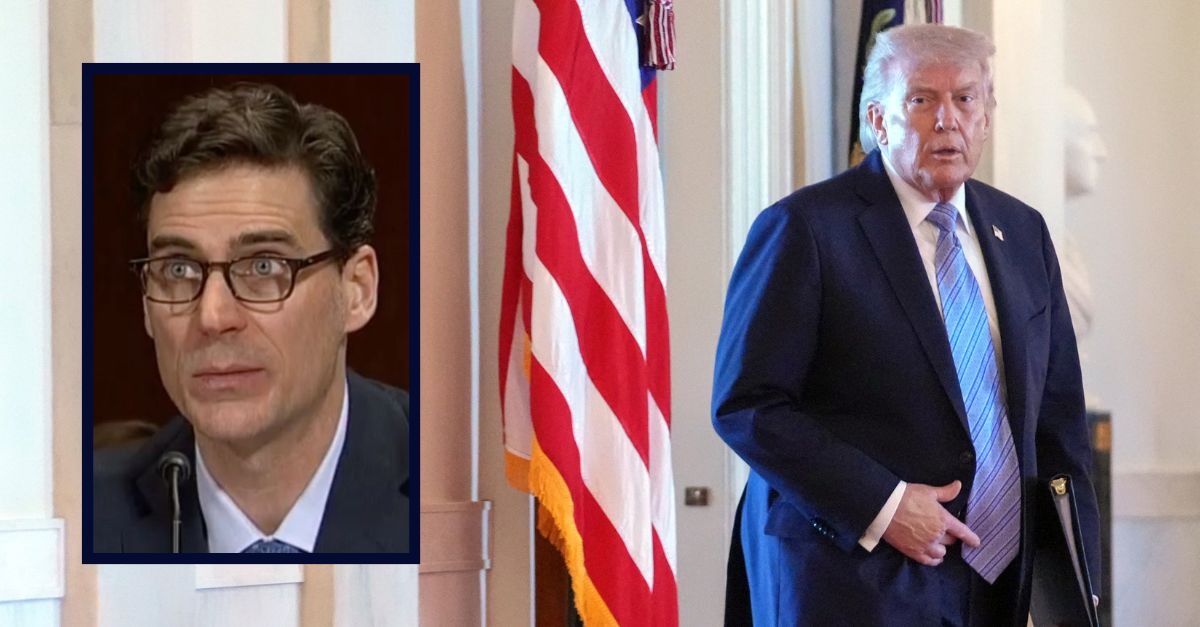
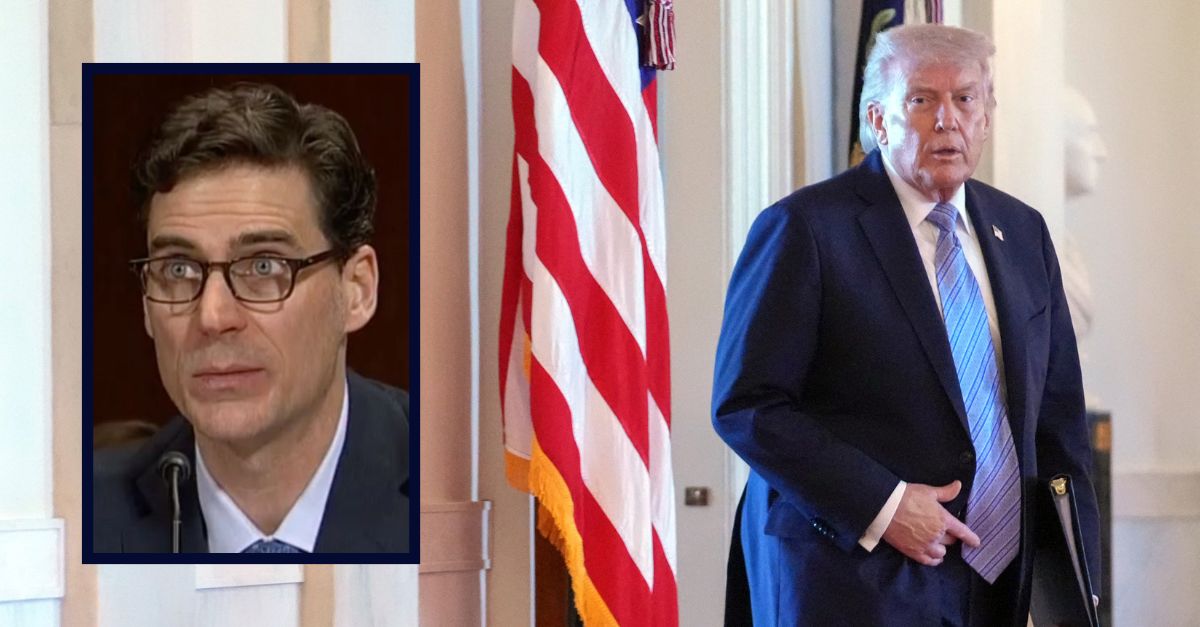
Main: President Donald Trump arrives for an event with small business leaders, Monday, May 4, 2026, in the East Room at the White House in Washington (AP Photo/Mark Schiefelbein). Left inset: U.S. District Judge J.P. Boulee pictured during a Senate Judiciary Committee hearing on Nov. 13, 2018 (CSPAN).
The judge presiding over a Fulton County, Georgia, demand for the return of all seized 2020 election ballots ruled Monday that three government witnesses” names should be made public for the simple reason that their identities are “already known.”
U.S. District Judge J.P. Boulee, a Donald Trump appointee, sided with Justin Glawe, a journalist who called it “bizarre” that the Trump administration tried to hide the names of individuals who are public officials whose titles appeared in the unsealed and redacted affidavits underlying the January search of the Fulton County Elections Hub.
“Currently, most of the witnesses—witnesses 1, 4, 5, 6, 7, 8 and 9—do not oppose their identities being revealed,” the judge noted. “Witnesses 2, 3 and 11, however, object to the removal of the redactions. The Court must thus decide whether the redactions as to witnesses 2, 3 and 11 should be removed.”
From the start of the case, Fulton County asserted that the Trump administration’s search warrants were “entirely devoid of probable cause” and the seizure of 2020 election ballots and tabulators was a “flagrant constitutional violation” supported by “witness speculation” and “speculative hearsay.” The county, for instance, traced the probe back to Kurt Olsen, a 2020 election denier turned director of election security and integrity who spoke with Trump several times on Jan. 6, 2021, and who tried to convince then-Acting Attorney General Jeffrey Rosen to back litigation that failed to overturn Joe Biden’s win at the U.S. Supreme Court.
While the DOJ argued that putting the names of its claimed election crime witnesses out there would raise “concerns over privacy, retaliation, and/or harassment associated with official confirmation of their providing evidence in a criminal investigation,” the judge said the combination of public reporting about witnesses 2, 3 and 11 and the fact that government documents identified them by their positions made naming them mandatory.
“By way of background, the Affidavits describe witness 2 as the ‘Republican-appointed member of the Georgia State Election Board’ and state that, prior to serving on the SEB, witness 2 was an obstetrician. As to the other witnesses, the Affidavits state that witness 3 is ‘the current House-appointed [SEB] member’ and that witness 11 is a current Fulton County Commissioner who worked as a poll worker during the 2020 election,” Boulee said. “Both parties seemingly admit that, even though the names are redacted, the identities of the witnesses are already known to the public (‘It seems like everybody knows who these 11 people are, yet here we are … arguing about it.’).”
From here, the judge hyperlinked to reports from 11Alive and the Atlanta Journal-Constitution, which noted that the Republican commissioner is Bridget Thorne and one SEB member is Janelle King. Glawe said in his own reporting that SEB member Dr. Janice Johnston was “obviously” the obstetrician referenced by the government.
“[I]t is undeniable that the 2020 election and the seizure of the election records are historically significant matters and that granting full access to the Affidavits is likely to promote public understanding of these events. The Court also cannot ignore that the redacted information concerns both public officials and a matter of public concern,” Boulee said. “Indeed, each of the witnesses currently holds a public office related to elections in Georgia and the underlying search at issue in this case involves a Georgia election.”
And if the DOJ was so concerned about privacy, then the details that helped identify the witnesses “should have been redacted,” the judge added.
Perhaps the most glaring problem with the government’s position was that two of the witnesses outed themselves in news reports.
“If these witnesses truly wanted to remain private, they would not have taken these actions,” Boulee said.
As a result, the judge granted Glawe’s motion to intervene and ordered the feds to file versions of the affidavits with the names of witnesses 2, 3, and 11 “within two days.”


