
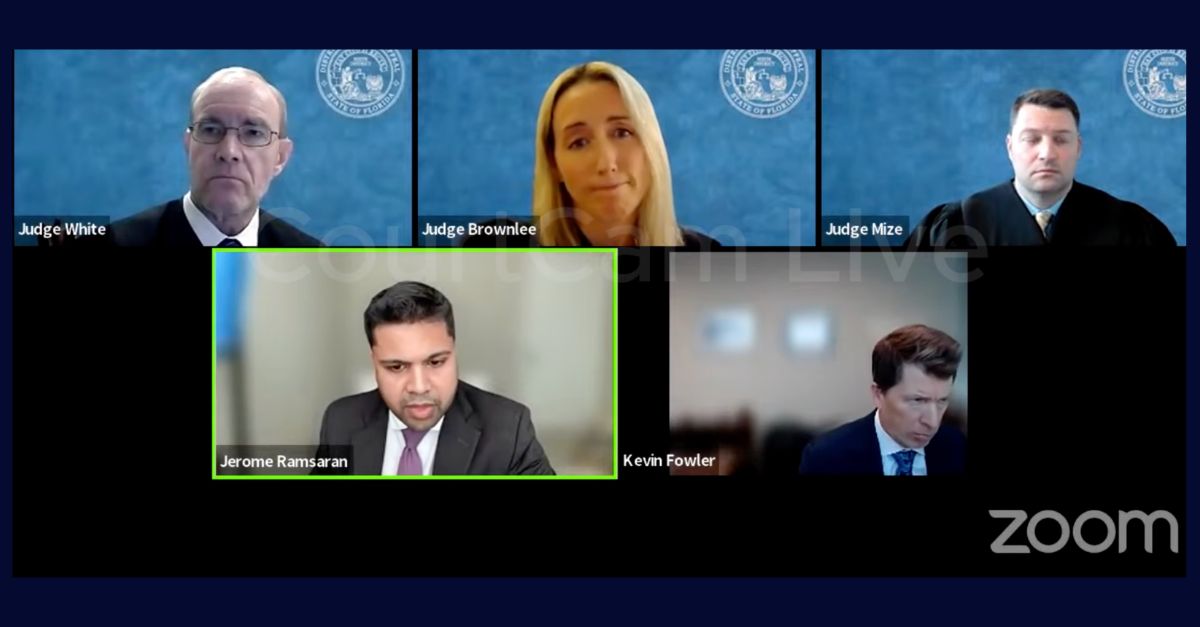
Clockwise from top left: Judge Keith White, Judge Paetra Brownlee, Judge Joshua Mize, attorney Kevin Fowler, and attorney Jerome Ramsaran (Florida Sixth District Court of Appeal).
A Florida attorney appearing before a court of appeals increasingly found himself in hotter and hotter water as he struggled to explain his work at a basic level and on several fronts.
In the matter before the court, civil lawyer Jerome Ramsaran is facing sanctions — including attorneys fees and costs incurred by the opposing party — over an allegedly insufficient brief he filed.
At the outset, one of the judges on the three-judge panel of the Sunshine State”s Sixth District Court of Appeal made clear that Ramsaran was facing sanctions on two distinct fronts.
First, he is subject to a general appellate rule punishing “the filing of any proceeding, motion, brief, or other document that is frivolous or in bad faith.” Second, he is subject to a Florida law punishing a lawyer who makes a claim or defense that “[w]ould not be supported by the application of then-existing law to those material facts.”
Judge Paetra T. Brownlee started off the proceedings by asking the attorney how long he had been practicing law.
“This month makes my 10th year in practice,” Ramsaran said.
Then, after some back-and-forth with the court, it was established that the attorney has been working in the appellate realm for around five years and has worked on “maybe more than 10, less than 20” appeals total. Ramsaran said his practice largely focuses on homeowners insurance claims, personal injury lawsuits, and actions against banks and other lending institutions “on behalf of consumers.”
Brownlee then settled into the heart of the matter.
“When I look to the argument portion of your initial brief, what I find are a plethora of citations to, sort of, I want to say boilerplate or well-settled rules of law that I don’t believe either party contends aren’t applicable here,” the judge explained. “But there’s just a sort of broad rule. There’s no argument with regard to any of those citations. And so can you tell me about that and why there is no analysis in the argument section of the brief?”
The judge went on to explain that rules governing appellate filings in Florida require an attorney to actually present an argument “with regard to each issue that you intend to raise on appeal.”
“May I look at the initial brief?” Ramsaran asked.
“Yes,” Brownlee said.
“I wasn’t aware we’d be talking about it today,” the lawyer replied before he pulled up and began to look at the document.
The judge interjected to explain a more fundamental issue beyond even the apparent violation of the appellate rule.
“How would the appellee know what arguments to respond to if you’re simply setting forth well-settled points of law?” she asked.
Ramsaran replied that he understood and said his team “fleshed this out a little better in our response to their motion for sanctions.” Then, the lawyer insisted “we do take a position” in the brief and continued poring over the document in an attempt to find the argument.
But before he could, Judge Joshua A. Mize interjected.
“Counsel, I’m almost surprised that you saw you didn’t understand we’d be discussing your brief today,” the judge said. “When the order to show cause specifically said the hearing was about your brief.”
Here, Ramsaran said he believed the hearing was about his lack of response to a prior show-cause order. But it was decidedly not.
Mize then read the order aloud: “Why sanctions should not be imposed against him pursuant to [an appellate rule] for, quote, ‘filing a brief that was frivolous or in bad faith.'”
Ramsaran reiterated his belief about the lack of response.
“Maybe I misunderstood,” the lawyer said.
After that, Ramsaran went through some of the details in the underlying litigation and argued there was a “judicial issue of fact” regarding his clients and the other party in the litigation.
Brownlee asked if that issue was in the record on appeal.
A lengthy discussion ensued where lawyer and judge aimed to suss out what happened with the record on appeal. Eventually, Brownlee gave up and went back to what she called her “original point.”
“I am wondering what is happening with the argument section of this brief such that it’s raised in here?” she asked. “And such that the appellee would have had notice that that is your argument?”
Ramsaran attempted to consult his brief but was admonished by both Brownlee and Mize for looking at the wrong pages — and the latter judge said the problem boiled down to two separate issues.
Mize explained:
So, before we get to the kind of merits of whether you could have had a claim — and whether or not the trial court did, in fact err; you had some basis to dispute that — I think the issue is: You wholly failed to articulate an argument in your brief, even assuming you had one, there’s just no argument at all. The argument section that you have labeled “Argument” is just kind of a cut-and-paste from various rules and cases with no explanation whatsoever how any of those authorities, you know, make an argument, why the trial would have erred according to those authorities. There was just no attempt — no serious attempt to meet your appellate burden.
Asked if he understood the criticism, the attorney said he did.
“All I can offer the court is this,” Ramsaran said a bit later on. “The case law that we cite goes to the arguments that were made — albeit they were not made in the argument section; they were made in an earlier section — but they go to the heart of those arguments.”
As the attorney looked at the document for a citation, Mize interjected yet again to ask: “Is there any part of your argument section, Mr. Ramsaran, you can point to and say this made an argument?”
To which the attorney replied: “No, no.”
Judge Keith F. White echoed his colleagues’ concerns about the lack of argument — but added a further wrinkle. The third judge said he had a hard time understanding how the appeal itself was even filed in “good faith” after the trial court judge disallowed a third amended complaint and dismissed the second amended complaint.
The case before the court is stylized as Foreman Electric Services, Inc. v. LSQ Funding Group, LC. The oral arguments in question occurred on Oct. 28, 2024. The video of the proceedings was recently uploaded to YouTube by a Florida attorney who works on trusts and estates.


