
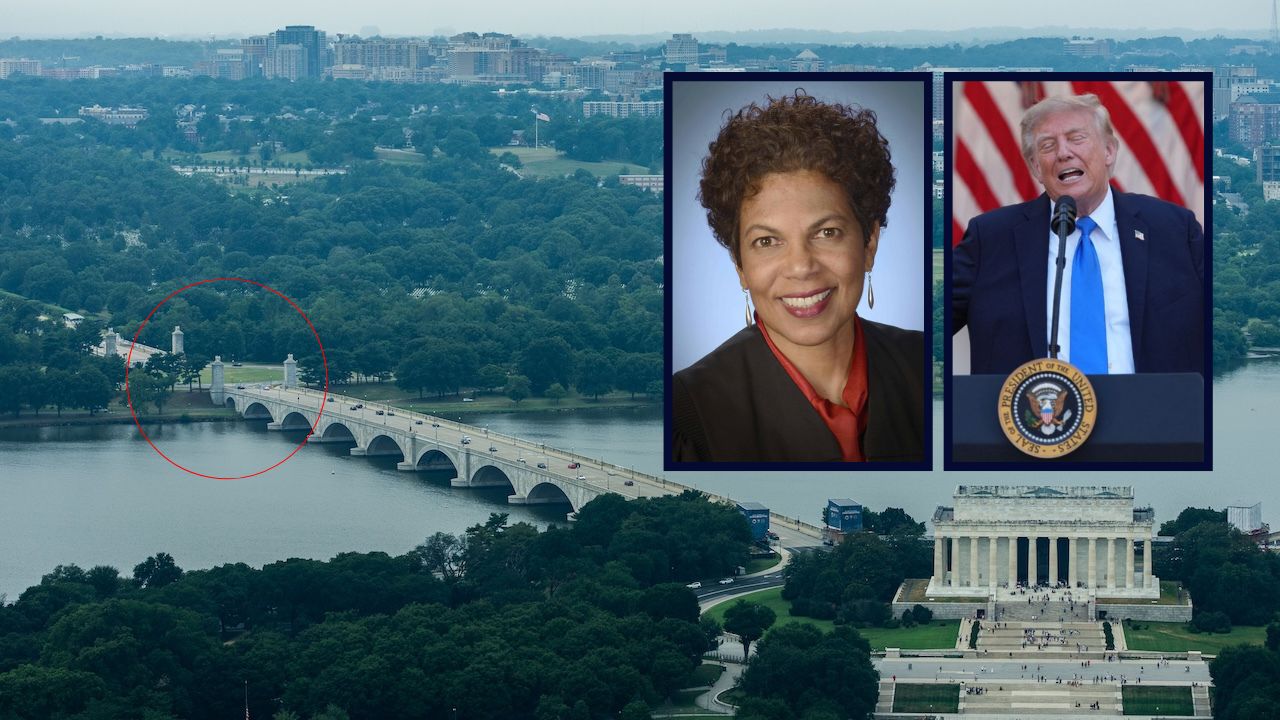
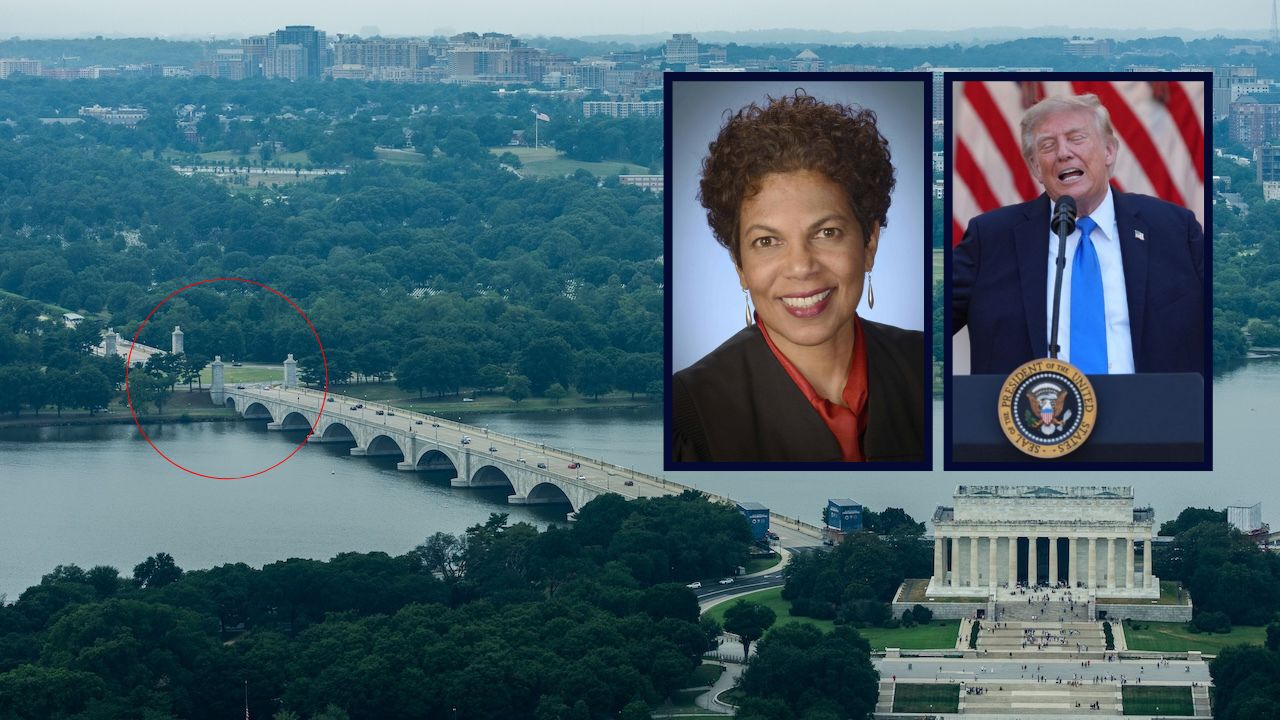
Main: Memorial Circle, where President Donald Trump has proposed building an arch to commemorate the United States’ 250th anniversary, the Arlington Memorial Bridge and the Lincoln Memorial are seen from the Washington Monument, Thursday, July 9, 2026, in Washington (AP Photo/Julia Demaree Nikhinson). Left inset: U.S. District Judge Tanya Chutkan (U.S. District Court for the District of Columbia). Right inset: President Donald Trump speaks during an event with Republican lawmakers in the Rose Garden of the White House, Wednesday, Sept. 2, 2026, in Washington (AP Photo/Alex Brandon).
One day after a judge once again ordered the DOJ to provide her “notice” of key developments, the Trump administration accused her of delay and said she should “just issue a decision” on the president’s “Great Triumphal Arch.”
Vietnam War veterans have primarily led the charge in challenging the looming “top grade Military Complex/Triumphal Arch” at Memorial Circle, which President Donald Trump said would “house, store, and have the rapid ability to use large numbers of drones, plus Snipers” across from Arlington National Cemetery.
The Commonwealth of Virginia and Washington, D.C., have since filed suit, most recently asking U.S. District Judge Tanya Chutkan to issue a temporary restraining order (TRO) as the key date of Nov. 5 fast approaches.
Love true crime? Sign up for our newsletter, The Law&Crime Docket, to get the latest real-life crime stories delivered right to your inbox.
In a Halloween motion, the newest plaintiffs said they intend to “prevent construction” of the 250-foot-tall arch and claimed “its construction violates at least five federal statutes.”
“Defendants have made clear that they will construct their Arch anyway, and have signaled that they are willing to outrun this Court to do so by threatening to start construction as soon as November 5, 2026, on the very day the Arch is approved by the National Capital Planning Commission,” the motion explained.
One day earlier, Chutkan heard from attorneys for veterans Michael Lemmon, Shaun Byrnes, Jon Gundersen and architectural historian Calder Loth at a preliminary injunction hearing.
“The arch is somehow intended to prevent assassination attempts against the president?” the judge reportedly asked while skeptical of the government’s position. “It’s going to be completed three years from now.”
Chutkan on Monday issued an order with “notice” requirements, seemingly tailored to give her time to act before the National Capital Planning Commission may approve the project on Nov. 5.
“Defendants shall provide notice within one hour of any decision by the National Capital Planning Commission, any decision by the National Park Service, and any decision by the Department of the Interior regarding an arch on Memorial Circle,” the order said. “Defendants shall also provide notice within thirty minutes of any activity related to or in preparation for the construction of an arch on Memorial Circle. Defendants are reminded that any construction or demolition in preparation for construction before the National Park Service issues final agency action authorizing construction or without 14 days’ notice would be a violation of the court’s previous orders.”
When the DOJ filed its opposition to the requested TRO on Monday, it pointedly tore into the Barack Obama-appointed jurist’s “problematic notice injunctions” and cited a concurrence from the late Justice Antonin Scalia to accuse her of inviting “needless head-on confrontations between district judges and the Chief Executive.”
A subsequent court filing asked Chutkan to clarify her order and “modify the timeframes in which notice must be provided to 24-hours.”
At the same time, the DOJ claims that Trump’s arch was “undeniably authorized” by Congress more than 100 years ago when “166-foot-tall columns surmounted by statues” were approved but never built.
“The proposed arch fulfills that Congressional vision and completes a significant gap on Columbia Island long lamented by the Capital’s planners. If the Court disagrees with Defendants, however, then it should just issue a decision on any of the fully briefed dispositive motions pending before it,” the DOJ said. “The longer those dispositive motions go without decision, the more emergency motions the Court will face.”
Noting that the U.S. Supreme Court allowed construction of Trump’s ballroom to proceed, the DOJ said the judge should deny the TRO because the plaintiffs simply “disagree with the design of the arch, find it distasteful, and do not want to see it,” meaning they lack standing.
The government highlighted Washington, D.C.’s apparent concerns about the arch’s impact on “endangered” bats — specifically the “northern long-eared” and “tricolored” variety — as an example of “nonsense.”
“Similarly, the District argues that the Arch project will require it to ‘expend additional funds to study the impacts of the Arch’ on bats. Nonsense. The arch is being constructed in a traffic circle, not a forest or a bat cave,” the filing said.
The complaint from the Washington, D.C., and Virginia plaintiffs did say that the arch would have “potential to interfere with the bats as they forage in or traverse Memorial Circle.”
The post ‘Just issue a decision’: DOJ ridicules ‘nonsense’ concerns about Trump arch’s impact on bats, snipes at judge’s ‘problematic’ injunctions first appeared on Law & Crime.


