
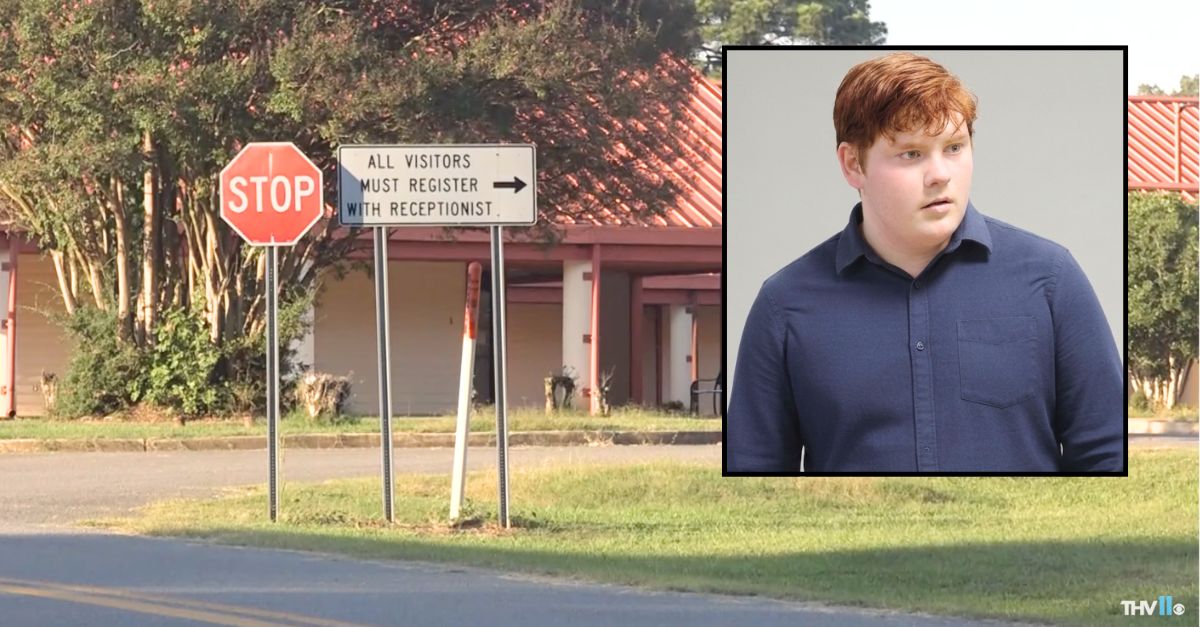
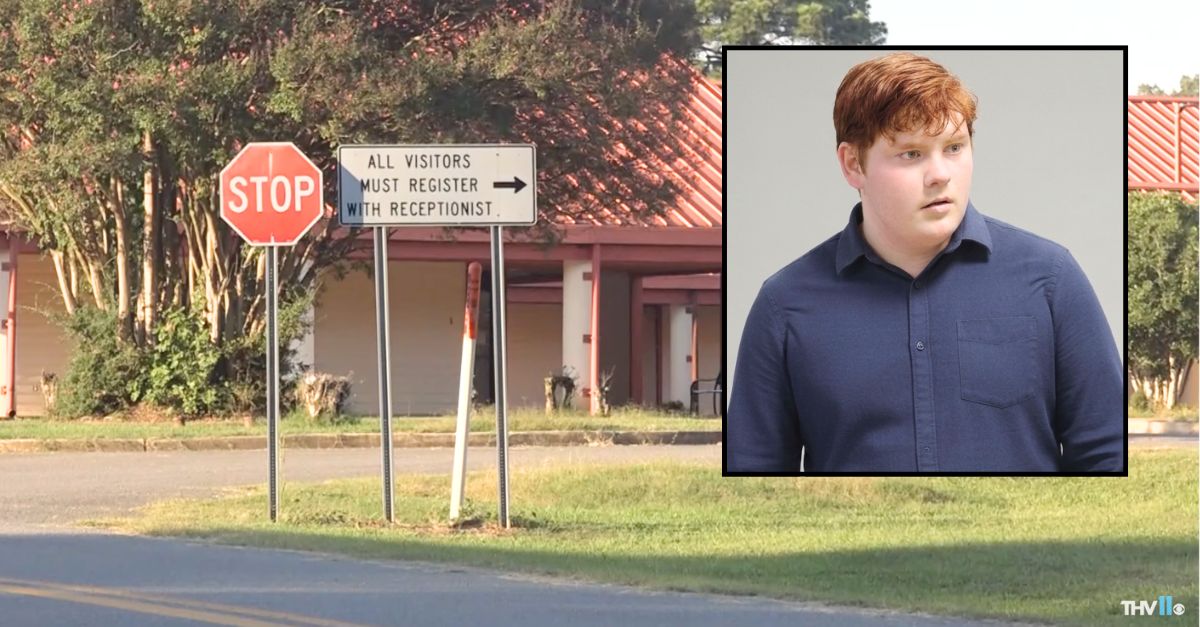
Background: The Southeast Arkansas Human Development Center in Warren, Ark. (KTHV/YouTube). Inset: Zachary Moore (Family).
As several employees of an Arkansas developmental center face charges in the death of a 21-year-old patient who was under their care, the man”s mother is sharing her efforts to ensure nothing similar happens again.
Zachary Moore was held down for nearly 13 minutes and injected with a chemical at the Southeast Arkansas Human Development Center in Warren, Arkansas, last fall, authorities said. Angela Stephens — his mother — has since received a $725,000 settlement from the state.
She is adamant that her work is not done.
“Part of that settlement was … money doesn’t bring Zachary back, but change can help the next Zachary,” Stephens told Law&Crime. “And why I say the next Zachary is because there is a boy named Zachary in his room when Zachary was killed, and is now going through therapy because he watched them kill him.”
“That little boy wrote a letter to me and gave me a toy for his funeral,” the mother added. “So my thing is fighting for the next Zachary, so he does not go through this. But, my thing with the settlement was they had to make me part of the changes, not just for Warren, but all five Arkansas facilities.”
Moore had IQSEC2, described as “a rare genetic condition that results from a change in function of a gene” by Unique, a nonprofit charity and support group for those affected by rare chromosome and gene disorders. It affects the brain, and Stephens has told CBS affiliate KTHV that her son had the mental capacity of a 5-year-old.
When he turned 16, Moore was placed in a state facility in Conway, Arkansas. “He was just pretty good up there; they had a routine, they had activities, and they had learned different ways to care for his needs and his mental situation,” his mother said.
However, sometime around the spring of 2025, administrative leaders decided to move him to the Southeast Arkansas Human Development Center, the state’s facility in Warren, Arkansas. This facility “has the residential capacity to serve 96 adults who have a primary diagnosis of intellectual or developmental disability,” according to the Arkansas Department of Human Services (DHS), while the Conway facility can house somewhere between 470 and 515 residents.
The move confused Stephens, as the employees in Conway “had found ways to care for him.” But, as she told Law&Crime, “there was really nothing I could do about it because there was nowhere else … he couldn’t come home.”
She said the reason that leaders of the Conway complex gave her for the change was less than clear, adding, “They just didn’t want to keep him.”
Stephens, members of her family, and Zachary’s “team” at the Conway complex went to the Southeast Arkansas Human Development Center and explained to employees there how to best care for him, such as making sure he wore his helmet and allowing him to have his “blackouts” without hurting others or himself. “They just didn’t accept these things, and so when he did have his fits or his blackouts, they were bad because they didn’t want to try to do things that were safe,” she said.
After Moore was moved, the calls and updates that came before weren’t there any longer — until one night.
On Sept. 7, 2025, “the nurse called me and told me that he had passed … that was it. She couldn’t tell me nothing else and hung up,” Stephens recalled. “So I was left stunned, half-asleep at night, going, wait a second, did she just say my son passed?”
Finding answers was difficult. Stephens said she tried the complex and the area’s police department, to no avail. Finally, she got some details — in the form of an account from an emergency responder.
“The ambulance, the driver … told me that it was the most vicious thing ever,” the mother recounted. “He said that nobody had an explanation, nobody knew when he quit breathing, nobody knew anything. … He said it was the worst situation he had ever been in.”
Stephens went to the sheriff’s department to find out why law enforcement was called out to the complex. The agency “wrote up warrants for video and paperwork from Zachary’s facility, and drove out there to the facility with us. If it wasn’t for that, I wouldn’t have got all the paperwork that I got.”
The Arkansas DHS released a report in October stating that, on that September day, Moore “became combative, attempting to bite other residents.” Employees at the facility attempted to restrain him, but this reportedly proved “ineffective,” so a chemical restraint called Geodon was administered.
Geodon is listed by the U.S. Food and Drug Administration (FDA) as being used for “the treatment of schizophrenia, as monotherapy for the acute treatment of bipolar manic or mixed episodes,” or as help in treating bipolar disorder.
It wasn’t until later that staff realized he was not breathing.
“All this started from … it was time for bed, and he had his tablet, and they took his tablet away and told him it was time for bed,” Stephens said she learned. “Well, he got aggravated, you don’t just take a tablet away, you talk to him.”
She added that he responds better to male employees than female, and “they had a little female aide attending to him, and he pulled her hair.” However, another aide took Moore’s hand out, and “it was squashed immediately.”
To keep from hurting others, Moore “bites his shirt,” his mother said, adding, “he’s taking his frustration out in a way that’s safer.” But an employee apparently tackled him, and Moore — without his helmet — was reportedly taken to the ground, held down for nearly 13 minutes, and given the chemical restraint.
He would later be declared dead.
Arkansas DHS said as part of its report that 11 DHS employees were subsequently put on administrative leave, and one was fired. The agency also changed its leadership at the facility, naming an interim superintendent, and said “additional steps to hold staff who did not follow procedure accountable” would be taken as the investigation continued.
“The loss of one of the residents entrusted to our care at the Southeast Arkansas Human Development Center was wholly unacceptable and is not reflective of the level of care we work to provide Arkansans every day,” Arkansas DHS Secretary Janet Mann said in October. “We offer our deepest sympathies to the individual’s family and are working to both hold accountable those responsible for this incident and make changes throughout our system to prevent future tragedies.”
Six people were reportedly charged with manslaughter and neglect of a vulnerable person. They were set to appear in court this week to either take a plea or announce they intended to go to trial.
Stephens says she will continue to fight for “the next Zachary.”
“I am still frustrated,” she told Law&Crime. “I am hoping that from this last court appearance, there was a couple of the legislators and loved ones still in facilities and have a concern along with me that they will come along with me to make changes and to prevent this from happening to others. I’m hoping that DHS keeps their word and keeps me informed on the changes and allows me to help them to improve.”
“I believe a lot more training and thought needs to go into background checks, drug tests, stuff like that,” she added, “when it comes to the care for our loved ones.”
Law&Crime reached out to Arkansas DHS for comment on the settlement.


