
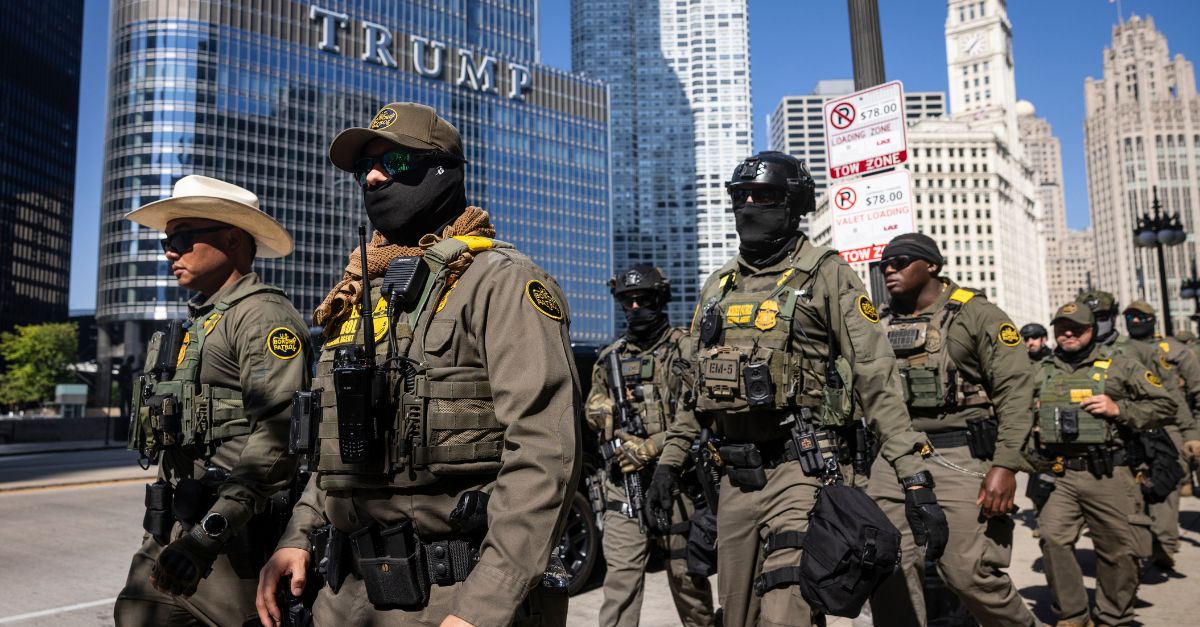
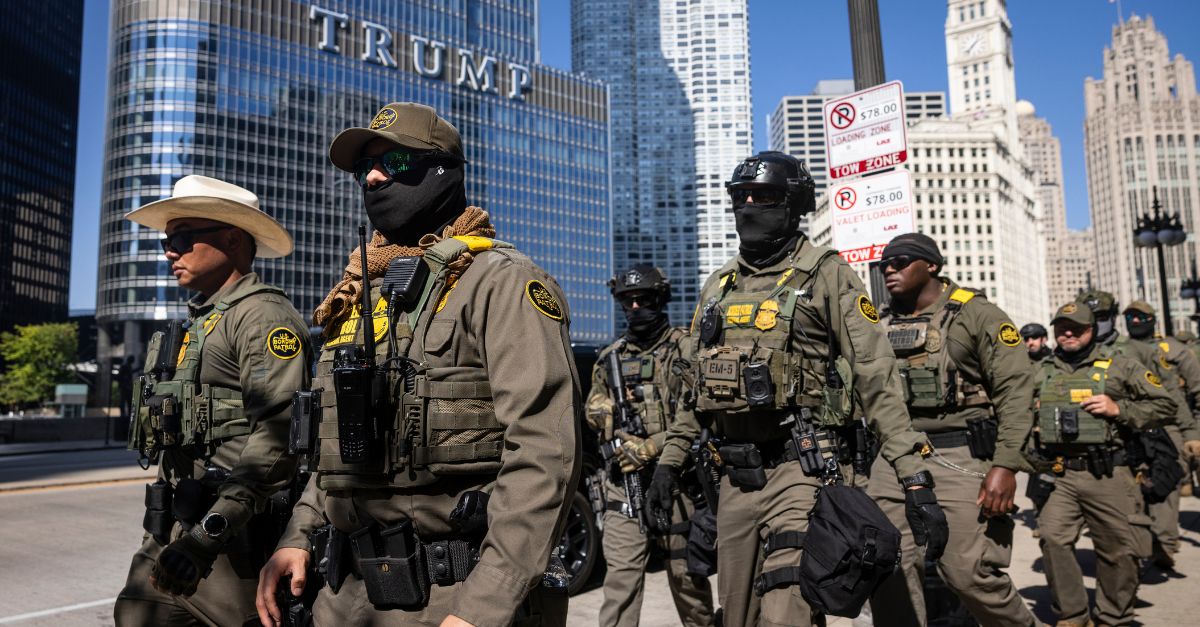
Federal agents from U.S. Immigration and Customs Enforcement and U.S. Customs and Border Protection walk along West Wacker Drive in the Loop, Sunday, Sept. 28, 2025, in Chicago. (Ashlee Rezin/Chicago Sun-Times via AP).
A federal judge has sided with the Trump administration over its deployment of immigration agents in Illinois, delivering a significant blow to state leaders seeking to rein in Immigration and Customs Enforcement (ICE).
“The Court finds that the United States has plausibly pled a cause of action for unlawful regulation and unlawful discrimination,” U.S. District Judge David Dugan wrote in a 16-page order in reference to two laws that the Illinois legislature passed late last year. The President Donald Trump-appointed jurist’s denial of Illinois’ motion to dismiss means ICE will have further leeway in its enforcement operations in the Land of Lincoln.
Love true crime? Sign up for our newsletter, The Law&Crime Docket, to get the latest real-life crime stories delivered right to your inbox.
In September 2025, the Trump administration launched “Operation Midway Blitz,” an ICE operation targeting “criminal illegal aliens” in Chicago and Illinois, according to the agency. As Dugan recounts, in response to the new initiative and to “protect the people of Illinois from enduring further abuses like those that occurred during Operation Midway Blitz,” the Illinois General Assembly enacted two new statutes that were subsequently signed into law by Illinois Gov. JB Pritzker.
The Illinois Bivens Act allowed for “any person” to “bring a civil action against any person who, while conducting civil immigration enforcement, knowingly engages in conduct that violates the Illinois Constitution or the United States Constitution.” The Court Access, Safety, and Participation Act (CASPA) created “a privilege against civil arrest for parties, witnesses, potential witnesses, and ‘court companions’ going to, remaining at, or returning from state-court proceedings,” Dugan details.
The Trump administration sued Pritzker and Illinois, alleging the new statutes violated the U.S. Constitution’s Supremacy Clause because states cannot “in any manner control the operations of” the federal government. In their complaint, attorneys with the U.S. Department of Justice (DOJ) addressed each state law specifically:
The Illinois Bivens Act and the CASPA directly regulate the Federal Government by dictating how and where federal law enforcement officers may carry out their federal duties and unlawfully discriminate against federal law enforcement officers. The Illinois Bivens Act regulates the Federal Government by creating a private cause of action, exposing federal law enforcement officials to civil liability and punitive damages for discharging their federal duties. Likewise, the CASPA purports to regulate the Federal Government by erecting an artificial and specious “buffer zone” accessible to the public in which federal law enforcement officers are prohibited from carrying out their duties.
Dugan found these arguments convincing.
Referencing the extent of Trump’s immunity, as affirmed by the Supreme Court, the Southern District of Illinois jurist wrote, “Law enforcement, not unlike the head of the executive branch, cannot carry out its duties under the burden of discerning and weighing the effects of conflicting state law.”
Dugan ruled that Pritzker and the other Illinois leaders who are part of the lawsuit have two weeks as of Wednesday to respond to the complaint.
The post Trump-appointed judge denies state’s attempt to rein in ICE, rules federal government must be able to ‘carry out its duties’ first appeared on Law & Crime.


