
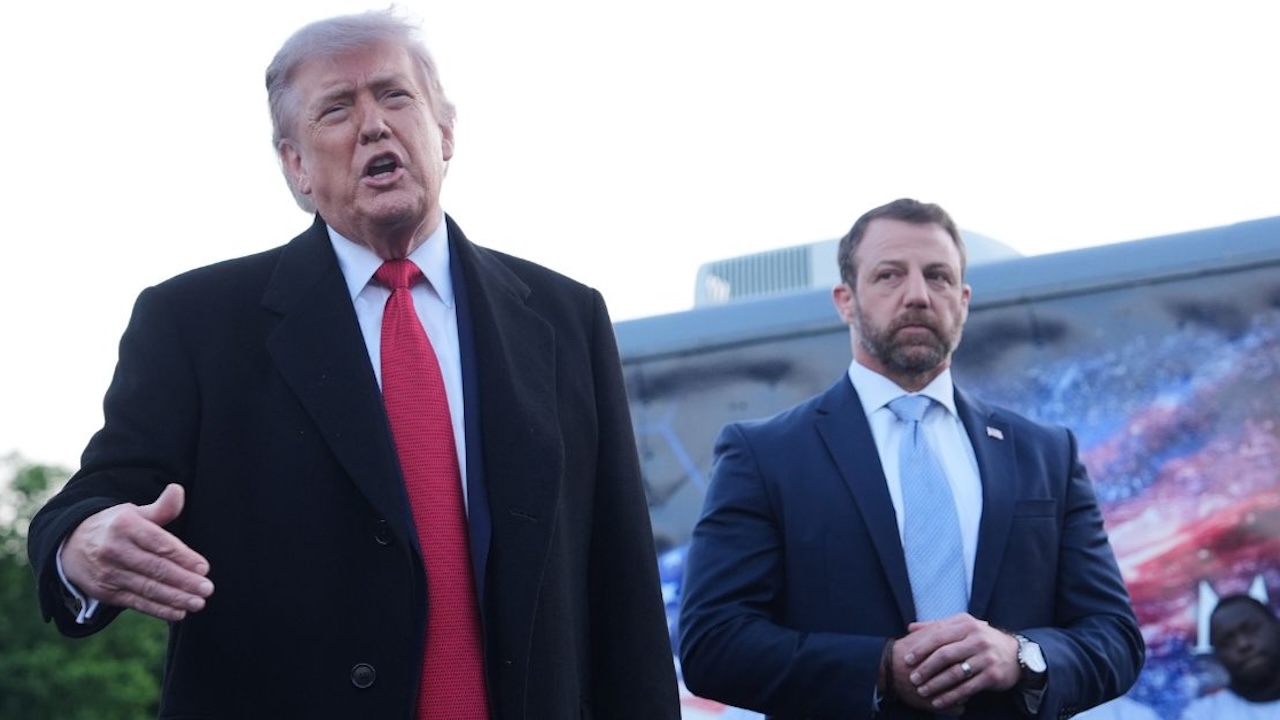
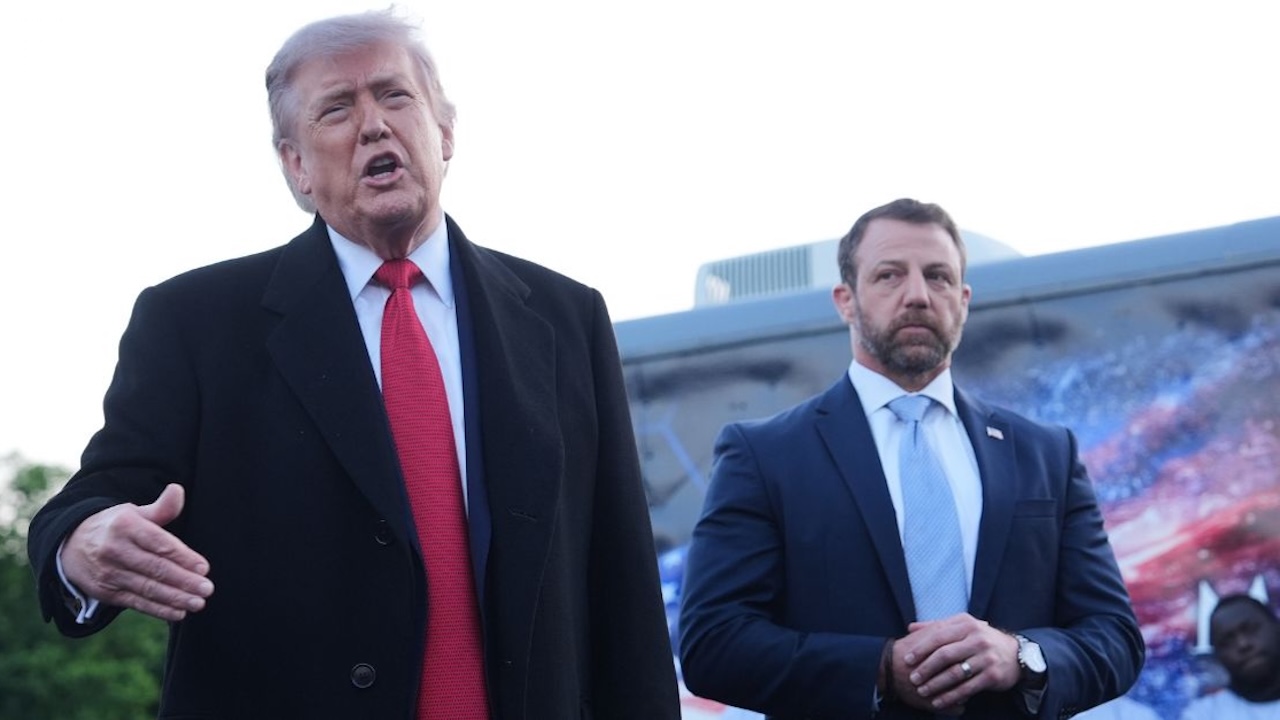
President Donald Trump speaks as he visits the Lincoln Memorial Reflecting Pool to see the new blue protective coating being applied as part of a renovation project, Thursday, May 7, 2026, in Washington, as Homeland Security Secretary Markwayne Mullin listens (AP Photo/Mark Schiefelbein).
At the start of 2026, the Trump administration made a concerted effort to blame anyone but President Donald Trump for the events of Jan. 6, 2021. Just a short time later, the FBI seized 2020 ballots, tabulators, and voter rolls in Fulton County, Georgia, where the president wanted to “find 11,780” votes and for years thereafter faced a RICO indictment.
While the Department of Justice (DOJ) has racked up loss after loss in lawsuits demanding blue states’ voter rolls, the executive branch has been working overtime through the Department of Homeland Security (DHS), the Social Security Administration (SSA), and the U.S. Postal Service (USPS) to implement Trump’s March executive order and reshape the way the nation votes by mail before the midterm.
Whether threats of potential prosecution for dissenting state officials or the prospect of ICE agents at the polls, seemingly every day there’s a new development — and a new potential source of confusion for voters.
Love true crime? Sign up for our newsletter, The Law&Crime Docket, to get the latest real-life crime stories delivered right to your inbox.
Here’s how we got here and where multiple whiplash-inducing legal challenges currently stand.
The executive order
In March, the president — who himself votes by mail — signed executive order 14399, titled, “Ensuring Citizenship Verification and Integrity in Federal Elections.”
The order included five sections. Sections 2(a) and 2(b) directed Secretary Markwayne Mullin’s DHS to establish “state citizenship lists” and ordered Attorney General Todd Blanche, Trump’s former personal attorney, to prosecute officials who “engaged in, or aid[ed] and abett[ed], the printing, production, shipment, or distribution of ballots to individuals who are not eligible to vote in a Federal election.”
Section 3 ordered the USPS to “initiate a proposed rulemaking” in order to “protect the integrity of the mail as a medium for transmitting Federal election ballots and establish uniform standards for mail-in or absentee ballot services[.]”
The lawsuits and where they stand
Starting in April, California and a host of other states joined together to “safeguard their constitutional authority to administer state and federal elections” and sued the administration in U.S. District Judge Indira Talwani’s court. The League of Women Voters likewise raised a constitutional challenge in Massachusetts, in a case before the Barack Obama-appointed jurist.
The voting rights group warned that “this is not the first time the President has unlawfully attempted to usurp power over federal elections” and said Trump’s “federal screening regime between voters and the ballot box” cannot stand.
All eyes are now on the U.S. Supreme Court because Talwani repeatedly sided with the plaintiffs on the unconstitutionality of the “legally void” Sections 2 and 3.
The 1st U.S. Circuit Court of Appeals then declined to disturb her findings in the states’ case, even though the “final rule” Trump ordered USPS to make had not yet been issued.
The 2-1 decision from late July recognized that the president “direct[ed] unprecedented levels of involvement by federal officials in how states administer elections,” and left the injunction in place.
Several weeks later, and after Talwani had extended her injunction nationwide in the League of Women Voters case, the federal government controversially filed a notice “after the courts were closed” on a Friday.
The Trump administration told Talwani that the USPS sent a “final rule” to the Office of the Federal Register, to be formally published “on August 26, 2026” and effective as of the day of the notice, “August 21, 2026.”
The judge quickly determined that the government violated her injunction but imposed no remedy, instead noting the plaintiffs could amend their complaints in light of the final rule’s publication.
On Aug. 24, the Supreme Court granted the Trump administration a stay pending appeal of Talwani’s injunction in the states’ case, with only Justices Sonia Sotomayor, Elena Kagan, and Ketanji Brown Jackson dissenting.
The stay “does not mean that any measure taken by the Government to implement the Order will necessarily be lawful,” the court’s conservative majority said in a per curiam order. “On that score, time will tell. But the Order itself does not harm the States, so the District Court lacked jurisdiction to bar the Government from trying to implement it.”
The DOJ chided the judge for making an “assumption” about what the “final rule” would dictate regarding mail-in ballots, claiming that the “published final rule does not simply mirror the proposals outlined in Section 3 of Executive Order 14,399.”
“For example, the Postal Service will not refuse to transmit ballots from individuals who were not included on a state-submitted list, as Section 3(b)(iii) of the Order contemplated,” U.S. Solicitor General D. John Sauer represented.
But on Sept. 4, Talwani granted the plaintiffs yet another injunction barring USPS from “implementing mandatory sections of its final rule.” And the 1st Circuit, on Sept. 10, again declined to act.
These are the fast and furious proceedings underlying the current dispute teed up at the Supreme Court, which the justices may act on soon.
There, the states have maintained that the “dangers of altering election rules on the eve of an election” are widespread confusion and, ultimately, the “intolerable risk” of “disenfranchising a substantial number of voters” in the upcoming midterm elections.
On the other hand, the DOJ claimed anew in a stay application last week before Justice Jackson that “election integrity” is paramount. The government downplayed the administration’s rule as “impos[ing] only modest envelope-design and addressee-information requirements for federal-election ballots sent via U.S. Mail.”
The League of Women Voters countered that the “eleventh-hour” attempt by the federal government to “dictate how states administer mail voting” must fail on the constitutional merits and due to timing.
A brief from prominent current and former state and local election officials echoed concerns about the time-crunch, while taking no position on whether USPS had authority to “promulgate” the final rule.
Implementing the rule at the state level can’t be done in such a short time and, in any event, “ballots are already going into the mail” in some states, with “other states” soon to follow, the amici curiae noted.
The brief cautioned that “late changes of [the] kind” proposed by USPS are exactly what the Purcell principle “forbids” and “counsels against.”
But will the justices take this off-ramp?
The post Multiple legal challenges of Trump’s mail-in ballot rules are unfolding at breakneck speed — what to know first appeared on Law & Crime.


