
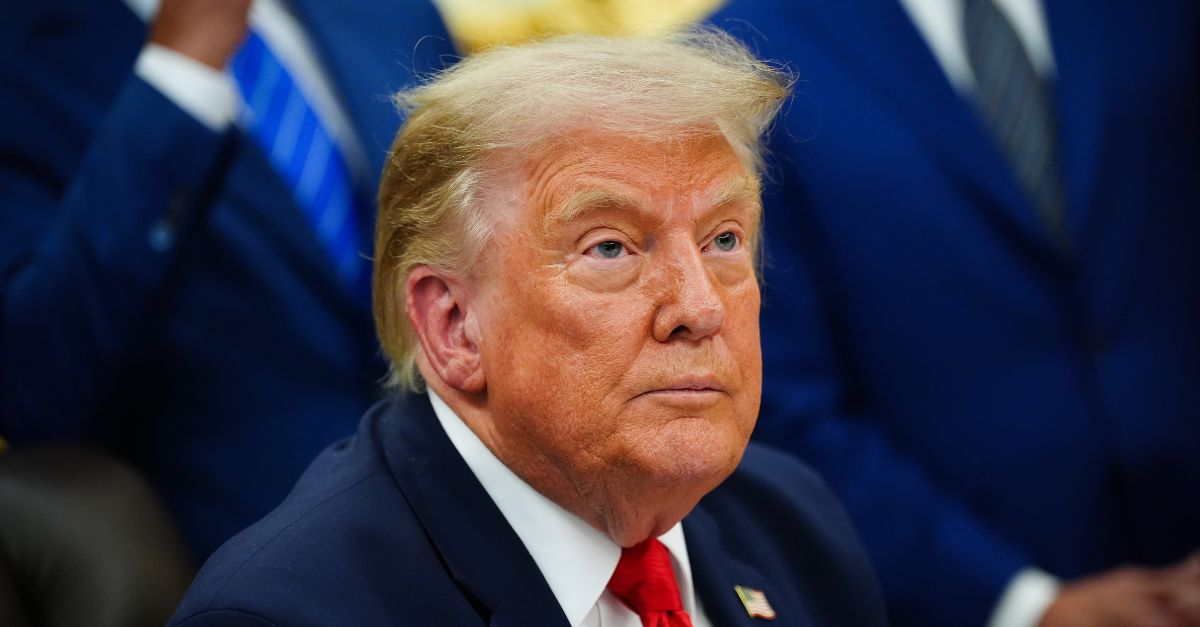
President Donald Trump speaks about Dulles International Airport modernization in the Oval Office of the White House, Wednesday, July 29, 2026, in Washington (AP Photo/Julia Demaree Nikhinson).
The Trump administration has now gone 0-20 in court challenges over efforts to obtain states’ “unredacted” voter rolls.
A Monday loss in Colorado before U.S. District Judge Philip Brimmer, a George W. Bush appointee, marks the 19th time a federal district court has ruled against the U.S. Department of Justice. In one instance, the U.S. Court of Appeals for the 6th Circuit also ruled against the DOJ – affirming a lower court ruling in favor of Michigan.
The latest ruling means that every court to have considered the issue has ruled in favor of the states and against the Trump administration.
Love true crime? Sign up for our newsletter, The Law&Crime Docket, to get the latest real-life crime stories delivered right to your inbox.
In December 2025, the U.S. Department of Justice sued the Centennial State and its Secretary of State Jena Griswold. The lawsuit alleged violations of the National Voter Registration Act (NVRA), the Help America Vote Act (HAVA), and the Civil Rights Act (CRA) of 1960.
In February 2026, the state filed a motion to dismiss. Throughout the litigation, various interest groups, including the Colorado Alliance for Retired Americans and Common Cause, a nonpartisan government watchdog, filed motions to intervene – which the court and parties accepted.
With minimal fanfare, Brimmer ruled in Colorado’s favor.
“The Court agrees with other courts to have considered the issue,” the opinion reads, explaining that the overarching dispute is whether Title III of the CRA gives the U.S. attorney general the authority to demand the voter records in question – though in a sidelong fashion.
Specifically, Brimmer starts by asking whether the CRA precludes the judge from using a basic set of procedural rules to decide the issue – effectively short-circuiting the DOJ’s argument.
“[T]he Court has the authority to determine whether the Attorney General has complied with the statutory requirements to compel the production of records described,” the opinion goes on, staking out the terrain. “[T]he Federal Rules of Civil Procedure govern and the Court can ‘evaluate the sufficiency of Plaintiff’s allegations regarding Defendants’ alleged failure to comply with Title III.”
This is a classic example of how the choice of legal framework often decides the outcome. That is, the specific question a court uses is often dispositive of how the court will answer a broader question.
The upshot of the decision is that “a valid Title III demand” was not “made in the first place,” the opinion says, citing recent precedent from a district court’s ruling in Oregon’s challenge to the federal records demand.
The judge takes the opportunity to describe what kind of data the Trump administration has been demanding from each state.
“The United States requests a copy of the SVRL [state voter registration list] that includes each registrant’s name, date of birth, address, the last four digits of the registrant’s social security number, and driver’s license number, state identification number, or HAVA identifier,” the opinion explains.
But here, as in every other case, the judge found “the nonpublic SVRL is not a record as contemplated under” the relevant statutes.
To hear the judge tell it, the case is about which record-retention statutes in the CRA actually apply to voter registration data — with the court basing its inquiry on the DOJ’s own demand letters.
“[The relevant statute] covers records and papers ‘which come into [the state’s] possession,'” the court explains. “[This statute] applies to those documents that ‘election officials receive, rather than create,’ specifying that such documents must relate to ‘any application, registration, payment of poll tax, or other act requisite to voting in such election.'”
In other words, the statutory authority cited by the government for the demand is about a specific set of circumstances. A related statute describes the records that can ever be germane to such a demand.
Regardless of whether the Trump administration was acting in line with the specific circumstances anticipated by the CRA – the judge briefly says the government ignored that part of the law – the DOJ also demanded the wrong kinds of documents, the court said.
Brimmer says the government is asking for state-created records, which are not covered by the CRA. What the government can demand are records submitted by voters themselves.
“If [the relevant statute] also covered records created by the state, then the phrase ‘come into [the state’s] possession’ would be superfluous,” the opinion goes on.
Returning to the salient framework – the idea of applying the Federal Rules of Civil Procedure – the court further found the lawsuit essentially confused the law so badly that the government “fails to state a claim for relief and amending the complaint would be futile.”
As a result, the government’s lawsuit cannot be refiled.
“Colorado’s SVRL is not a record that must be produced under [the relevant statute],” the opinion concludes. “Therefore, the Court will dismiss the complaint with prejudice.”
The post Trump admin goes 0-20 in cases seeking voter data, confuses the law so badly court dismisses Colorado lawsuit ‘with prejudice’ first appeared on Law & Crime.


