
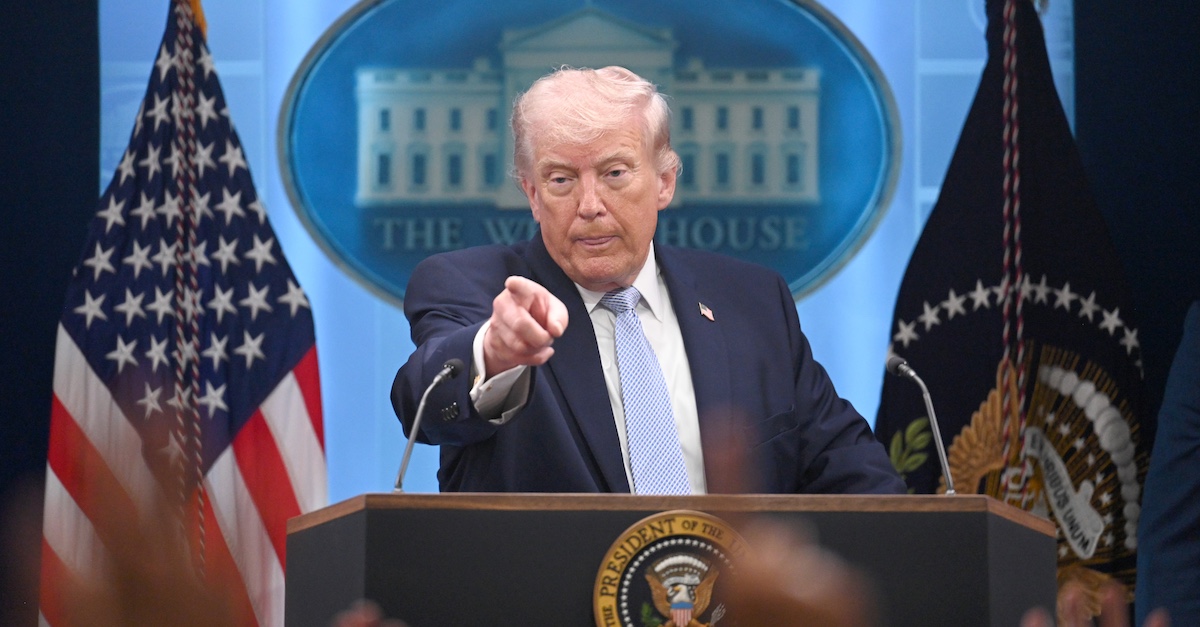
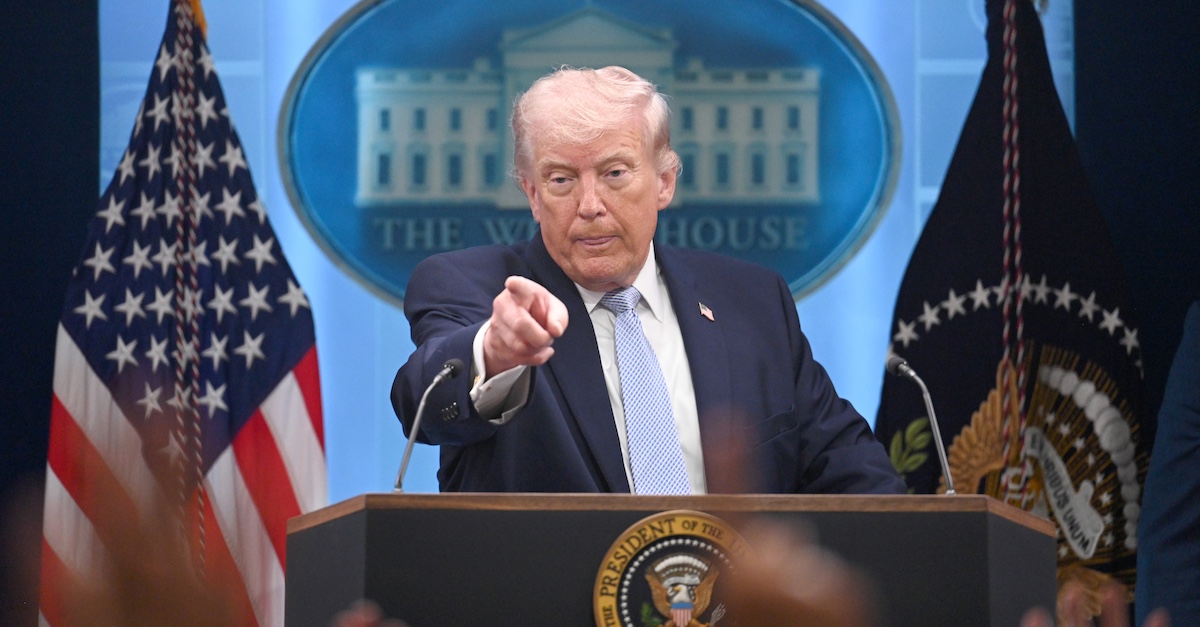
The United States President Donald Trump holds a press conference in the James S. Brady Press Briefing Room at the White House on April 6, 2026 in Washington DC. (Photo by Chen Mengtong/China News Service/VCG via AP).
A Trump administration lawsuit against an entire federal court in Maryland must fail and soon, an appellate brief filed this week argues.
In May 2025, Chief U.S. District Judge for Maryland George L. Russell III, a Barack Obama appointee, issued a standing order automatically granting stays against the government in response to petitions for writs of habeas corpus filed by immigrants facing deportation.
While the court saw the move as a matter of judicial economy — citing a “recent influx of habeas petitions” and concomitant scheduling problems in response to ramped up immigration enforcement efforts — the Trump administration saw red.
In June 2025, the U.S. Department of Justice took aim at the U.S. District Court for the District of Maryland in a lawsuit simultaneously rebuking Russell”s standing order as “judicial overreach” and asking each of the 15 judges sitting on the court to recuse themselves.
In late July and early August 2025, the court pushed back against the lawsuit. In late August 2025, sitting U.S. District Judge Thomas T. Cullen, an appointee of President Donald Trump, dismissed the case in its entirety, calling the effort “novel and potentially calamitous.”
The DOJ, in turn, appealed the district court’s ruling.
Now, the defendant judges have filed their response brief with the U.S. Court of Appeals for the 4th Circuit and are once again represented by former U.S. solicitor general and conservative attorney Paul Clement.
“This extraordinary branch-on-branch lawsuit is unprecedented for a reason: It is fundamentally incompatible with the constitutional separation of powers,” the brief begins. “As the out-of-district court forced to sit in judgment of its sister district correctly concluded, the Executive lacks the power to bring it several times over. And, in all events, this lawsuit is meritless.”
The filing says the district court was responding to a “flood of last-minute immigration petitions” that left “little room for orderly proceedings.” So, in response, the lower court “took a page out” of the appellate court’s own “playbook” to assess each habeas petition.
That is, Clement points out, the 4th Circuit itself has a standing order which similarly stayed deportations — for 14 days upon docketing.
The filing goes on to refer to the order as an “ordinary docket-control mechanism” and contrasts that quotidian effort with the government’s “extraordinary response” of suing each and every judge by name on the bench “as well as its clerk of court.”
“Judge Cullen properly recognized the Executive’s gambit as ultra vires and promptly dismissed it,” the response brief goes on.
The brief also defends the standing order in the context of habeas cases.
“The nature of habeas, and its limits, means that the petitioner is subject to the Executive’s total control—and, absent judicial intervention, can be spirited out of the court’s reach at a moment’s notice,” Clement writes. “In that circumstance, a brief interval to docket a petition and determine whether relief is available and necessary is not a convenience; it is a critical component.”
At a basic level, the defendant judges argue, the government’s lawsuit was really just an effort to enlarge executive power.
To hear the government tell it, the case is about the interplay of district court’s jurisdiction with the Immigration and Nationality Act (INA). Clement strongly urges the 4th Circuit to reject this framework.
“[T]he Executive urges a version of the separation of powers where only one branch is truly sovereign and can assail judicial rules not as an incidental feature of ordinary controversies but via frontal assaults, in this case against the District Court, but in theory against this Court or the Supreme Court itself,” the response brief continues.
The judges point out that the Trump administration had any number of options in response to Russell’s two-day stay order – including by raising its concerns in response to one of the habeas cases themselves, by filing an inquiry with the judicial council, or supporting legislation that specifically prohibits standing orders in the context of deportations.
“The one thing it most certainly could not do is to sideline an entire Judicial District via a novel suit that is an obvious affront to the separation of powers,” the brief goes on. “Judge Cullen correctly treated this wolf as a wolf. The Executive simply does not have the power to sue the Judiciary.”
Clement invokes a slippery slope-style argument in general and specific ways – setting a dire precedent for the separation of powers should the lawsuit be resolved in the administration’s favor as well as a headache-filled state of affairs for the Maryland federal court system should the litigation move forward in the normal course of action.
From the brief, at length:
If this misguided lawsuit were allowed to proceed, tensions between the branches would only escalate, with Executive depositions of Judicial officers (and vice-versa) and cross-examinations in open court exploring Judicial motivations and Executive necessities. And if this first-of-its-kind lawsuit were to succeed, it would not be the last—and the next one could be against this Court (or the Supreme Court) and cause greater disruption still…
If this case were to go forward, the next step would be discovery, with Article III judges and principal Executive Branch officers “prob[ing]” each others’ “mental processes,” producing documents, and litigating privilege disputes of epic proportions. Then comes final judgment and the potential for a permanent injunction, the effect of which could be to place the United States District Court for the District of Maryland in indefinite judicial receivership of an out-of-district colleague. And the virus would only spread.
To that end, Clement urges the appeals court to act with haste and to stop the government’s lawsuit from going any farther.
“If this suit succeeds, what was unprecedented will become commonplace,” the brief continues. “To be clear, the Executive need not win all (or any) of these battles; merely allowing such cases to proceed past the threshold would transform the separation of powers. The winner would be the Executive, which would have managed to permanently elevate itself over its coordinate branches. The loser would be not just or even principally the Judiciary, but the Constitution and the People it protects.”


